
News · 5 August 2026 · 6 min read
'My husband died in March. Now I've been told the tax rules on our investment property died with him — is that real?'
Australia's negative gearing and CGT overhaul grandfathered existing investors — but under the legislation as passed, a property held in joint names could lose that protection if one owner dies or the property transfers in a divorce. Crossbenchers called it the widow's tax. A fix has been announced but not enacted. Here is what it means, and why the decision it forces is an asset question, not a tax one.
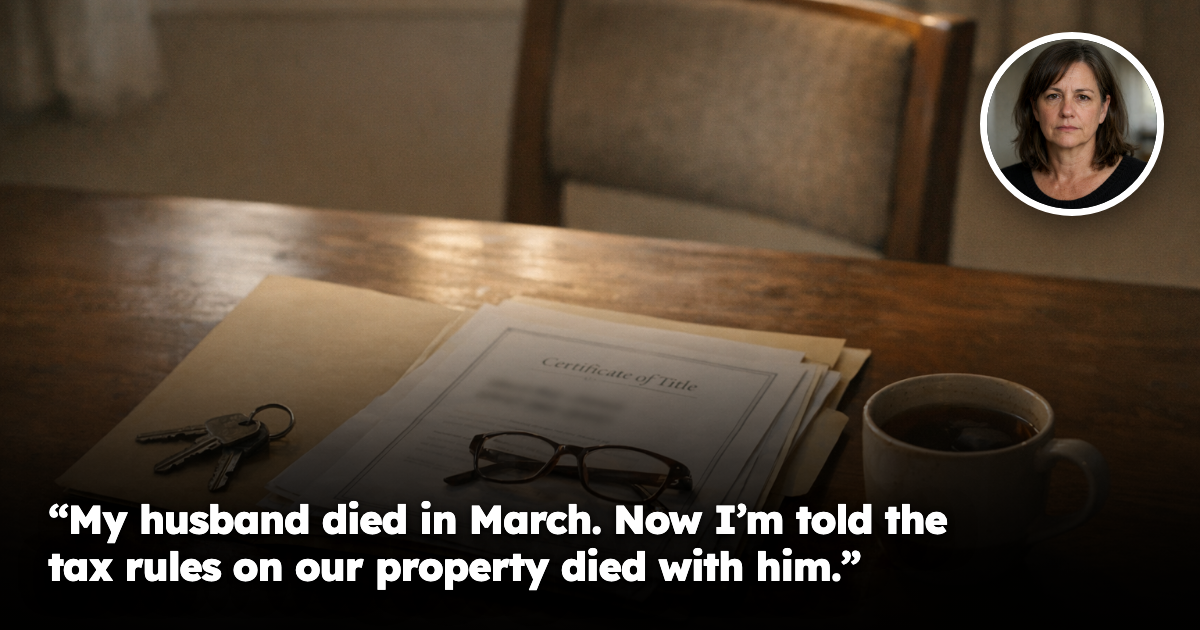
She found out from her accountant, not from the government.
A Central Coast woman in her fifties came to us last week with a question she had already asked three other people and gotten three different answers to. She and her husband bought an investment unit in 2014. Joint names, joint loan, joint everything — the way most Australian couples do it, without thinking twice about it, because that is what the broker’s form said and it seemed like the fair thing to do.
Her husband died in March. Somewhere in the pile of paperwork that follows a death, her accountant mentioned — almost in passing — that the transfer of his half of the property into her name might have quietly cost her the tax treatment they had held for twelve years.
Her question to us was blunt: “Is that real, or is someone getting this wrong?”
It is real. And it has a name now.
What actually happened
Australia’s negative gearing and capital gains tax overhaul passed both houses of Parliament on 25 June 2026. It is law.
The part most investors understood was the grandfathering. If you already owned an investment property as at 7:30pm on 12 May 2026 — including if you were under contract and waiting to settle — you keep your existing negative gearing and CGT treatment for as long as you hold that property. The new rules do not bite until 1 July 2027. New builds keep both concessions regardless.
That is the headline, and for most investors the headline was reassuring enough that they stopped reading.
The part almost nobody understood was sitting in the fine print. Under the legislation as it passed, a property held in joint names could lose that grandfathered protection if one of the owners dies, or if the property transfers as part of a divorce settlement.
Crossbenchers named it the widow’s tax, and the name stuck, because the mechanics are hard to defend. Two people buy an asset years before any of this was announced. They play by every rule in front of them. Then one of them dies — or a marriage ends, sometimes for reasons the person losing the concession had no say in at all — and a tax benefit that was explicitly promised to them evaporates on a technicality of paperwork.
Independent Senator David Pocock pushed for an amendment to preserve those concessions where an asset transfers by family law court order or on the death of a joint tenant. Finance Minister Katy Gallagher confirmed in the Senate the issue would be dealt with in a second tranche of legislation. The Treasurer has since said publicly that it will be fixed, and this week the government finally put detail around how.
The uncomfortable part: the fix is announced, not enacted. It is a stated intention sitting in front of a Parliament that has already demonstrated it can pass legislation of this size with a hole like this in it. The Greens conceded they had not realised what they voted for. Nobody spotted it. That should tell you something about how carefully any of us should be reading the second tranche.
So what should she actually do?
Here is where most of the commentary stops, and where the real question starts.
The answer to “has my tax treatment changed?” is a structuring question for a good property tax adviser, and she should have one — before life makes the decision for her rather than with her. Ownership structure, estate planning and family law interact here in ways that are genuinely complicated, and the 1 July 2027 start date means there is runway to get it right rather than react.
But the question underneath her question was different. What she was really asking was: “Should I just sell it?”
And that is not a tax question at all. That is an asset question — and it is the one almost everybody gets backwards.
A tax concession changes the carrying cost of a property. It does not change whether the property is any good. Investors who have built real wealth over multiple decades did it by owning the right asset in the right location and holding it through cycles. Negative gearing was a passenger in that outcome. It was never the driver. When the tax environment moves — and it moves constantly — the quality of the underlying asset is the only thing left standing.
Which is exactly why the answer has to be resolved at street level, not suburb level.
This is the part that surprises people. When we run our data across a suburb, the spread between the best-performing streets and the worst inside that same suburb, same median, same postcode is routinely wide enough to be the entire difference between a good hold and a bad one. Days on market on one street can sit at a fraction of the street three blocks over. Vacancy, tenant depth, the ratio of owner-occupiers to investors, the supply pipeline pointed at that pocket — none of that is uniform across a suburb, and none of it shows up in the median price everybody quotes at you.
That gap matters enormously in a life event, because life events come with timing you do not control. A deceased estate has deadlines. A property settlement has a court-ordered window. If you are ever forced to transact inside a fixed timeframe, the street you own on stops being an abstraction and becomes the entire outcome. A tightly-held street with genuine owner-occupier demand gives you a clean exit at a fair number. A saturated street with a thin buyer pool gives you a discount and a six-month campaign, in a window where you do not have six months.
So the honest answer we gave her was in two parts. Get the structure reviewed properly, because the rules genuinely did change and joint ownership is now a live variable rather than a default. But do not let a tax headline make an asset decision for you. Pull the street-level data on what she actually owns, and answer the real question — is this a property worth holding on its own merits? — with evidence instead of anxiety.
In her case, it was. The unit sits on a street with materially tighter days-on-market and lower vacancy than the suburb average that everyone had been quoting at her. It was never the tax treatment that made it a good asset. Losing some of that treatment does not make it a bad one.
What it means for you
If your investment property is in joint names with a spouse or partner — and statistically, it probably is — this is worth an hour of a professional’s time this month rather than a phone call in the worst week of your life. The concession you are relying on may be more conditional than you assumed.
But the wider lesson is the one that keeps repeating through every policy cycle we have watched: tax settings change, and good assets keep working anyway. The investors who get hurt by reform are almost never the ones who owned quality property. They are the ones who bought a tax outcome and called it a strategy.
Australia still has a structural shortage of well-located housing, a build-cost floor that is not going anywhere, and a population that has to live somewhere. That does not change because a schedule in a tax bill needed a second draft. What changes is how much precision it now takes to pick correctly — and precision has never come from a suburb median or a headline. It comes from knowing exactly what is happening on the street you are buying into.
Get the structure right. Then make sure the asset was worth structuring around in the first place.
If there's a specific street you're weighing up right now, check its Street Score first — it's free, takes ten seconds, and tells you whether that street is pulling the suburb average up or riding on it.
Market data & R-Scores for locations in this article
Drill Down Into the Markets Mentioned Above
Inspect live monthly R-Scores, median prices, rental yields, and street-by-street scores for the cities and council areas referenced in this article:
Frequently asked questions
Can an investment property in joint names lose its grandfathered tax treatment if one owner dies in Australia?
Yes. Under the legislation as passed, a property held in joint names could lose its grandfathered negative gearing and CGT protection if one owner dies, even if it was originally grandfathered.
What is the 'widow’s tax' people are talking about?
It is the nickname given to the situation where a joint owner’s death can cause an investment property to lose the tax treatment it had been promised under the grandfathering rules. Crossbenchers used the term because the loss can happen because of death or divorce, not a voluntary sale.
Has the government fixed this problem yet?
A fix has been announced, and the government has said it will be dealt with in a second tranche of legislation. But that fix is announced, not enacted.
If I own an investment property with my spouse, what should I look at first?
The article says to get the ownership structure reviewed properly, because joint ownership is now a live variable rather than a default. It also says this is something to do before a death or separation forces the decision.
Should a change to negative gearing or CGT rules automatically make me sell an investment property?
No. The article says that is an asset question, not a tax question, and that tax concessions change carrying costs rather than the quality of the property itself. The better next step is to assess the street-level performance of the asset before deciding.
General information only. It does not take your objectives, financial situation or needs into account, and nothing here is legal, financial, taxation or investment advice specific to your circumstances.