News · 15 August 2026 · 5 min read
'Two people came to my first open home. One of them was my neighbour'
She styled the house, fixed the deck and priced it exactly where her agent said. Two people came to the first open home, and one of them lived four doors down. Here is what attendance actually measures, why it is not a verdict on your home or on the market, and the street-level number almost nobody checks before they list.
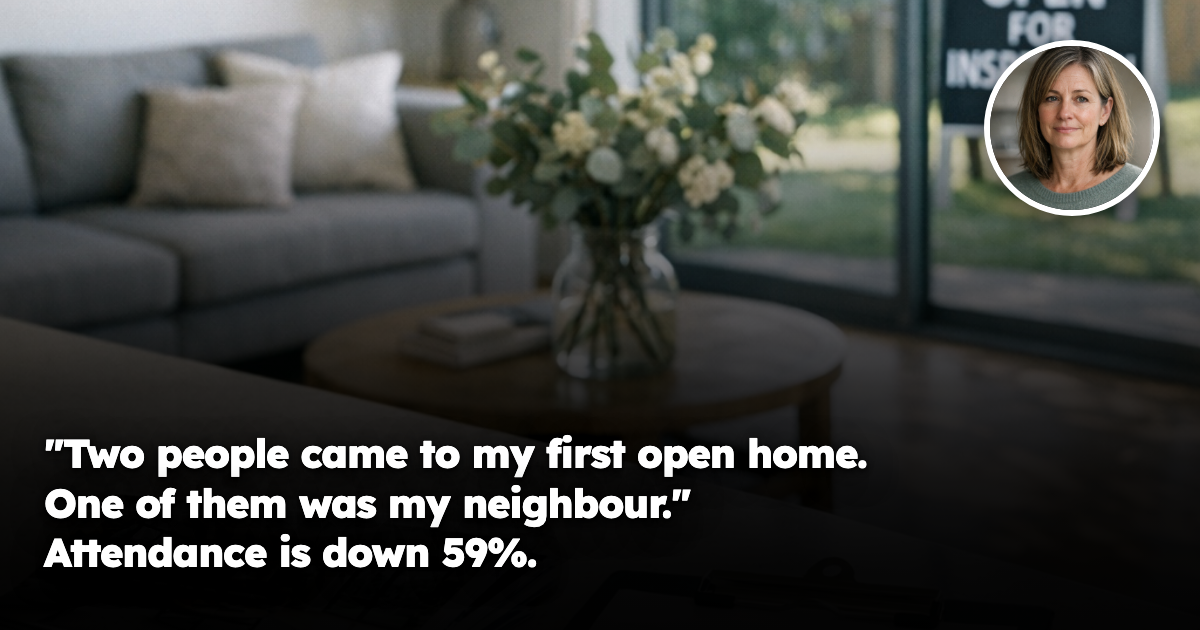
She had done everything properly.
The house was styled. The deck she'd been meaning to fix for three years was finally fixed. The price was exactly what her agent recommended, not a dollar more. She left at nine on the Saturday morning so the place would be empty and warm and smell like nothing at all.
Two people came through. One of them lived four doors down and wanted to see what she'd done with the kitchen.
She rang us on the Monday and asked the question almost every seller asks in that moment, in almost exactly these words: is my house the problem, or is the market the problem?
First, the honest part: it probably isn't her
It would be easy, and wrong, to tell her this is all in her head.
Listings across her city jumped roughly 18 per cent in July alone — in the middle of winter, when the market is supposed to be asleep. Total stock on the market climbed past twenty thousand homes. Auction listings nationally are down about 20 per cent over the year as sellers quietly retreat to private treaty, which is what vendors always do when they stop trusting a public result. Combined asking prices slipped about 1.1 per cent in a month. The number of homes sitting unsold for more than six months keeps climbing.
And the figure that actually explains her Saturday: open homes in her city are averaging around two people. That is a 59 per cent drop in a year.
So no, it wasn't her deck. Her agent was telling her the truth.
But here's the part that matters more than the reassurance: both halves of her question were wrong.
Attendance is not a verdict. It's a measurement.
"Is it my house or the market" assumes those are the only two options, and that whichever one it is, there's nothing much to be done.
Attendance isn't a judgment on your home and it isn't a judgment on some single national mood. It is a measurement of one specific thing: how many buyers exist, right now, at your price point, on your street, for your type of property.
That's called buyer depth. It is a real number. It varies enormously between properties that look identical on paper. And — this is the expensive bit — it could have been measured before she listed.
There's a line that circulates in a falling market, and it's true: a property only needs one buyer. Lower attendance doesn't automatically mean a lower price, and a well-priced home can still draw real competition.
But look closely at why that's true, because it cuts both ways. "You only need one buyer" is a comfortable sentence when there are forty of them and a terrifying one when there are two.
Thin depth doesn't mean you can't sell. It means you sell without competitive tension — and competitive tension is the entire mechanism by which a price gets discovered above the number you hoped for. With depth, buyers bid against each other and the market tells you what it's worth. Without it, you negotiate against one person who knows they're the only one in the room. Same house. Same suburb. Completely different outcome.
Why "the market" is the wrong unit entirely
In the same week her open home drew two people, rents across another capital were running at roughly 7 per cent growth for the year — while a single suburb inside that same city recorded a 21.3 per cent rise in one quarter.
Three times the annual rate, in three months. Same city. Same quarter. Same tax changes, same interest rates, same migration figures.
If one city can contain both of those numbers at once, then "the market" isn't an explanation. It's an average of things that are behaving nothing like each other.
This is a street question, not a suburb question
Buyer depth is not a suburb attribute. It's driven by who actually wants to live on that particular run of road, at that price, in that kind of home — which is why two houses in one suburb, sharing a postcode, a median, a school catchment and a train station, routinely differ by 20 to 30 per cent on effective yield once you measure achieved rents, real vacancy duration and actual days on market rather than advertised numbers.
Attendance is simply the leading indicator of all of it. The number of people through the door in August is what becomes the eleven-week campaign in October, and then the price reduction in November. It is the same reason a house that has never flooded can be repriced by a line on a map — the buyer pool changes long before the median does.
A suburb median averages the street with forty interested buyers and the street with two, and confidently reports a number that describes neither of them.
Which is exactly what happened to her. She researched a suburb. She sold on a street. Nearly everybody does it in that order, and the gap between the best and worst streets in one suburb is where the money quietly goes.
What to actually do with the number
Count it, don't feel it. Ask your agent for attendance figures, enquiry volume and second inspections — as numbers, weekly. "Quiet out there" is not data.
Separate the three causes. Low attendance is either price, presentation or depth. They have completely different fixes, and only one of them is solved by discounting. Cutting the price to fix a depth problem is the most expensive mistake in a soft market, because thin depth doesn't get thicker when you drop $40,000 — you just hand it over.
Measure below the suburb. Achieved sale prices, real days on market and genuine buyer volume for your street and stock type. Not the median. Not the appraisal.
And if you're buying — read it the other way. Thin attendance is the absence of competition. That is, precisely and only, the condition under which a genuinely good asset becomes available at a price nobody bid up.
The part nobody says out loud
Listings are at their highest in over a year. Attendance has halved. Buyers are under less pressure to act than they've been in years, and vendors who priced to last year's optimism are stacking up in the six-month-plus pile.
That is not a market where property stops working. It's a market where selection starts mattering more than timing — where the average asset struggles and the well-chosen one still finds its buyer, because the depth was there before the downturn and is still there during it.
The mistake was never deciding to own property. It was choosing one without ever asking how many people would want it back.
She counted the people who came to her open home.
Nobody had counted them before she listed.
If there's a specific street you're weighing up right now, check its Street Score first — it's free, takes ten seconds, and tells you whether that street is pulling the suburb average up or riding on it.
Frequently asked questions
Does a low turnout at my first open home mean my house is the problem?
Not necessarily. The article says attendance is a measurement of buyer depth at your price point, on your street and for your type of property — not a verdict on the home itself.
What does open home attendance actually tell a seller in Australia?
It shows how many buyers exist right now for that specific property, at that price, on that street. In the article, low attendance is treated as an indicator of thin buyer depth, not just a bad open day.
If only two people come through, should I automatically drop the price?
No. The article says low attendance can come from price, presentation or depth, and only one of those is solved by discounting. Cutting the price to fix a depth problem can be an expensive mistake.
Why does the article say suburb averages can be misleading?
Because a suburb median can blend very different streets and property types into one number. The article argues you should look below the suburb at achieved sale prices, real days on market and genuine buyer volume for your street and stock type.
What should I ask my agent if my open home is quiet?
Ask for attendance figures, enquiry volume and second inspections each week, as numbers. The article also says to separate whether the issue is price, presentation or buyer depth before making a decision.
General information only. It does not take your objectives, financial situation or needs into account, and nothing here is legal, financial, taxation or investment advice specific to your circumstances.