News · 6 October 2026 · 4 min read
Three parties, three migration numbers. Does his $610,000 apartment still work under all of them?
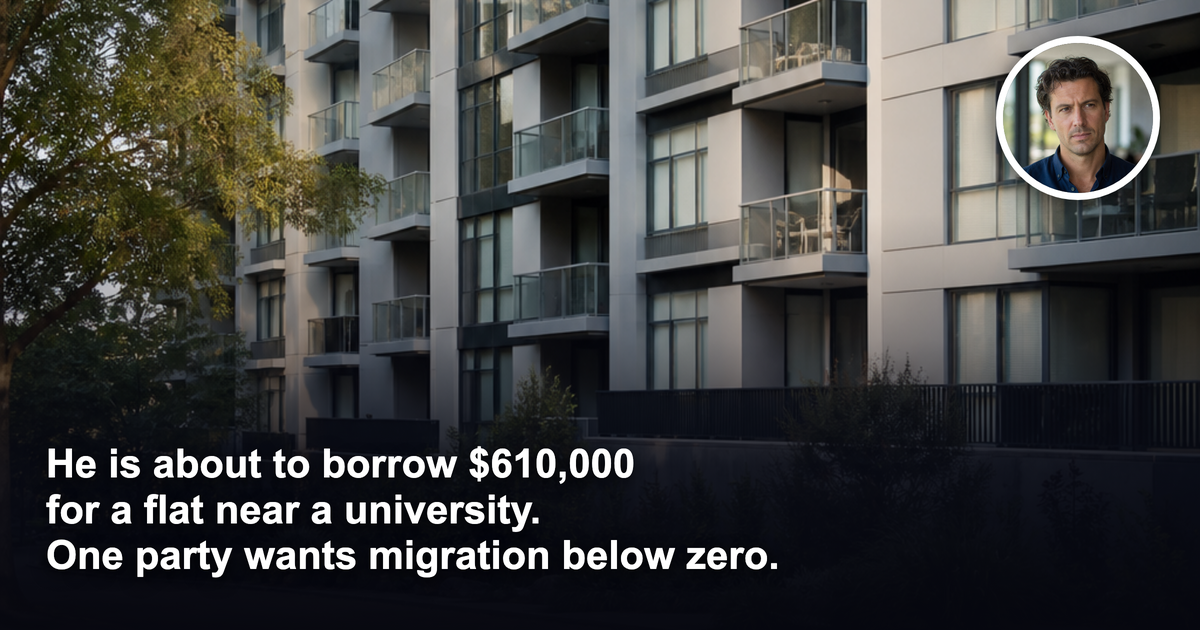
He is 39, partnered, with a mortgage on the family home and about $140,000 of usable equity. He has a pre-approval, a broker who is keen, and a contract sitting in his inbox for a two-bedroom apartment a short walk from a university campus. The loan would be about $610,000.
He is 39, partnered, with a mortgage on the family home and about $140,000 of usable equity. He has a pre-approval, a broker who is keen, and a contract sitting in his inbox for a two-bedroom apartment a short walk from a university campus. The loan would be about $610,000.
He is a composite illustration, not a real person. The decision is very real, and a lot of people are sitting on a version of it this week.
The pitch for the apartment was simple. Students and new arrivals need somewhere to live. They land and they rent. Vacancy around the campus has been tight. The agent called the demand "structural".
Then the ABC published a side-by-side of what the three major political players now say they would do with migration, and the word structural started to look a little thin.
What the three parties have actually said
This is the comparison as the ABC reported it on 6 October 2026. Nothing more, nothing less.
- Labor says it is enforcing its target of 225,000.
- The Coalition says it will more than halve migration.
- One Nation wants net migration below zero in its first years in government.
Those are three very different countries to own an apartment in. We are not going to tell you which one is coming. Nobody knows, and anyone who claims to is selling something.
The point for an investor is simpler and less comfortable. Until this week, the migration assumption inside most apartment pitches was a single number heading in one direction. Now there are three on the table, and one of them is negative.
The question
"The whole reason this apartment stacks up is that people keep arriving and renting near the campus. If migration halves, or goes below zero, does my $610,000 loan still make sense? Or am I buying a story that one election could cancel?"
The answer: you are buying a dependency, and you need to price it
Every investment property leans on something. A house in an established suburb leans on local families, local jobs and the fact that nobody is building more of that street. An apartment near a university leans on a flow of people who were not in the country last year.
Neither is wrong. One of them is simply more exposed to a policy decision made in Canberra.
That exposure has a cost, and the honest version of the arithmetic looks like this.
Run the numbers with demand continuing as it has. Then run them again with arrivals more than halved. Then run them with net migration negative for a couple of years. If the apartment only works in the first scenario, the agent has sold you a bet on an election outcome, with a $610,000 loan as the stake.
If it still washes its face in the second scenario, you have a reasonable asset with a known risk. If it survives the third, you have something genuinely resilient, and the policy noise is just noise.
Most people never run the second or third version. They run the first, feel good, and sign.
What it means for you
The apartments most sensitive to migration settings share a profile. Dense supply. A tenant pool made up largely of students and recent arrivals. Short leases, high turnover, and dozens of near-identical listings in the same postcode competing for the same renter.
That is exactly where a change in the number of people arriving shows up first and hardest. A landlord with the only four-bedroom house on a leafy street does not notice a migration cut for a long time, if ever. A landlord with one of 300 two-bedroom units in one tower notices it the week the next semester starts smaller.
Two streets in the same suburb can be having completely different outcomes, and the migration debate makes that gap wider.
The expensive mistake
The mistake is to treat a political position as a prediction and buy or sell on it. People did this with interest rates, with rental caps, with every rail line that was announced and then paused.
Reacting to the headline is how investors end up buying at the top of a story and selling at the bottom of it.
The less exciting, more profitable move is to stop asking what will happen and start asking what your asset can survive. Policy risk is a stress test, and the test is run before you sign.
The Ripehouse reframe
We do not pick elections. We pick streets.
A portfolio built on the right asset type, in a street with a deep local tenant pool and limited new supply, does not need a particular migration number to work. It works because the demand underneath it is local and hard to legislate away.
That is why we spend so much time at the street level rather than the suburb or city level. The city headline says "migration cut". The street data says whether the renters on your street were ever migrants in the first place.
We also publish our results, including the portfolios that underperformed, so you can see what a structure built this way actually did across a full market cycle. Across our client portfolios, median portfolio growth has run at +19.0 per cent per year on a 5-year rolling basis, against roughly 4.3 per cent nationally (benchmark: CoreLogic/Cotality). Past performance is not a guarantee of future results.
He has not signed yet. His next move is to run the loan under all three migration numbers and see which one it falls over in.
If you want to see how a decision like this is tested street by street rather than headline by headline, join Jacob's free live webinar, If I Were Buying an Investment Property in Australia Today.
General information only. It does not take your objectives, financial situation or needs into account, and nothing here is legal, financial, taxation or investment advice specific to your circumstances.