News · 16 October 2026 · 5 min read
Three houses for $340,000: what the regional cash play says about the equity you are sitting on
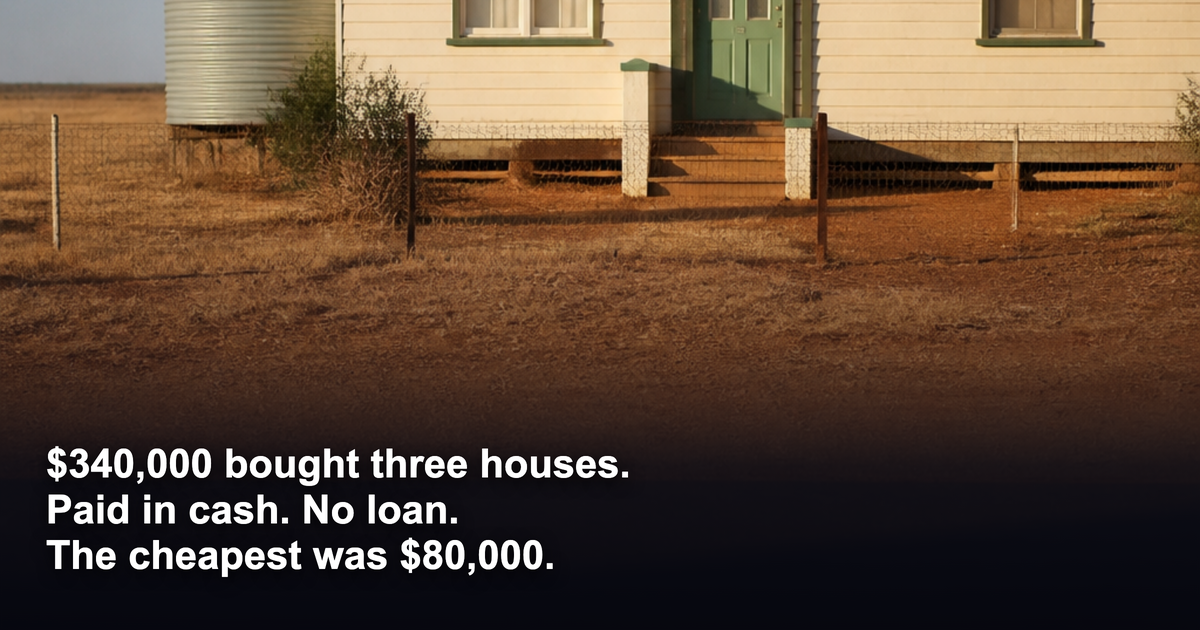
$340,000. Three houses. Paid in cash, over six months, in Moree, Cobar and Bourke.
Three houses for $340,000
$340,000. Three houses. Paid in cash, over six months, in Moree, Cobar and Bourke.
That is the story on realestate.com.au today, and it has done exactly what it was designed to do. Everyone with a Sydney mortgage and a bit of equity has just done the mental arithmetic: my usable equity would buy three of those.
So take the deal seriously, because the numbers inside it are more useful than the headline.
What was actually bought
According to the report, the investor paid $150,000 for a three-bedroom weatherboard in Moree, $110,000 for a rundown house in Cobar, and $80,000 for a two-bedroom house on an 885 square metre block in Bourke.
All three were found off-market through a buyers agency, via Facebook community groups and letterbox drops. All three needed work. The agency describes the renovations as cosmetic: paint, tiles, doors and the yard, nothing structural, done by local handymen for $10,000 to $20,000 a house.
The Moree house is the one with a finished figure. Renovation trade costs came to $13,373, plus $3,500 for project management, taking the purchase and renovation spend to $166,873 before acquisition costs. Cobar has an indicative budget of $20,000. Bourke is budgeted at around $10,000.
Add it up and the three houses, renovated, come to roughly $386,000 before stamp duty, legals and the buyers agency fee. That is still less than the deposit on a lot of Sydney houses.
Why the money left Sydney
The investor's own explanation, as reported, is blunt. Sydney stopped being viable for him as an investor. The purchase price against the rent took too long to show a return, and he says higher interest rates along with the negative gearing and capital gains changes he describes from the May federal budget killed the numbers.
Whether or not you share his reading of the tax changes, the underlying problem is the one most Sydney owners with equity now face. At current Sydney prices, one investment property means a large loan and a rent that, on his numbers, does not get close to the repayments. The gap comes out of your salary every month.
So the capital went somewhere the price was low enough for the rent to do the work. That is the opportunity being sold here, and on its own terms it is a legitimate one.
What it means if you have equity or cash
If you own a Sydney home with usable equity, this story changes the shape of your decision. The question used to be whether you could afford one more property. The question now is whether the same capital should become several cheaper ones, and if so, which ones.
Three things in the deal deserve more attention than the price.
He paid cash. No loan means no repayments, so even a modest rent is positive from the first week. Most readers would be borrowing against their home to do this, and the moment there is a loan, the rent has to clear interest, insurance, rates, management and maintenance before it clears anything else. A $150,000 house is a very different asset with $150,000 of debt sitting behind it.
There is no rent figure. The report does not state what any of the three houses will return. The Moree house is still being prepared for the rental market. Nobody knows yet who rents these houses, at what price, or how long they sit empty between tenants. A cheap purchase price tells you the entry cost. It tells you nothing about the exit, and in a small town the exit is the part that hurts.
Three towns, three sets of problems. The houses are hundreds of kilometres from the owner and from each other. Cobar is described in the report as a mining town, which means its rental demand leans on one industry. Each house has its own council, its own insurer and its own tradesperson who may or may not answer the phone. Three cheap houses carry three times the management load of one, with none of the economies.
The expensive mistake
The expensive version of this story is the one where a reader sees three houses for $340,000 and buys three cheap houses because they are cheap.
Cheap and good are different properties. An $80,000 house can be a sound long-term hold with a stable tenant on a street the council keeps maintained. The identical house two streets over can sit vacant for months, attract the wrong tenant and lose a third of its value when the only buyer in town is another investor who read the same headline.
In regional towns that difference is sharper than in a capital. Two streets in the same town can be having completely different outcomes, and the gap between them never shows up in a median or a news story.
The Ripehouse view
We have no argument with regional NSW. We buy in regional markets when the street-level data earns it.
We do not buy a town. We buy a street, and we buy it because the data on that street, vacancy, days on market, buyer depth, who is arriving and who is leaving, says the asset will hold its tenant and its value through a bad year as well as a good one.
That is the difference between a headline and a structure. The investor in this story may have chosen three excellent streets. The report does not say, and that is the point. A plan that depends on one buyers agent's eye for off-market bargains is a plan you cannot repeat. A plan built on measured, published results across many portfolios can be.
On a 5-year rolling basis our clients' portfolios have grown at a median of +19.0 per cent per year, against roughly 4.3 per cent nationally, and we publish the full distribution, including the portfolios that underperformed. Benchmark: CoreLogic/Cotality. Past performance is not a guarantee of future results.
The right asset on the right street, chosen with data, beats the right headline. Structure, not timing.
If you are sitting on Sydney equity and wondering whether it should become three regional houses or one better one, join Jacob's free live webinar and see how we test a decision like this street by street.
If there's a specific street you're weighing up right now, check its Street Score first — it's free, takes ten seconds, and tells you whether that street is pulling the suburb average up or riding on it.
General information only. It does not take your objectives, financial situation or needs into account, and nothing here is legal, financial, taxation or investment advice specific to your circumstances.