News · 15 October 2026 · 5 min read
He was quoted up to $25,000 just to find out if his family trust is a problem
He is 40 and has just been quoted somewhere between $10,000 and $25,000 in professional advice. Not to change anything. To find out whether he has to.
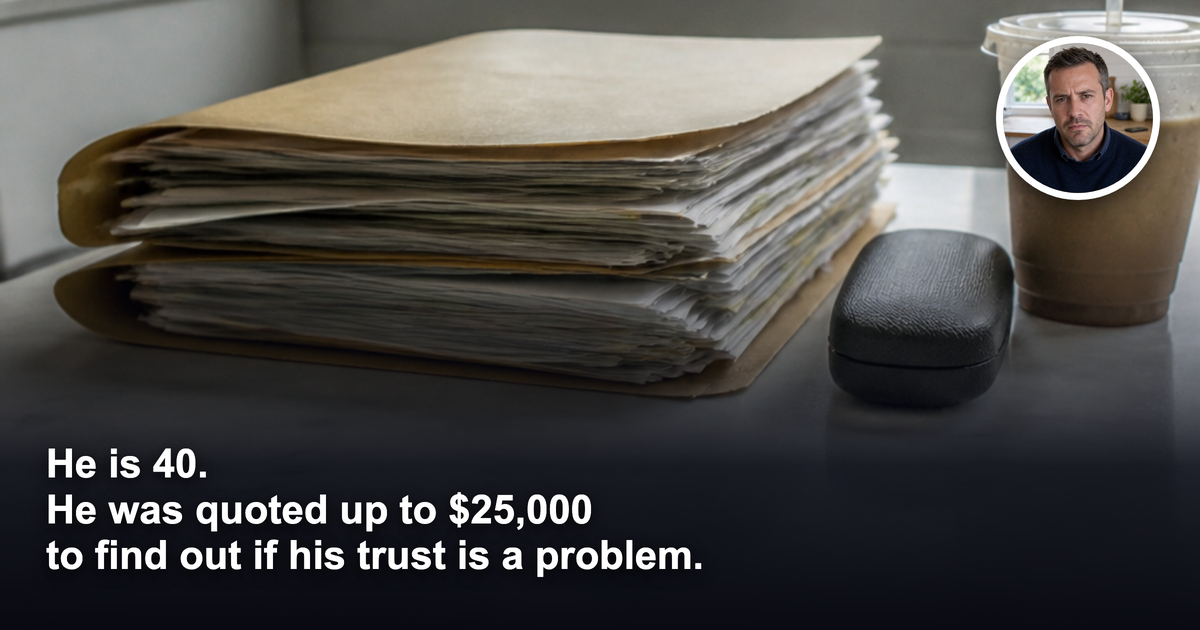
He is 40 and has just been quoted somewhere between $10,000 and $25,000 in professional advice. Not to change anything. To find out whether he has to.
He lives in Hobart with his partner and their two primary-school kids. Three years ago, on his accountant's advice, he set up a discretionary family trust and bought one rental house through it. He was told it was the sensible way to hold property: flexible, protected, tidy for the kids one day. The trust has never paid a dollar to anyone except him and his partner.
He is a composite illustration, not a real person. The bill, the quote and the numbers below are real and come from the ABC's reporting on 15 October 2026.
On Wednesday the Treasurer introduced a bill that would impose a 30 per cent minimum tax on discretionary trusts from July 2028. The same day, a tax academic told the ABC the way some trusts are used is "bordering on a joke". Small business advocates called that a myth and described the bill as "a kick in the gut".
He read all of it on his phone before work.
The question
"I bought one rental through a family trust because I was told that was the responsible way to do it. Now there is a bill for a 30 per cent minimum tax on trusts, and I have been told I might need to spend up to $25,000 just to find out if it touches me. I'm not hiding anything. Did I set this up wrong?"
The answer: nothing has changed yet
Start with what is actually on the table, because the headline and the bill are different things.
A bill has been introduced. It has not passed. It proposes a 30 per cent minimum tax on discretionary trusts starting July 2028, according to the ABC. It could be amended, delayed or voted down. Nothing about his trust is different this morning from last week.
The Treasurer says the reforms would affect less than 10 per cent of small businesses. Treasury analysis cited by the ABC suggests about 140,000 of an estimated 350,000 small businesses using discretionary trusts would not need to pay the new tax.
So who is the target?
The academic, Associate Professor Dale Boccabella from UNSW, gave the ABC an example. A 17-year-old beneficiary who has been allocated nothing for years turns 18 and is suddenly allocated $22,500, because that sits under the effective tax-free threshold. In some cases, he said, the money never reaches the child. It stays with the parents.
The Australian Council of Social Service put it in income terms. Someone earning $200,000 or more who would usually pay 47 per cent on extra income can bring that rate down to 30 per cent or less by passing income through a discretionary trust to adult children or a private company.
That is the behaviour the bill is aimed at. A trust that pays income to the two adults who actually earned it, at their own marginal rates, is doing none of that.
The cost he cannot avoid
Now the part the headline leaves out.
The Housing Industry Association told the ABC its members are being quoted between $10,000 and $25,000 in legal and accounting advice to work out whether the change even applies to them. Its managing director said about three in five small businesses in the housing industry use a trust, and that the result for many may be that they do not have to restructure at all. They still have to pay to find that out.
There are more than 1 million trusts in Australia and about 84 per cent are discretionary, the ABC reports. The number has doubled since 2001-02. That is a lot of people being invited to buy certainty at $10,000 a time.
And if the answer is "yes, restructure", the bill may not be the end of it. The ABC notes restructuring a trust can trigger stamp duty at state level. New South Wales has promised to waive it if re-elected next year. No such promise exists in Tasmania, where he lives, or anywhere else.
This is the unfair bit. The price of finding out is charged to everyone, whether or not they were ever the target.
What it means for you
If you hold property through a discretionary trust, or you are about to, three things.
- Do not restructure on a headline. The bill is proposed, the start date is 2028, and the detail may change. Moving a property out of a trust is a sale for duty purposes in most states. That is a real cost against a possible one.
- Get the question answered once, properly, with your actual distribution history in front of a licensed adviser. The expensive version of this is paying for the same answer three times as the bill changes shape.
- Ask the harder question. Did you buy the trust, or did you buy the property? If the trust was the reason the deal made sense, a rule change in Canberra can take the reason away. If the property was the reason, the wrapper is a detail.
This is general information, not tax or legal advice. Talk to a licensed adviser about your own position.
The Ripehouse reframe
A rule change tests the setup. It never tests a single deal.
We watch a lot of portfolios where the structure was the clever part and the asset was an afterthought. The tax wrapper was elegant, the house was whatever the buyer's agent had that month. When the wrapper gets a 30 per cent floor put under it, those portfolios have nothing left to argue with.
The portfolios that absorb this are the ones built the other way round. The asset was chosen because the street-level data stacked up: rent against price, days on market, vacancy, who is buying in that pocket and why. Two streets in the same suburb can be having completely different years. A property on the right one earns its place in any structure, trust or no trust, 2028 or not.
Structure beats timing. The right asset on the right street beats both, and it beats headlines.
For investors asking whether their trust still makes sense, the better question is whether the property inside it would, and that is what Jacob's free live webinar tests street by street.
If there's a specific street you're weighing up right now, check its Street Score first — it's free, takes ten seconds, and tells you whether that street is pulling the suburb average up or riding on it.
General information only. It does not take your objectives, financial situation or needs into account, and nothing here is legal, financial, taxation or investment advice specific to your circumstances.