News · 15 October 2026 · 4 min read
A $700,000 reserve sold for $801,000: what Victoria's published-reserve rule changes for buyers with equity
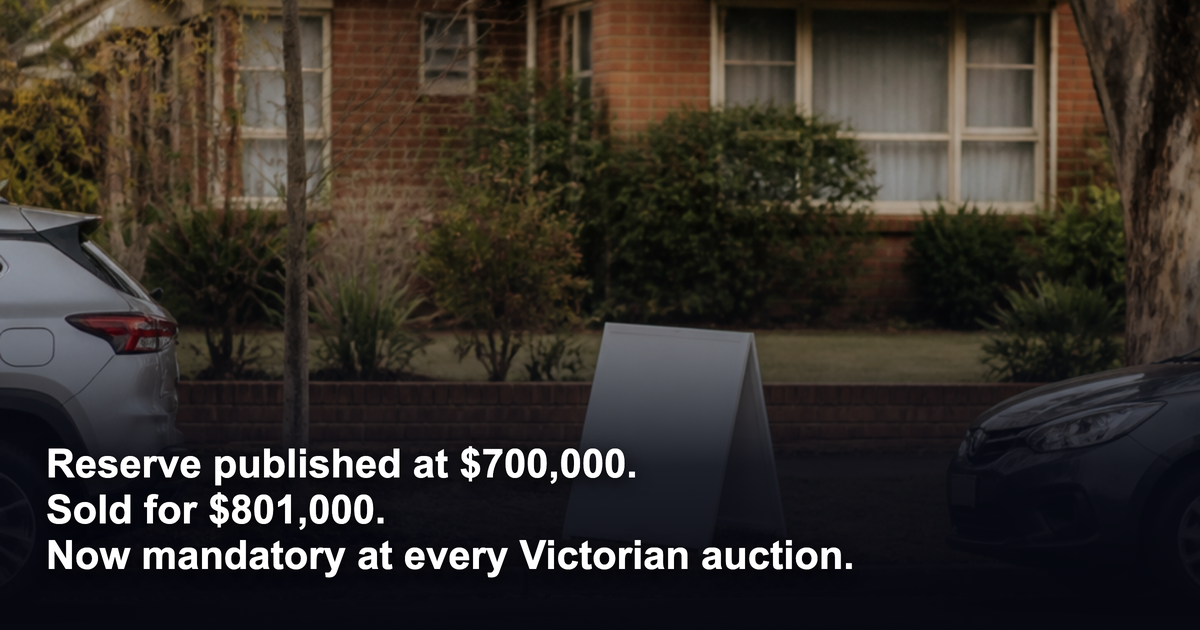
On October 3, a house in Gladstone Park went to auction with its reserve already advertised: $700,000. Four bidders turned up. It sold for $801,000, according to The Sydney Morning Herald's report on the first vendors to try Victoria's new rule.
The number first
On October 3, a house in Gladstone Park went to auction with its reserve already advertised: $700,000. Four bidders turned up. It sold for $801,000, according to The Sydney Morning Herald's report on the first vendors to try Victoria's new rule.
That is $101,000 over a figure every bidder could see a week in advance.
Hold it next to two other results from the same report.
In Watsonia, a 1960s house carried a published reserve of $1 million. The opening bid matched it and the house sold for $1,090,000.
In Rowville, a four-bedroom house went out with a $1,325,000 reserve. Two prospective buyers walked away as soon as they saw it. Three stayed. It sold for $1,336,000, which is $11,000 over.
Same rule. Same city. Same spring. One reserve was cleared by 14 per cent, one by 9 per cent, one by less than 1 per cent.
That spread is the whole story.
What changed on October 16
From today, a Victorian vendor selling by auction or fixed-date sale must advertise the reserve at least seven days beforehand. The SMH reports the law follows its Bidding Blind investigation into underquoting. The Real Estate Institute of Victoria backed the transparency aim but opposed the seven-day requirement, arguing it limits a vendor's flexibility.
The old problem was plain. A buyer paid for building inspections, was told by the agent they were in the game on the quoted range, then arrived to find they were the only bidder and more than $100,000 short. One of the Gladstone Park vendors told the SMH he watched his own daughter go through exactly that. It is why he published his reserve when he had no obligation to.
So the information gap that cost buyers inspection fees, legal fees and months of weekends has, in one state, been closed by law.
That is good news for anyone with capital to deploy. It is also the moment people start making a new kind of mistake.
What it means if you have equity to deploy
If you own a home with usable equity and have been circling Victorian auctions, three things are different this weekend.
- Your walk-away price is now set against a real floor rather than a guide. You know before you pay for a pest report whether you can even reach the start line.
- Pre-approval sizing becomes concrete. If the reserve is $1,325,000 and your ceiling is $1.3 million, you are out, and you found out for free. The two Rowville buyers who left did precisely that. The agent told the SMH they were unlikely to be the best buyers for that house anyway. From their side, the rule saved them a wasted Saturday.
- Competition changes shape. In the SMH examples, a reserve pitched with some room drew four bidders and ran $101,000 past it. A reserve pitched at full price filtered the field down to three and ran $11,000 past it. A published reserve does not just tell you the floor. It tells you something about how the vendor is playing the day.
The decision, and where it goes wrong
The first mistake is reading the reserve as the value.
The reserve is the vendor's floor. In Gladstone Park the floor was $700,000 and the market said $801,000. In Rowville the floor was $1,325,000 and the market said $1,336,000. Clearing the reserve tells you the vendor is satisfied. It tells you nothing about whether you paid the right price for the asset you now own.
The second mistake is assuming every house will now come with a number attached.
The REIV chief executive told the SMH the challenge will be whether agents advise clients that private sale is the better route to the best price. If that drift happens, the auction stock with published reserves may skew toward vendors confident enough to show their hand, while the opaque pricing moves behind closed doors. A Macedon Ranges agent who has published reserves for more than 20 years argues the market will not be harmed. Time will tell. Either way, a buyer with equity should expect two markets for a while: one you can read, one you cannot.
The third mistake is the expensive one.
It is spending your borrowing capacity on the auction you can see rather than the asset you should own. A visible reserve makes it easier to bid. Easier to bid and right to buy are different things. Transparency about one Saturday's floor does nothing to tell you about the street's vacancy, its days on market, its resale depth or whether this purchase fits the sequence of the next three.
The Ripehouse reframe
A published reserve is one data point about one vendor's expectation on one day.
Two streets in the same suburb can be having completely different outcomes at the same time. One is turning over in a fortnight with multiple bidders. The other is sitting for months and leasing at a discount. The reserve printed on the listing will not tell you which one you are standing in.
Our clients' portfolios have returned a median of 19.0 per cent growth per year on a 5-year rolling basis, against roughly 6.3 per cent for the combined capitals over the same period (benchmark: CoreLogic/Cotality). Past performance is not a guarantee of future results. That gap did not come from reading reserves better than anyone else. It came from choosing the asset and the street first, and treating the sale method as the last detail.
Structure beats timing. The right asset, the right street and the data beat headlines, including the welcome ones.
If you are deciding whether a Victorian auction with a published reserve is the right place for your equity, the number you need was never the reserve. Want to see how we test a decision like this street by street? Join Jacob's free live webinar.
If there's a specific street you're weighing up right now, check its Street Score first — it's free, takes ten seconds, and tells you whether that street is pulling the suburb average up or riding on it.
General information only. It does not take your objectives, financial situation or needs into account, and nothing here is legal, financial, taxation or investment advice specific to your circumstances.