News · 5 September 2026 · 3 min read
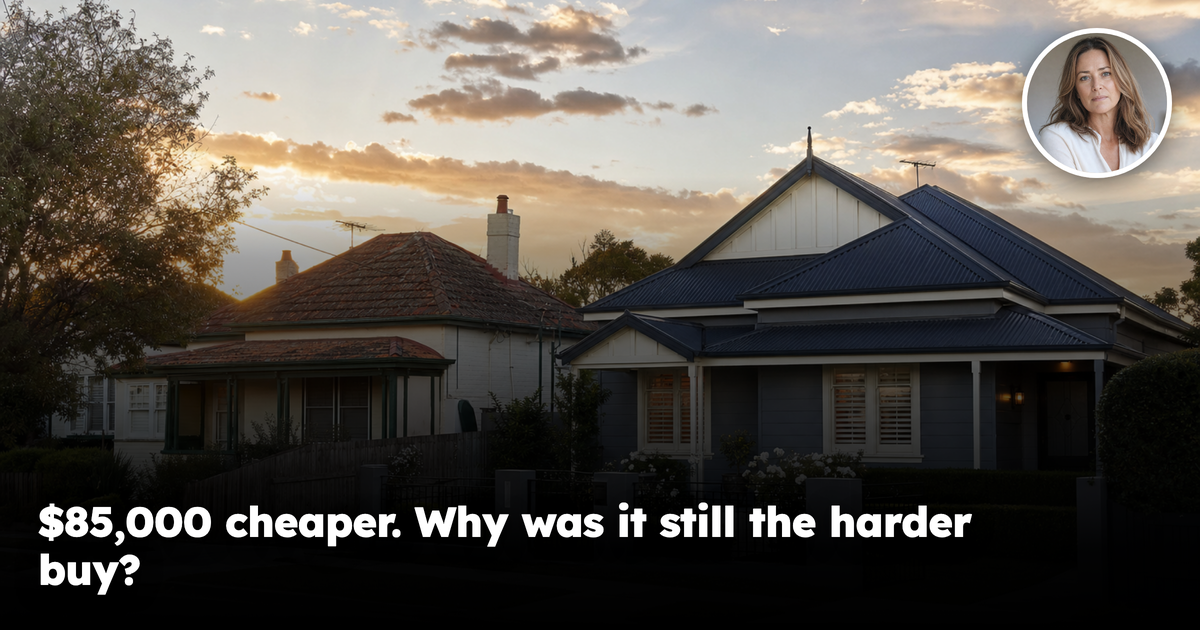
The $85,000 housing gap: why is the cheaper home still the harder buy?
A cheaper house can still be the harder investment when rent, vacancy and resale depth tell a different story.
The $85,000 housing gap: why is the cheaper home still the harder buy?
A 46-year-old woman had $85,000 saved and thought a cheaper house would finally make property investment possible. Then two nearby homes fell by almost the same amount, and the cheaper one still failed every test that mattered.
The question
One property was listed at $620,000. A similar home three streets away was $705,000. Both had recently been repriced as buyers pulled back. The cheaper house looked like the obvious opportunity.
But the numbers underneath were different. The lower-priced home had weaker achieved rent, longer vacancy periods and more competing listings. Its street also had fewer recent sales, which meant fewer clear comparables when the owner eventually needed to sell.
“If the price is lower, why does the decision feel riskier?” she asked.
The answer
Because price is only the entry number. An investment property has to survive the period after the purchase as well.
The first test is finance. A lower purchase price reduces the deposit, but it does not automatically fix serviceability. Lenders still assess the loan against income, existing commitments, buffers and the reliability of the rent. A property with a cheaper sticker price can create a larger cash-flow gap if its achieved rent is materially weaker.
The second test is rentability. Asking rent is not the same as achieved rent. Two houses in the same suburb can have very different tenant demand because of walking routes, traffic noise, parking, light, slope, nearby competing stock and the quality of the immediate streetscape.
The third test is exit depth. A property is not liquid merely because it is affordable. If most comparable homes sit for weeks, attract few inspections and compete against a large pipeline of new listings, the eventual seller may have to accept a discount or wait through a long campaign.
That is why street-level data matters. Ripehouse Advisory’s research checks achieved rents, genuine vacancy duration, days on market, tenant enquiry depth, competing supply and buyer depth at the address level. In one suburb, the strongest and weakest streets can produce a 20–30% difference in effective rental performance after vacancy and holding costs are included. The suburb median hides that spread.
Why the cheaper house can be the expensive decision
A buyer who saves $85,000 on the purchase price may give some of it back through weaker rent. A $55 weekly rent gap is $2,860 a year before vacancy. Add a longer letting period, extra advertising, or a resale campaign that runs for months, and the apparent bargain becomes a different financial proposition.
This does not mean the cheaper property should automatically be rejected. It means the discount has to be explained. A quiet rear street, a better block or a genuine supply constraint can make a lower price an opportunity. A weak street, poor access or a deep competing pipeline can make it a warning.
Our earlier analysis of the school-zone boundary showed why two homes can share a suburb label while the market treats them differently. A separate analysis of a substation discount showed the same principle from another angle: the exact physical relationship between a property and its surroundings can matter more than the broad suburb story.
The practical sequence is straightforward. Start with the exact address. Compare achieved rent, not the agent’s target. Measure vacancy and days on market for genuinely comparable homes. Map competing listings and planned supply. Then ask what happens if the property sits empty for six weeks or the next buyer has more choice than today.
The strongest property decisions are not made by chasing the cheapest number. They are made by finding the asset whose rent, demand and resale depth justify its price.
For her, the answer was not “never buy the cheaper house”. It was “do not confuse a lower entry price with a lower risk”. The right property, on the right street, selected with evidence, can still build durable wealth. Headlines move sentiment; address-level data tells you where the opportunity is.
If there's a specific street you're weighing up right now, check its Street Score first — it's free, takes ten seconds, and tells you whether that street is pulling the suburb average up or riding on it.
Frequently asked questions
Why can a cheaper house be a harder property investment than a more expensive one?
Because the purchase price is only the entry number. A cheaper home can still have weaker rent, longer vacancy periods and poorer resale depth, which can make it riskier over time than a pricier property with stronger demand.
What should I compare before buying an investment property in Australia?
The article says to compare achieved rent, vacancy duration, days on market, competing listings and buyer depth at the exact address level. It also matters how lenders assess the loan against your income, commitments and the reliability of the rent.
Is asking rent enough to judge whether an investment property will pay its way?
No. The article says asking rent is not the same as achieved rent, and actual tenant demand can differ street by street. Weak achieved rent and longer letting periods can create a bigger cash-flow gap than the lower price suggests.
What is the main resale risk with a cheaper property?
A property is not easy to sell just because it is affordable. If comparable homes are taking weeks to sell and there is a large pipeline of new listings, the owner may need to wait longer or accept a discount.
What is the practical next step before choosing between two similar homes?
Start with the exact address and compare the local evidence, not just the suburb median. Check achieved rent, genuine vacancy, competing supply and recent sales so you can judge whether the lower price is a real opportunity or a warning.
General information only. It does not take your objectives, financial situation or needs into account, and nothing here is legal, financial, taxation or investment advice specific to your circumstances.