News · 2 September 2026 · 4 min read
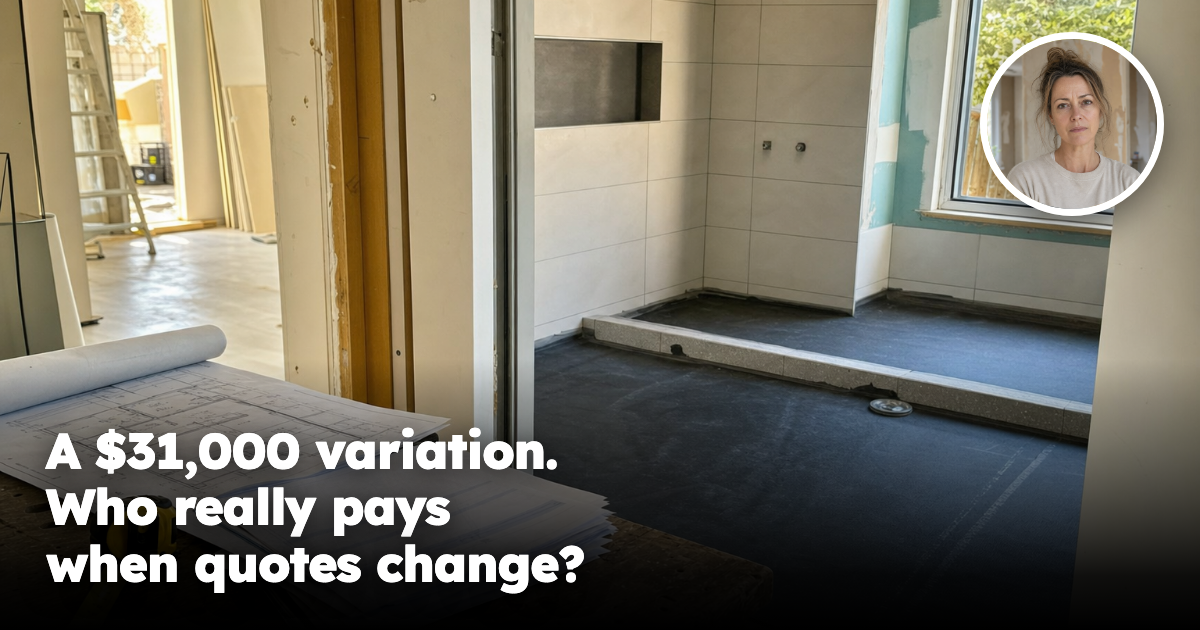
The $31,000 renovation variation that blindsided her: who really pays when the quote changes?
A homeowner watched a fixed-price renovation rise by $31,000. The answer shows how variations, hidden work and exact-street demand shape property value.
The $31,000 renovation variation that blindsided her: who really pays when the quote changes?
A renovation can begin with a fixed number and end with a very different one. For a 48-year-old homeowner in Melbourne’s north, the gap was $31,000 — enough to change whether the project improved the property or simply swallowed its usable equity.
She had budgeted for a $164,000 renovation. The scope covered a kitchen, laundry and bathroom, with a written quote and a completion window. Six weeks in, the builder presented variations for waterproofing, drainage and changes behind the old walls. The revised total was $195,000.
Her question was blunt: if the builder gave a fixed quote, how could the bill move by nearly 19 per cent?
The answer: “fixed price” does not mean “every unknown is free”
A fixed-price building contract generally fixes the price of the work described in the contract. It does not automatically transfer every risk hidden behind a wall, under a slab or inside old services to the builder.
The first distinction is between a genuine change to the agreed work and a cost required to complete the original work safely. If the homeowner adds a window, changes the tile specification or moves a wall, that is a straightforward variation. If demolition reveals damaged framing or non-compliant plumbing, the argument becomes more complicated: was the condition reasonably discoverable, was it allowed for in the contract, and did the builder follow the variation process?
That paperwork matters. A homeowner should be able to see what changed, why it changed, how much it costs and whether it affects the completion date. A verbal “we’ll sort it out later” can turn a manageable surprise into an argument over thousands of dollars.
The second distinction is between a cheap quote and a complete quote. A low initial number can win the job while leaving provisional allowances for the items most likely to move: excavation, demolition, electrical upgrades, waterproofing, structural work and waste removal. Those allowances are not necessarily dishonest. They are a warning that the final price is not yet known.
Why the $31,000 matters beyond the renovation
The homeowner’s spreadsheet initially showed a $42,000 equity buffer after the planned work. The variation reduced that to $11,000 before interest, temporary accommodation and the cost of delays. The project could still add value, but the margin for error had narrowed sharply.
This is where renovation decisions become property decisions. A new kitchen may photograph beautifully, but buyers do not pay dollar-for-dollar for every improvement. The result depends on the property’s layout, the quality of the finish, the surrounding stock and the depth of demand for that exact type of home.
RHA’s street-level data often shows why a renovation that works on one side of a suburb struggles on the other. Two streets can share a postcode and broad suburb median while differing in buyer depth, days on market and achieved prices for renovated homes. A busy road, awkward parking, flood exposure or a thin pool of owner-occupier buyers can cap the resale value long before the builder’s invoice does.
That is why the right question is not simply, “Will this renovation add $31,000?” It is, “Does this exact address have enough demand to reward the work, and is the finished asset likely to compete with better-located homes?”
Our guide to reading street-level property signals explains why suburb averages can conceal the real spread. The same principle applies when comparing renovation risk with resale value: the building, street and buyer pool matter as much as the improvement itself.
What should a homeowner do when the quote changes?
Start with the contract, not the emotion. Ask for the clause that permits the variation and a written breakdown of labour, materials, margins and timing. Check whether the work is essential, whether an independent inspection is appropriate and whether a cheaper compliant solution exists.
Do not approve a large variation simply because the walls are open. Get the price and consequences in writing. If the builder says a decision is urgent, ask what happens if the work pauses for 24 hours while the documents are reviewed. A short delay can be cheaper than an undocumented commitment.
Keep a running project total that includes rent or accommodation, interest, storage, design fees, approvals, appliances and contingency. A renovation that is affordable at $164,000 may not be affordable at $195,000, even if the completed home is technically worth more.
For an investment property, test the finished value against nearby competing stock rather than against the cost of the renovation. Compare achieved rents, vacancy, days on market and the number of similar homes competing for the same tenant or buyer. Exact-address data can reveal whether the project is creating a scarce product or an expensive version of something already abundant.
The opportunity hidden in the shock
The $31,000 variation was a serious warning, but it did not automatically make the property a bad investment. It forced a better decision: finish only the work the address could support, document every change and protect the margin that made the project worthwhile.
Property investment still rewards people who buy the right asset in the right location and understand the numbers beneath the headline. A renovation is not valuable because the invoice is large. It is valuable when street-level demand, durable construction and disciplined costs combine to produce a property that buyers and tenants genuinely want.
If there's a specific street you're weighing up right now, check its Street Score first — it's free, takes ten seconds, and tells you whether that street is pulling the suburb average up or riding on it.
Market data & R-Scores for locations in this article
Drill Down Into the Markets Mentioned Above
Inspect live monthly R-Scores, median prices, rental yields, and street-by-street scores for the cities and council areas referenced in this article:
Frequently asked questions
Why can a fixed-price renovation quote still go up in Australia?
A fixed-price contract usually only fixes the work described in the contract. If hidden issues are found behind walls, under slabs or in old services, the builder may treat the extra cost as a variation rather than absorb it.
What counts as a valid renovation variation versus a real change in the scope of work?
A variation is straightforward when the homeowner changes the agreed work, such as adding a window, changing tiles or moving a wall. It becomes more complex when damage, non-compliant plumbing or other hidden problems are discovered during demolition.
What should a homeowner ask for before approving a bigger renovation bill?
Ask for the contract clause that allows the variation and a written breakdown of labour, materials, margins and timing. The article says the change, the reason for it and any delay should all be in writing before approval.
How can a renovation cost blowout affect whether the project still adds value to the property?
A bigger bill can quickly reduce or remove the equity buffer the renovation was meant to create. The article says a project that looked affordable at $164,000 may not still stack up at $195,000 once extra costs are included.
Why does street-level demand matter when deciding whether a renovation will pay off?
The article says suburb averages can hide big differences between streets, including buyer depth, days on market and resale prices for renovated homes. An exact address with weaker demand, like a busy road or flood exposure, may not reward the work even if the renovation is high quality.
General information only. It does not take your objectives, financial situation or needs into account, and nothing here is legal, financial, taxation or investment advice specific to your circumstances.