News · 21 August 2026 · 6 min read
"I spent $9,400 improving a house I rent. When I left, I was offered nothing — and I'd broken no rule"
She asked permission, got a verbal yes, and spent $9,400 improving a rental over four years. When she left she was offered nothing — and she had broken no rule. The compensation right exists only inside a written agreement.
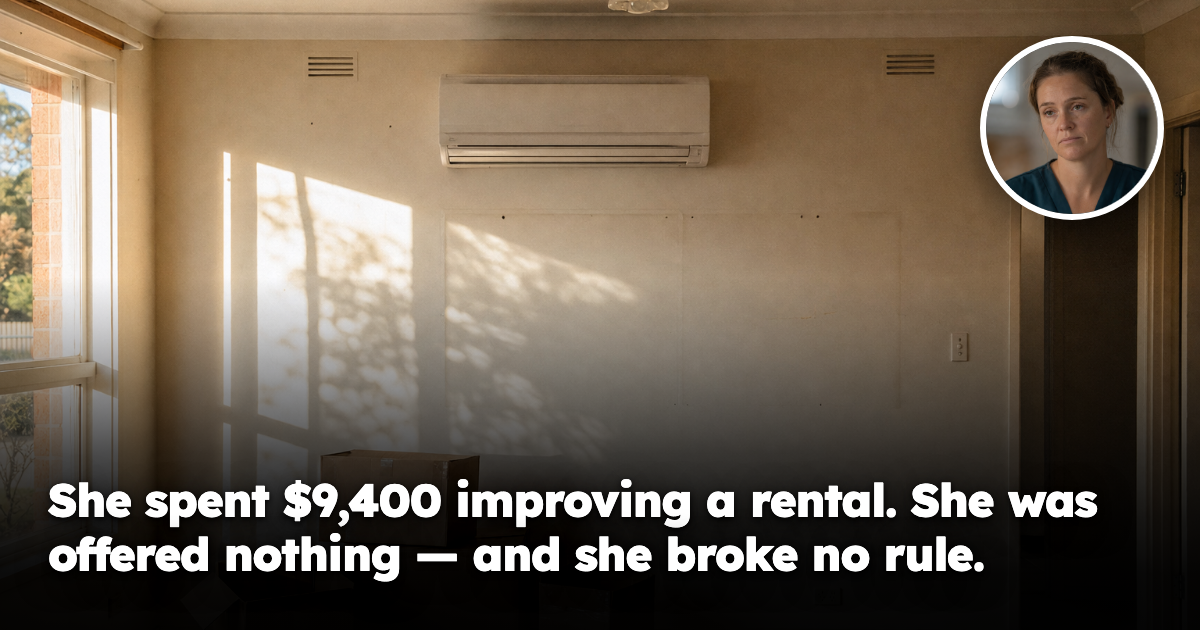
She is 34, a veterinary nurse, and she rented the same three-bedroom house for six years. Not a stopgap. A home.
The house was sound but bare. No cooling in a west-facing living room that hit the high thirties by four in the afternoon. A kitchen with a gap where a dishwasher should be. A back step with no handrail, which mattered once her mother started visiting with a walking frame.
So she did what a long-term tenant does when the landlord is pleasant and nobody wants to move. She asked. The agent said, by phone, words to the effect of yes, that's fine, go ahead. She organised a licensed electrician for a split system, a plumber for the dishwasher, and a handrail bolted properly into the brickwork.
Total, across four years: $9,400.
When she gave notice this year, she asked whether she'd be compensated for the air conditioner and dishwasher, or could take them with her. The answer was no to both. She hadn't been ambushed by a hidden clause. She hadn't breached anything anyone was chasing her over. She simply had no written agreement — and in this division of the law, the written agreement is not paperwork. It is the only place her rights ever existed.
Her question, which we get in some version most months:
"I improved someone else's asset with my own money, with their blessing, and I've got nothing to show for it. How is that the outcome?"
The answer: the compensation right is a clause, not a law
The rules for attaching a fixture to a rental read, at first glance, like a tenant-protective scheme. A tenant may request approval in an approved form. The landlord must decide within 28 days. The landlord must not act unreasonably in refusing. In a body corporate, the landlord must pass the request on within 28 days and report back. And if a request is refused, the tenant can go to a tribunal, which may make any order it considers appropriate.
That is a genuine, workable process. It works when used. But look at where the money sits.
If the landlord agrees, the agreement must be in writing, must describe the fixture, and must state any conditions. Those conditions may include maintenance obligations. They may include whether the tenant is allowed to remove the fixture. And where removal is not allowed, the conditions may include that the landlord is obliged to compensate the tenant for any improvement the fixture makes to the premises.
The whole story is in the verbs. The form requirements are must. The compensation is may — a permitted condition of a written agreement, not a freestanding duty owed by every landlord to every tenant who improves a property.
No written agreement, no conditions. No conditions, no compensation clause. No clause, nothing to enforce. Her verbal yes created goodwill. It did not create a right.
Then there's the part almost nobody has read
Now assume the tenant didn't ask at all, or went beyond what was agreed. You'd expect a breach notice, maybe a claim for the cost of putting things back.
The law offers the landlord something else entirely. Where a tenant attaches a fixture without the required agreement, the landlord may waive the breach and treat the fixture as an improvement to the premises for the landlord's benefit — expressly instead of taking action for breach.
Consider what that means commercially. A tenant installs a $6,000 split system without paperwork. The landlord can chase a breach, argue about restoration and end up with a hole in the wall — or waive it, keep the unit and own an improved asset. The second option isn't a concession. It's the better deal, and the statute names it.
There is no matching provision the other way. Nowhere does the tenant get to say I'll waive your breach and keep the value.
This is why the paperwork is not bureaucracy. The written agreement is the tenant's only mechanism for capturing the value of their own money. Skip it — even with the friendliest landlord alive — and the default is total transfer.
To be fair in both directions: none of this makes landlords villains. A landlord who inherits a dishwasher they didn't ask for must maintain, insure and eventually replace it — an obligation as well as an asset. Unapproved structural work can be dangerous and can void insurance. Someone has to be accountable for what gets bolted to a building. And there is a real, separate gateway: a fixture may be attached where it is necessary for a tenant's safety, security or accessibility — though the detail of that right sits in a regulation, not the Act, which is why so few people can tell you what it covers.
Her handrail, incidentally, was probably the strongest claim she had. She never made it.
What this means if you own the property
Here's the part investors miss. A tenant who wants to install a split system is telling you something a rent roll cannot: they intend to stay. Tenant-funded improvements cluster where people put down roots — and people put down roots on particular streets, not in particular postcodes.
That is the whole argument for street-level data. Two houses can share a suburb, a median, a growth rate, a catchment and a council, and still be different assets. What they don't share is achieved rent, real vacancy duration, true days on market and tenant tenure. We routinely find a 20–30% spread in effective yield between the best and worst street inside a single suburb — driven by how long tenants stay and how fast a vacancy refills.
A suburb median has never once told you whether a tenant plans to be there in five years.
And the fixtures rules quietly reward the owners on the right streets. Long tenures produce improvement requests. Improvement requests, properly papered, produce a better asset — sometimes at the tenant's expense, more often as a shared arrangement that keeps a good tenant in place for another three years. On a street with twelve-day vacancies and four-year tenancies, that compounds. On a street with five-week vacancies, nobody ever asks to install anything, because nobody expects to stay.
The close
Every rule described here is published. The 28-day window, the unreasonable-refusal bar, the approved form, the written-agreement requirement, the compensation limb and the waiver provision all sit in plain language, free to read, long before they matter to anyone.
That is what makes property a rational asset rather than a gamble. The risks are legible. So are the opportunities — vacancy behaviour, tenure, achieved rent, the difference between one street and the next. None of it is hidden. It is simply unexamined by almost everyone bidding beside you.
Risk you can read is risk you can price. And a priced risk isn't a threat. It's an edge.
Related reading: how the emergency repairs cap works and why the notice order matters, what it actually costs a tenant to end a fixed term early, and the water charge a tenant may not have to pay at all.
She still drives past the house occasionally. The split system is still in the living room window. She paid for it, she chose it, she had it installed properly — and it was never, at any point, hers.
If there's a specific street you're weighing up right now, check its Street Score first — it's free, takes ten seconds, and tells you whether that street is pulling the suburb average up or riding on it.
Frequently asked questions
If a tenant gets verbal approval to improve a rental in Australia, are they entitled to compensation when they leave?
Not on verbal approval alone. The article says compensation only exists if it is part of a written agreement that describes the fixture and its conditions.
What has to happen for a tenant to claim money back for a fixture they paid for?
The landlord’s agreement must be in writing and include the fixture details and any conditions. If the agreement says the landlord must compensate the tenant for the improvement, that clause can be enforced.
Can a landlord keep a tenant-installed fixture if there was no written approval?
Yes. The article says the landlord may waive the breach and treat the fixture as an improvement for the landlord’s benefit instead of taking action for breach.
What should tenants in Australia do before paying for things like air conditioning or a dishwasher in a rental?
They should get the approval and any compensation or removal terms in writing before work starts. Without that, the tenant may end up with no right to remove the fixture or claim reimbursement.
Why does this matter for property investors and landlords?
Tenant-funded improvements can signal longer tenancy and stronger rental stability. The article says good street-level data matters because vacancy length, achieved rent and tenant tenure can vary sharply even within the same suburb.
General information only. It does not take your objectives, financial situation or needs into account, and nothing here is legal, financial, taxation or investment advice specific to your circumstances.