News · 4 August 2026 · 7 min read
'I drove past my own investment property and there was a lockbox on the fence. My tenant had been renting it out for $450 a week more than she pays me — is that even legal?'
She drove past her own investment property and found a lockbox on the fence and suitcases on the lawn. Her tenant had been letting the house at $210 a night — roughly $450 a week more than the rent being paid. The sub-letting breach is the easy part. The costly mistake is what most landlords do next.
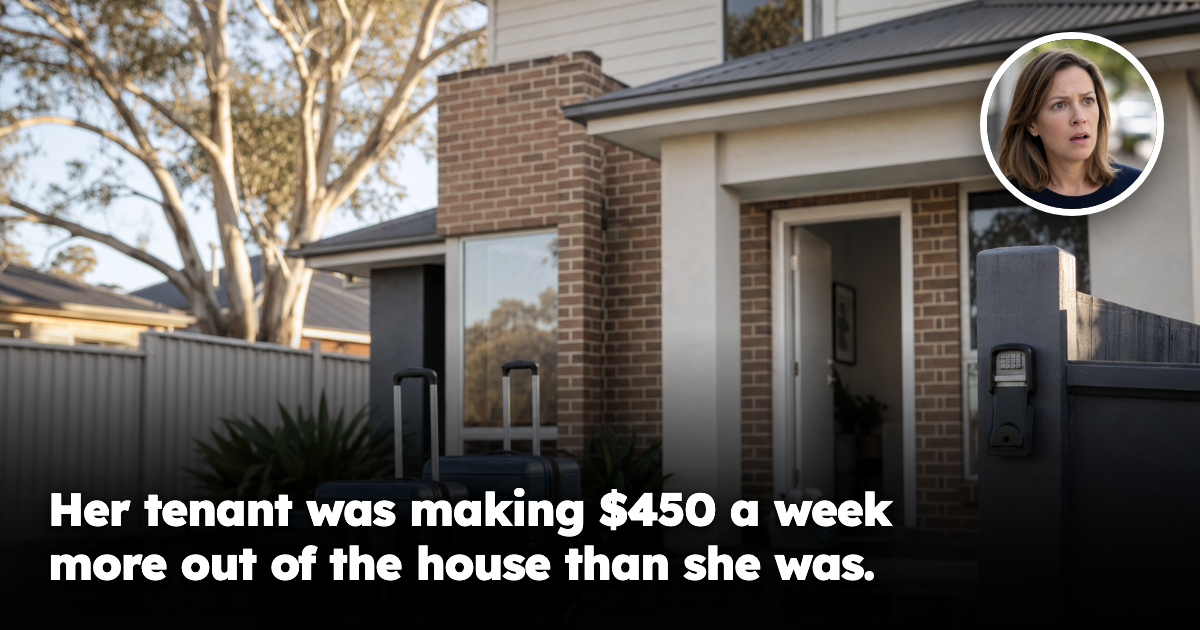
She wasn’t snooping. She was driving her daughter to netball, took the shortcut she’d taken a hundred times, and glanced at the three-bedroom brick-and-render place she’d owned since 2019.
There was a black key lockbox zip-tied to the front fence post. Two matching suitcases on the lawn. A cleaner’s caddy propped inside the open front door, and a woman she’d never met wheeling a vacuum out to a hatchback.
Her tenant of two years pays $610 a week, always on time, never a complaint from the property manager. What she found that night, after twenty minutes on a holiday-letting site, was her own hallway, her own kitchen splashback, and her own back deck — listed at $210 a night with a two-night minimum and a 4.8-star rating from 61 stays.
At 80 per cent occupancy, that’s a little over $1,060 a week coming in. She gets $610 of it.
The question she sent us
“I drove past my own investment property and there was a lockbox on the fence. My tenant had been renting it out for about $450 a week more than she pays me. Is that even legal? And if she can make that much out of my house — should I just be doing it myself?”
We get asked some version of this constantly at the moment, and it’s arriving from two directions at once. Landlords who suspect their tenant has quietly turned the place into a business. And landlords who’ve done the arithmetic on that nightly rate and want to know why they’re leaving it on the table.
Both halves of the question have the same answer, and it isn’t the one most people expect.
The answer: the first half is the easy part
Sub-letting a whole residential property for short stays without the owner’s written consent is, in virtually every Australian jurisdiction, a breach of the tenancy agreement. Standard residential leases require the landlord’s consent to assign or sub-let, and running a whole-of-property nightly letting operation goes well past “having a mate stay over”. The remedy is a breach notice through the property manager, and if it isn’t remedied, escalation to the relevant state tribunal — the same forum that sided with a landlord over $2,400 of bond withheld for a $600 paint job, and the one a tenant would need for $9,400 of improvements made to a rental with no written compensation agreement in place.
So: she has a clear path. But before she took it, we asked her a different question — because the breach notice is a five-minute problem, and the second half of her question is the one with actual money attached.
Her instinct was that the $450-a-week gap was free money she’d been ignoring. It usually isn’t. Strip out the parts the listing doesn’t show you — platform fees, the cleaner between every stay, linen, consumables, higher insurance, utilities she’d suddenly be paying herself, furnishing the place, and the vacancy that arrives the moment the school holidays end — and the gross-to-net haircut on short-stay is brutal. Somebody was making money on her house. It was nowhere near $450 a week, and the person carrying the risk was the one holding the lease, not the one holding the title.
And then there’s the part that isn’t in anyone’s spreadsheet: policy risk. Short-stay letting is currently the most politically exposed corner of Australian residential property. Victoria already levies short-stay accommodation. There is an active, publicly-backed proposal for a 7.5 per cent levy on short-term rentals in New South Wales, pitched as a funding source for homelessness services. Councils in high-tourism regions are tightening caps and permits, and the political appetite for restricting nightly letting is rising, not falling — because in the towns where it’s concentrated, it is visibly competing with long-term housing.
Building an investment case on a cash-flow stream that four different levels of government are actively trying to tax or cap is a strategy with a countdown clock on it.
Where the real answer lives: the street, not the suburb
Here’s the part that made her sit up, and it’s the part suburb-level data will never show you.
Short-stay saturation is not a suburb phenomenon. It’s a street phenomenon.
When we run our research engine across a market, we’re scoring at street level — and in coastal and tourism-adjacent suburbs the divergence inside a single postcode is extraordinary. One street, three hundred metres from the beach path, can be carrying a heavy concentration of nightly-let dwellings. The street two blocks back — same suburb, same school catchment, same postcode, same median on the portal — is almost entirely owner-occupied and long-term rented.
Those two streets look identical in a suburb report. They behave like different asset classes. It’s the same effect we mapped when we compared five NSW towns and found the real story was in the streets rather than the suburb averages.
The saturated street has more transient occupancy, weaker long-term tenant demand, higher effective vacancy in the off-season, more churn, and a buyer pool at resale that is disproportionately made up of other short-stay operators — which is precisely the buyer pool that evaporates the day a levy or a permit cap lands. The quiet street two blocks back has stable owner-occupier depth, a tighter long-term rental market, and a resale buyer pool of families who don’t care what the levy does.
Same suburb. Same median. Completely different risk profile, and completely different exit liquidity. This is the entire reason we score streets rather than suburbs — the gap between the best and the worst street inside one suburb is routinely wider than the gap between two suburbs people agonise over choosing between. If you’re comparing markets on a suburb median, you’re looking at an average of two things that shouldn’t be averaged — the same trap that makes a headline national figure of −0.4 per cent hide suburbs that are still running hard.
Her property, as it happens, sits on the quiet side. That’s why it rents reliably at $610 to a long-term tenant. It’s also, ironically, exactly why her tenant’s short-stay operation worked — a genuinely nice street, close enough to the drawcard, without the transient churn.
What this means for you
Three things, in order.
Check your lease and check your listings. If you own an investment property, spend ten minutes searching the major holiday-letting platforms for your own street, your own floorplan, your own splashback. It costs nothing. If something turns up, it’s a breach notice through your property manager, not a confrontation on the front lawn.
Don’t confuse a gross nightly rate with a return. The headline number on a listing is revenue, not profit, and it is carrying operating costs, vacancy seasonality and a genuine, escalating policy risk that a long-term lease simply does not carry. Long-term rental fundamentals, by contrast, are about as strong as they have been in a generation — rents are at records in every capital.
Buy the street, not the story. Whether a property is a good hold has almost nothing to do with which letting model is fashionable this year, and almost everything to do with the fundamentals underneath it — owner-occupier depth, long-term rental demand, supply pipeline, days-on-market, and the quality of the specific street it sits on.
The bottom line
This story reads like a cautionary tale about landlords getting done over. It’s actually the opposite.
Her asset performed exactly as it was supposed to. It attracted a reliable long-term tenant at a fair rent, on a street with real underlying demand — demand so real that someone else built a business on top of it. She didn’t need a nightly-let strategy or a policy tailwind or a clever structure. She needed a well-chosen property on a well-chosen street, and she’d already had one for seven years without fully understanding why it worked.
That’s the whole game, and it’s why property remains one of the most forgiving asset classes in the country for investors who do the work upfront. The headlines will keep cycling — levies, reforms, forecasts, four straight months of softening national prices. None of it changes the mechanics, and most of the loudest 2026 headlines have already been wrong once. Well-researched property on the right street, held with the right structure, has compounded through every one of those cycles, and most Australian owners are still comfortably ahead.
The investors who get hurt are the ones chasing a yield story. The investors who do well are the ones who know, street by street, exactly what they own and why.
If there's a specific street you're weighing up right now, check its Street Score first — it's free, takes ten seconds, and tells you whether that street is pulling the suburb average up or riding on it.
Frequently asked questions
Is it legal for a tenant in Australia to sub-let an entire investment property as a short-stay rental without the owner's consent?
In virtually every Australian jurisdiction, no. The article says whole-of-property short-stay sub-letting without the owner's written consent is a breach of the tenancy agreement and can be dealt with through a breach notice and, if needed, the relevant state tribunal.
What should a landlord do first if they suspect their tenant is listing the property on a holiday-let site?
The article says to check the lease and search the major holiday-letting platforms for the property, its street, and its floorplan. If a listing is found, the next step is a breach notice through the property manager rather than confronting the tenant directly.
Why isn't the nightly rate on a short-stay listing the same as profit for the owner?
Because the gross rate does not include platform fees, cleaning, linen, consumables, higher insurance, utilities, furnishing costs, or vacancy periods. The article says the short-stay gross-to-net haircut can be brutal, and the person taking the lease risk is not necessarily the one keeping the money.
What is the main risk of relying on short-stay rental income in Australian property?
The biggest risk is policy exposure. The article says short-stay letting is politically exposed, with Victoria already levying it, a proposed 7.5 per cent NSW levy, and councils in tourism areas tightening caps and permits.
Why does the article say investors should look at the street, not just the suburb?
Because short-stay saturation can vary dramatically from one street to the next, even within the same suburb and postcode. The article says those streets can have very different vacancy, tenant demand, resale buyers, and risk if levies or permit caps are introduced.
General information only. It does not take your objectives, financial situation or needs into account, and nothing here is legal, financial, taxation or investment advice specific to your circumstances.