
News · 25 August 2026 · 4 min read
She was told her rental home was not safe. Tasmania’s new rule changes who gets the final say
Tasmania’s new rental-safety rules give tenants a 14-day pathway for reasonable furniture modifications. The fairness fight for renters and owners comes down to the address-level details.
She was told her rental home was not safe. Tasmania’s new rule changes who gets the final say
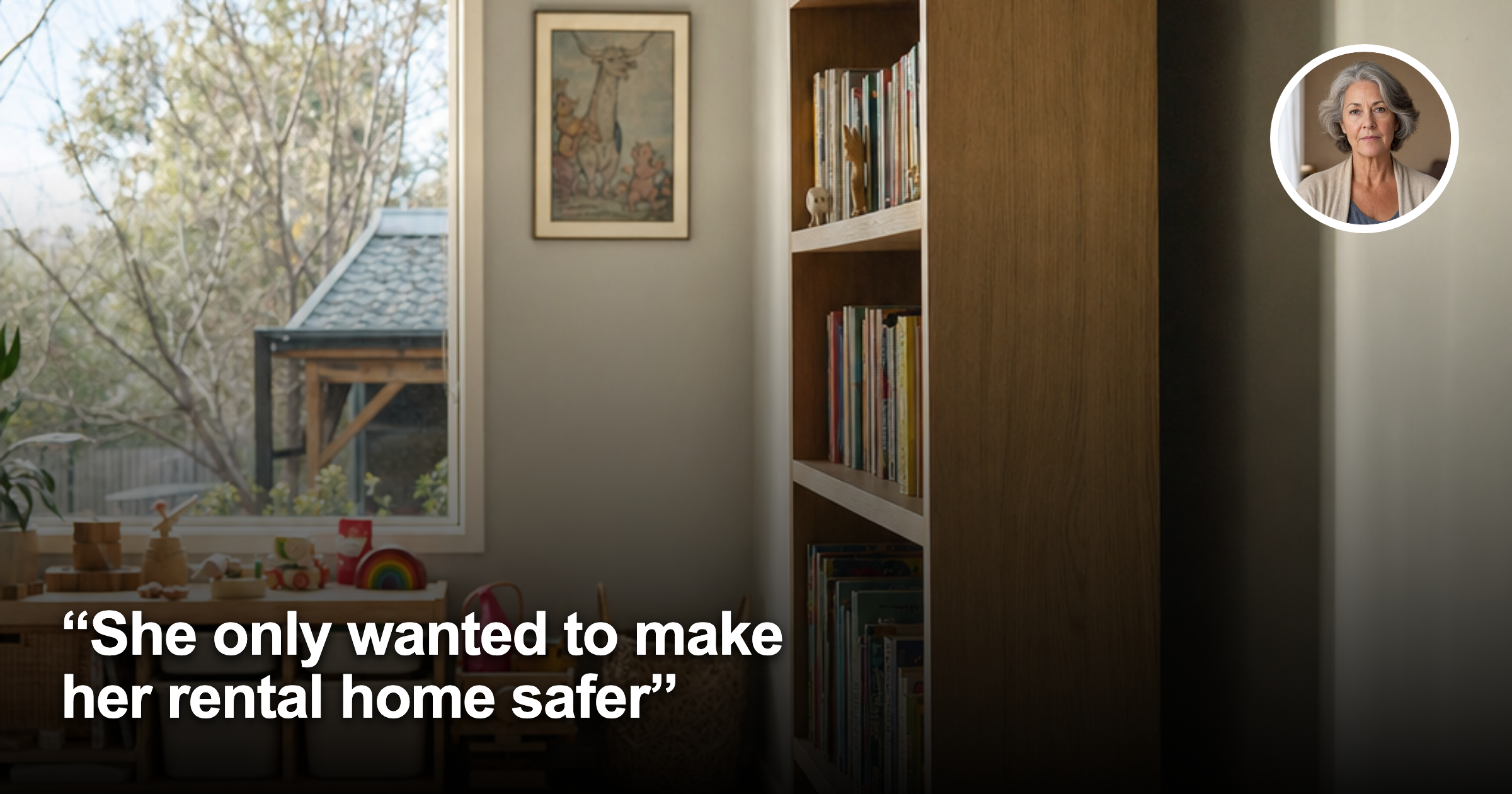
When a 62-year-old recently widowed renter asked whether she could anchor a tall bookcase to the wall, the answer she expected was simple: ask the owner and wait.
The problem was that waiting was part of the risk. The bookcase stood in a narrow room, close to where her grandchildren played when they visited. She was not asking to renovate the property or change its character. She wanted to stop a heavy piece of furniture from tipping.
That small request sits inside a much bigger argument about Australian renting: when a tenant is trying to make a home safer, should an owner be able to say no, or can the law protect safety without turning every landlord into an unwilling renovator?
What has changed?
Tasmania has passed new rental-safety laws aimed at making it easier for tenants to secure heavy furniture. The rule separates work that leaves no permanent damage from work that does.
If a tenant can affix furniture without causing permanent damage, consent is not required. If the installation will leave permanent damage, the tenant must seek approval. The owner must respond to a formal request within 14 days and cannot unreasonably refuse it.
If the tenant believes a refusal is unfair, the dispute can be taken to the Residential Tenancy Commissioner. The tenant is still responsible for repairing damage when the tenancy ends, and a landlord can make a claim against the bond if that repair is not completed.
The political fight is obvious. Tenants see a basic safety decision finally being treated as their decision. Owners see another rule that can create cost, uncertainty and a new path into a dispute. Both concerns are real, but the detail matters more than the slogans.
Is this a win for renters or another risk for owners?
It is both a protection and a test of management.
For a tenant, the important change is that “no” is no longer the easiest answer when a safety modification is reasonable. A request has a time limit, a refusal must be reasonable where permanent damage is involved, and there is an escalation path.
For an owner, the new rule does not make the tenant responsible for every consequence. The tenant still carries the repair obligation. The sensible response is to create a clear written process: describe the furniture, identify the fixing method, state whether the work is reversible, and keep a record of the condition before and after the installation.
That process is especially important because a dispute rarely arrives as one isolated hole in a wall. It arrives after a difficult tenancy, a rushed inspection or a disagreement over what counts as “permanent”. Good documentation protects the relationship and the asset.
The suburb average will not answer the investment question
This is where broad property commentary often misses the investor’s real problem. A state-wide rental rule tells you the legal framework. It does not tell you how a particular property will perform.
At Ripehouse Advisory, the practical question is what happens at street level. Is the home attracting families who value a safer layout? Is the rental stock older and more likely to need modifications? How quickly do comparable homes lease, what is the achieved rent rather than the advertised rent, and how many suitable alternatives are available within the same school and transport pocket? That is the same address-level test investors should apply when rental reforms change the balance between owners and tenants.
Two properties in the same suburb can face very different tenant demand. One may have a flexible living area, secure storage and a layout that makes safety work straightforward. Another may have narrow rooms, older fittings and a history of repeated maintenance disputes. A suburb vacancy figure cannot separate those assets.
Street heatmaps, days-on-market, achieved-rent records and supply-pipeline data can. They can also show whether a safety-focused upgrade is likely to improve tenant retention or simply add cost without changing the depth of the renter pool.
That is the line between a political headline and an investment decision. The headline tells you what the rules say. The address-level evidence tells you whether the property can absorb the rules and still produce a resilient outcome.
What should a landlord do now?
First, review the property for obvious safety issues before a tenant has to raise them. Second, give tenants a written channel for modification requests and respond within the required timeframe. Third, distinguish reversible work from permanent work instead of rejecting every request automatically. Finally, photograph the relevant wall, fitting and furniture before approval and again when the tenancy ends.
For tenants, put the request in writing and be precise. Explain the risk, the proposed fixing, who will do it, whether it can be removed, and how any marks will be repaired. A reasonable request is easier to assess than a general demand to alter the home.
The broader lesson is uncomfortable for both sides. A rental property is an investment, but it is also a home. Rules that recognise safety do not automatically destroy an owner’s return; rules that ignore safety do not automatically protect it. The outcome depends on the property’s condition, the tenant pool and the quality of the process around it.
For investors, that is encouraging rather than alarming. The right asset on the right street, measured with the right local data, can handle changing rules far better than a property chosen on a suburb median alone. As with any property decision shaped by changing regulation, property investment still rewards preparation: understand the law, test the address and buy where the evidence supports durable demand.
If there's a specific street you're weighing up right now, check its Street Score first — it's free, takes ten seconds, and tells you whether that street is pulling the suburb average up or riding on it.
Frequently asked questions
What are Tasmania’s new rental-safety rules for anchoring heavy furniture?
Tasmania now separates furniture fixes that cause no permanent damage from those that do. If there is no permanent damage, the tenant does not need consent; if there is permanent damage, the tenant must ask the owner first.
How long does a landlord have to respond to a tenant’s request under the new Tasmania rule?
The owner must respond to a formal request within 14 days. If the tenant thinks a refusal is unreasonable, the dispute can be taken to the Residential Tenancy Commissioner.
Can a landlord refuse a request to anchor furniture in Tasmania?
Yes, but not unreasonably when the work would cause permanent damage. The new rule is designed to stop safety-related requests being refused automatically.
Who is responsible if wall damage is left after a tenant installs furniture?
The tenant is still responsible for repairing any damage when the tenancy ends. If the repair is not completed, the landlord can make a claim against the bond.
What should landlords do now to manage furniture modification requests in Tasmania?
They should use a clear written process, check whether the work is reversible, and keep records before and after installation. The article also says documentation is important because disputes often turn on what counts as permanent damage.
General information only. It does not take your objectives, financial situation or needs into account, and nothing here is legal, financial, taxation or investment advice specific to your circumstances.