News · 11 August 2026 · 8 min read
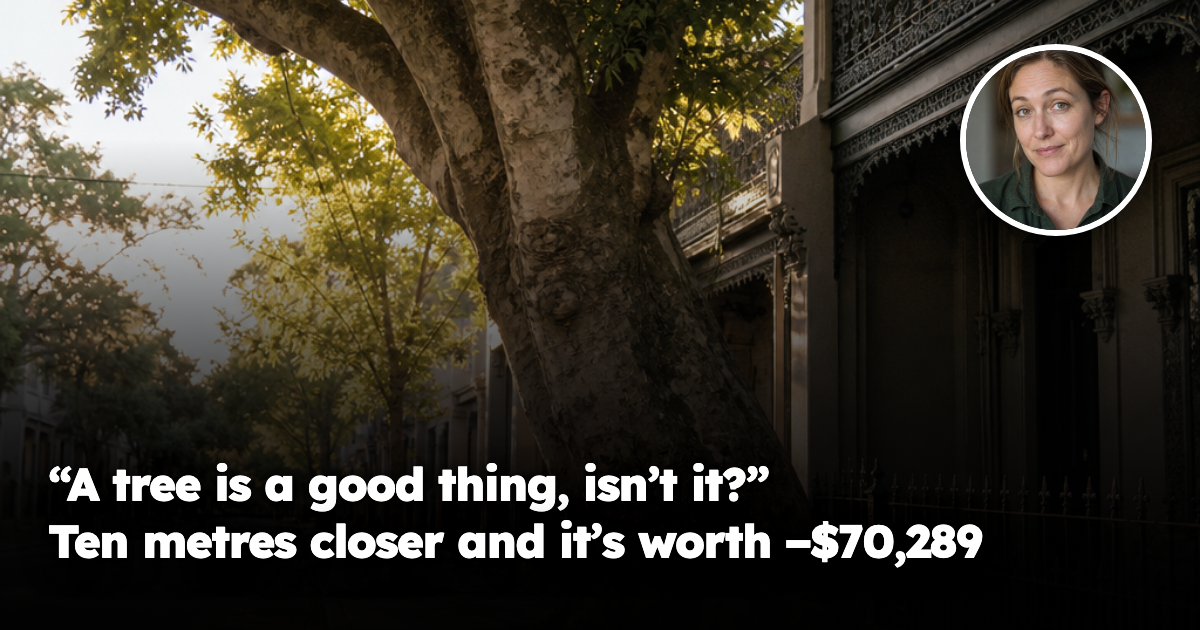
'A tree is a good thing, isn't it?' A Sydney owner asked us about the sapling going in on her verge
A council notice said a replacement tree was going in on her verge. She assumed that was good news. Then she found research measuring the effect of a single street tree on sale price - and discovered the whole outcome turns on a distance no suburb report has ever contained.
She started the email with an apology. She thought it was a stupid question.
A council notice had arrived telling her a replacement street tree was scheduled for the verge outside her inner-west terrace. There was a consultation window. She could write in, or say nothing and let it happen.
Her instinct was to say nothing, because a tree is a good thing. Shade in February. Birds. The street looks better. She owns the terrace and one investment property two suburbs over, and in nine years she had never once thought of a tree as a financial variable.
Then someone at work mentioned they'd read that trees can knock money off a house, and she couldn't work out whether that was true, whether it applied to her, or whether asking made her sound like someone who hates trees.
It is not a stupid question. It's one of the sharpest we've been asked this year, because the honest answer is a number, the number is large, and it turns on something almost nobody measures.
The answer is yes, and the variable is metres
Here is the finding, from peer-reviewed research published in an urban-planning journal.
Researchers took 1,568 property sales in one inner-Sydney local government area between January 2021 and August 2024 and matched them against council mapping of more than 48,000 street trees. They controlled for the things that obviously drive price — bedrooms, bathrooms, parking, land size, distance to transport and schools — then asked what a single public street tree does to a sale price depending on how far away it is.
A single street tree within 10 metres of the centre of a home was associated with a price 2.69% lower. In a market with an average house price of $2,613,000, that is about $70,289.
The same tree, 10 to 20 metres away, was associated with a price 1.16% higher. About $30,310.
Read those two sentences again, because the gap between them is roughly $100,000 and the only thing that changed was the distance.
Beyond 20 metres the effect on the individual property faded to marginal — but the researchers noted it still contributed to the location value of the whole street. The tree stops being about your house and starts being about your address.
Why proximity flips the sign
This is not a story about people disliking trees. The same body of work found canopy makes streets more desirable, and the market pays for that.
It's a story about what a large living object does at close range. Roots and drainage. Roots and underground services. Branches over a roofline. Light into front rooms. The view now, and the view in fifteen years when the thing is twice the size. The wrong species too close to a building is a maintenance liability with a root system, and buyers price liabilities.
Then the detail that made this owner sit up. The average lot in the study area is 176 square metres, and the average distance from the centre of a home to its own boundary is about 8 metres.
Think about that. The boundary is 8 metres from the middle of the house. The verge is just past it. So a street tree planted directly out the front isn't near the 10-metre line — it is inside it, automatically, by geometry. On those blocks the penalty band isn't an edge case. It's the default.
Which is why "a tree is a good thing" and "that tree is worth minus $70,000" are both true statements, about different trees, on the same street.
The part that should bother every investor
Now hold that finding next to the way property is actually researched.
An investor looking at this suburb would pull a median price, annual growth, rental yield, vacancy rate, days on market, maybe demographics. Every one of those numbers is computed across the whole suburb. Not one contains a distance in metres from a front door to a tree trunk.
And yet the research measured an effect worth around 2.7% of a home's value — on a $1.2 million house, roughly $32,000 — driven by a variable that changes house by house along a single street. Not suburb to suburb. Not street to street. Door to door.
This is the structure we keep running into. When we've written about how a renovation can move you to the top of your street's range without moving the range itself, or what happens to a buyer pool when something large gets built behind the back fence, the mechanism is identical: the thing that decided the outcome was never in the suburb data, because a suburb average is built by adding up houses that behave nothing alike and dividing.
Trees are the cleanest example we've found. Most location factors have to be argued — you can debate whether a road is too busy or an aspect is poor. This one was regressed against 1,568 actual sales and came out as a function of distance in metres. That street- and property-level resolution beats suburb averages isn't an opinion here. Somebody measured it and published the coefficient.
Be precise about the limits, though. This is one study, one inner-city market, high medians, small lots, a specific species mix. The exact percentages will not transfer to a Perth greenfield estate or a Brisbane Queenslander on 600 square metres. What transfers is the shape: a single fixed object metres from your building can move the sale price by low single-digit percentages in either direction, and which direction depends on measurement, not sentiment.
That is what our research process is built to look at — the assessment below the suburb, at the level of the actual street and the actual block, where the gap between the best and worst positions in one postcode routinely runs to 20–30% on effective yield once you use achieved rents, real vacancy duration and real days on market instead of suburb averages. The verge out the front is one more item on that list, and now it's a quantified one.
What it doesn't mean: reach for the chainsaw
We need to be blunt, because the news this month makes it necessary.
A court in Sydney has just fined a man $187,500 over the clearing of 287 trees from council-owned foreshore bushland — around 1,210 square metres stripped beside a waterfront property, to open up water views. The court heard the site could take about 30 years to recover. The council called it the worst act of environmental vandalism in its history. The work began as a job to trim some grass.
That is what this looks like when somebody treats a measured price effect as a licence.
Set the ethics aside and just do the arithmetic. The measured penalty for a badly placed street tree was around $70,000. The penalty imposed by that court was $187,500 — before legal costs, before remediation, before the fact that the trees are gone for three decades and the reason is now on the public record attached to the address.
An owner who removes or damages a protected tree, on public land or often on their own, is not capturing 2.69%. They are buying a prosecution, a restoration order and a disclosure problem. A lot of otherwise sensible people have destroyed far more value in this lane than they were chasing.
The finding is not an instruction to remove trees. It's an instruction to know what is there, and what is coming, before you buy or before a consultation window closes.
What we told her to do
Four things, none involving a chainsaw.
Find out the species and the position. "Replacement street tree" is not a single outcome — location along the verge and mature size are the whole question. Councils publish street-tree strategies and species lists, and will usually tell you exactly what is going in where if you ask during the window.
Measure it yourself. Not from the fence — from the centre of the house, which is how the research measured it. On a small lot geometry may have already decided it, in which case the useful conversation is about species and setback, not whether a tree goes in at all.
Use the consultation window rather than resenting it later. A polite, specific submission about position and species is a normal planning interaction and dramatically cheaper than every alternative.
Then apply it to the property you actually earn from. She had never looked at the verge of her investment property. That's where a fixed 2–3% drag matters most, because it compounds against a leveraged asset she plans to hold another decade — the same habit as checking your holding costs before they surprise you.
The reframe
Her question was whether a tree is good or bad for her house. The better question, worth carrying into every purchase, is: which of the things that will decide this property's value are measured, and have I looked at any of them?
Because the encouraging half of this research is the half nobody quotes. If a badly placed tree is worth roughly minus $70,000 and a well-placed one plus $30,000, then canopy is not a risk factor. It is a priced characteristic the market is currently getting wrong in both directions — some homes discounted for a real proximity problem, others sold at full price with a verge that will be a problem in ten years, and a third group carrying genuine, measurable, permanent locational advantage that no suburb report will ever show a competing buyer.
That third group is the entire opportunity. And canopy is being actively increased almost everywhere — capital-city councils have committed to raising it for decades ahead, with hot days forecast to become more frequent — so well-treed streets at sensible setbacks are getting more valuable, not less. The policy direction is one-way.
That is not an argument against owning property. It is the plainest argument we have for owning a specific one, chosen deliberately. The owner who knows what is on the verge, what is coming, and how far it sits from the middle of the building holds a better asset than the neighbour who bought the same suburb and got a different result.
She apologised for asking about a tree. Without meaning to, she had asked the only question that matters: what is actually on this street, and has anybody measured it?
If there's a specific street you're weighing up right now, check its Street Score first — it's free, takes ten seconds, and tells you whether that street is pulling the suburb average up or riding on it.
Market data & R-Scores for locations in this article
Drill Down Into the Markets Mentioned Above
Inspect live monthly R-Scores, median prices, rental yields, and street-by-street scores for the cities and council areas referenced in this article:
Frequently asked questions
Can a street tree in Sydney really affect a home's sale price?
Yes. In the inner-Sydney study, a single public street tree within 10 metres of the centre of a home was associated with a 2.69% lower sale price, while one 10 to 20 metres away was associated with a 1.16% higher price.
Why does the distance to the tree matter so much?
The article says close trees can create maintenance and amenity issues such as roots, drainage, branches over the roofline and reduced light. Once the tree is further away, it can add to the street’s appeal without sitting right against the home.
Why might a replacement tree on a verge be more relevant than it sounds?
On the small lots in the study area, the verge out the front could easily fall inside the 10-metre band from the centre of the house. That means a tree planted directly outside may have a property-specific effect, not just a general street appeal effect.
What should an owner do during a council tree consultation window?
The article suggests finding out the species and exact position, measuring the distance from the centre of the house, and making a specific submission if needed. That is cheaper and safer than doing nothing and regretting the outcome later.
Does the article suggest removing or damaging a tree to protect value?
No. It warns against that approach, noting a Sydney court fined a man $187,500 over clearing council-owned foreshore bushland. The article says the point is to know what is there and what is coming before you buy or before the consultation closes.
General information only. It does not take your objectives, financial situation or needs into account, and nothing here is legal, financial, taxation or investment advice specific to your circumstances.