News · 17 August 2026 · 5 min read
'My builder sent me a $38,000 variation for rock. I asked one question and it disappeared'
A builder billed $38,000 for rock found after signing. The law required that ground to be investigated and costed before the contract existed — and bars charging for what the investigation should have revealed.
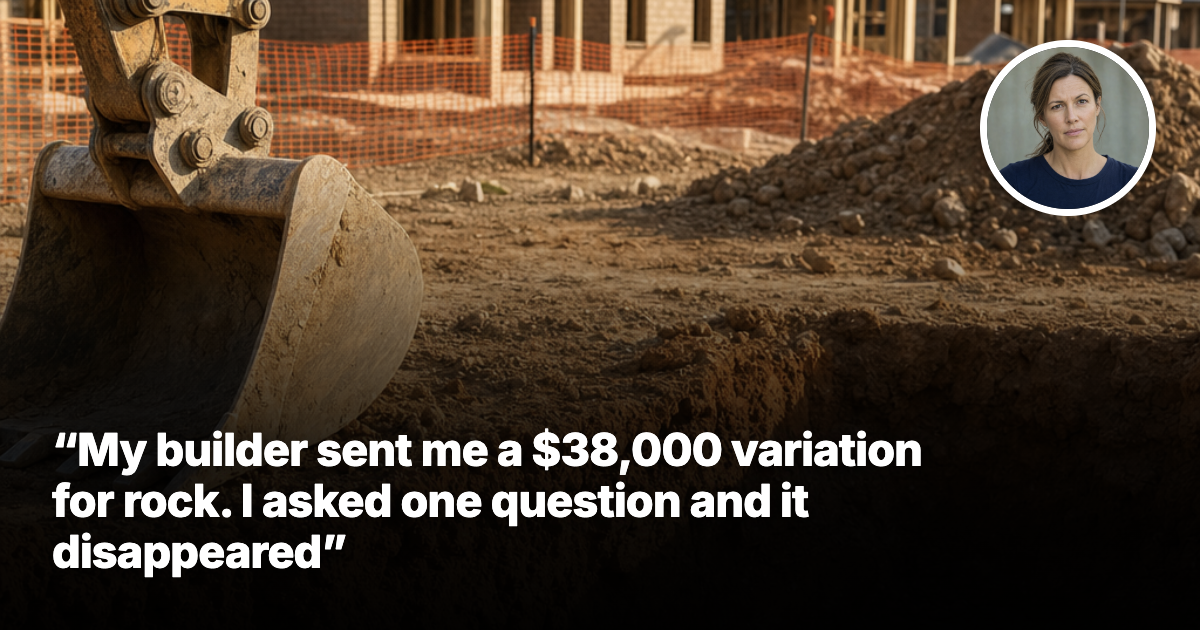
She had budgeted for a build to go slightly over. Everybody tells you that. What she had not budgeted for was a single-line invoice arriving eleven weeks after she signed, for a condition that had been sitting under her block since long before either of them saw it.
The situation
The owner is in her early forties, a first-time builder rather than a first home buyer — she already owned one older investment property and had decided that this time she would build new. Outer-growth-corridor block, 512 square metres, registered land, a volume builder's mid-tier double-storey plan. Fixed-price contract signed in autumn: $684,000, with the usual schedule of allowances attached.
Site works started. Eleven weeks after signing, an email arrived with a variation notice: $38,000, described as additional excavation and footing works "due to rock and unsuitable material encountered at depth".
She rang the builder's client liaison and got the answer everybody gets. Ground conditions are unknowable. Every contract has this risk. It is nobody's fault. If she wanted to proceed, she needed to sign and return the variation.
The question she asked us
"Is $38,000 for rock just something you have to accept when you build? Or is there a version of this where I don't pay it?"
There is. And the thing that decides it is not negotiation, goodwill, or how firmly she pushed back. It is a question about a document that was supposed to exist before she signed anything.
The answer
Most people assume a builder's obligation to investigate a site begins when the excavator arrives. In a major domestic building contract, it does not. It begins earlier — and it is framed as a duty, not a courtesy.
Where the work requires footings to be built or altered, or may adversely affect existing footings, the builder must obtain foundations data for that site before entering into the contract. Not before starting work. Before signing.
And "foundations data" is defined much more broadly than most owners expect. It is the information a builder exercising reasonable care and skill would need in order to prepare two things: a proper footings design for the site, and an adequate estimate of the cost of constructing those footings. Costing is written into the duty. The obligation was never just to work out what to build — it was to work out what it would cost, before quoting a price.
The provision goes further and tells the builder what to have regard to when deciding whether they have gathered enough. Relevant Australian Standards. Whether engineer's drawings and computations are needed. Whether a drainage plan is needed. And explicitly: the need for information on the fall of the land on the site.
Then comes the part almost nobody knows exists. After the contract is signed, the builder cannot seek money from the owner that is not already provided for in the contract, if that additional amount could reasonably have been ascertained had the builder obtained all the foundations data the section required.
Read that again as a homeowner rather than as a lawyer. The blow-out most likely to happen to you is also the blow-out the law is least willing to let a builder charge you for. Not because the cost isn't real — rock is real, excavation is expensive — but because the entire point of the duty is that this specific category of cost was supposed to be discovered and priced before you were asked to commit to a number.
There is a second lock. Where a builder wants to vary the plans or specifications, they must give written notice describing the variation, why they want it, its effect on the work and permits, any delay, and its cost and effect on the contract price. Then: a builder is not entitled to recover any money in respect of a variation unless they have complied with that process and can establish that the variation was made necessary by circumstances that could not have been reasonably foreseen at the time the contract was entered into. A tribunal can override that in exceptional-hardship cases, but only where it would not be unfair to the owner.
So the builder's own framing — ground conditions are unknowable — is not a defence. It is the exact issue in dispute. The statutory test is not whether the rock was inconvenient. It is whether it was reasonably ascertainable from an investigation that was legally required before pricing.
One important boundary: this variation machinery does not apply to contractual terms dealing with prime cost items and provisional sums. Allowances are a separate mechanism with separate rules, which is why so many disputes turn on whether a charge is really a variation or an adjustment to an allowance. Labelling matters, and it is not always chosen in your favour.
Her one question was simple: may I have a copy of the foundations data you obtained for this site before we signed, including the footings cost estimate? Owners are entitled to a copy of foundations data the builder obtained. The variation was withdrawn.
What this means for you — and where the money actually is
Here is the part that outlives the dispute.
That investigation is not a formality. It produces a per-lot engineering fact — a site classification that dictates the footing system your block requires — and it can differ between blocks four doors apart in the same estate. Fall of land, depth to rock, fill history, drainage path, reactivity: all measured at the parcel, all invisible above it.
This is the same structural truth we find everywhere in our research. A suburb median averages together properties whose underlying physical facts are not comparable. Two blocks can share a postcode, an estate name, a median, a school catchment and a builder's price list, and be genuinely different assets — which is why we consistently measure a 20–30% spread in effective yield between the best and worst streets inside a single suburb, using achieved rents, real vacancy duration and actual days on market rather than suburb averages and advertised figures.
Build costs behave the same way. The cheapest block in a release is often cheapest because something underneath it is expensive, and that difference gets discovered either by a $38,000 variation or by reading the data first.
None of which is an argument against building, or against property. Rising input costs and tighter contracting rules fall hardest on the marginal project — the one that only worked if nothing went wrong. Well-selected land in a location with genuine scarcity absorbs a bad surprise; a thin site chosen on headline price does not. The opportunity is not in avoiding property. It is in refusing to buy an average.
She researched builders for six months. She never asked for one document about the ground. Almost everyone does it in that order.
If there's a specific street you're weighing up right now, check its Street Score first — it's free, takes ten seconds, and tells you whether that street is pulling the suburb average up or riding on it.
Frequently asked questions
Can a builder in Australia charge a homeowner extra for rock they find after the contract is signed?
Not if that cost could reasonably have been worked out from the site investigation the builder was legally required to do before the contract was signed. The article says a builder cannot seek extra money for a cost that should have been ascertained through the required foundations data.
What is ‘foundations data’ in a domestic building contract?
It is the information a builder exercising reasonable care and skill needs to prepare a proper footings design and an adequate estimate of the cost of constructing those footings. The article says it should be obtained before entering into the contract.
What should a homeowner ask for if they receive a variation for ground conditions like rock?
Ask for a copy of the foundations data the builder obtained before signing, including the footings cost estimate. The article says owners are entitled to a copy of that data.
When is a builder allowed to recover money for a variation to the plans or site works?
The builder must give written notice explaining the variation, why it is needed, its effect on the work, permits, delays and cost. They also need to show it was made necessary by circumstances that could not reasonably have been foreseen when the contract was entered into.
Why does the article say ‘ground conditions are unknowable’ is not a good enough answer?
Because the law requires the builder to investigate the site before pricing the contract, including matters like fall of land, drainage, engineer’s drawings and footing requirements. The question is not whether rock exists, but whether it should have been reasonably discovered and costed before signing.
General information only. It does not take your objectives, financial situation or needs into account, and nothing here is legal, financial, taxation or investment advice specific to your circumstances.