News · 12 October 2026 · 4 min read
She self-manages a $720,000 Melbourne townhouse from interstate. Now there is a three-strike licence plan.
She is 39 and single, and she kept the two-bedroom Footscray townhouse she bought for $720,000 in 2019 when work moved her to Canberra. She manages it herself. Her brother does the inspections. The tenant pays on time and texts her when the hot water plays up.
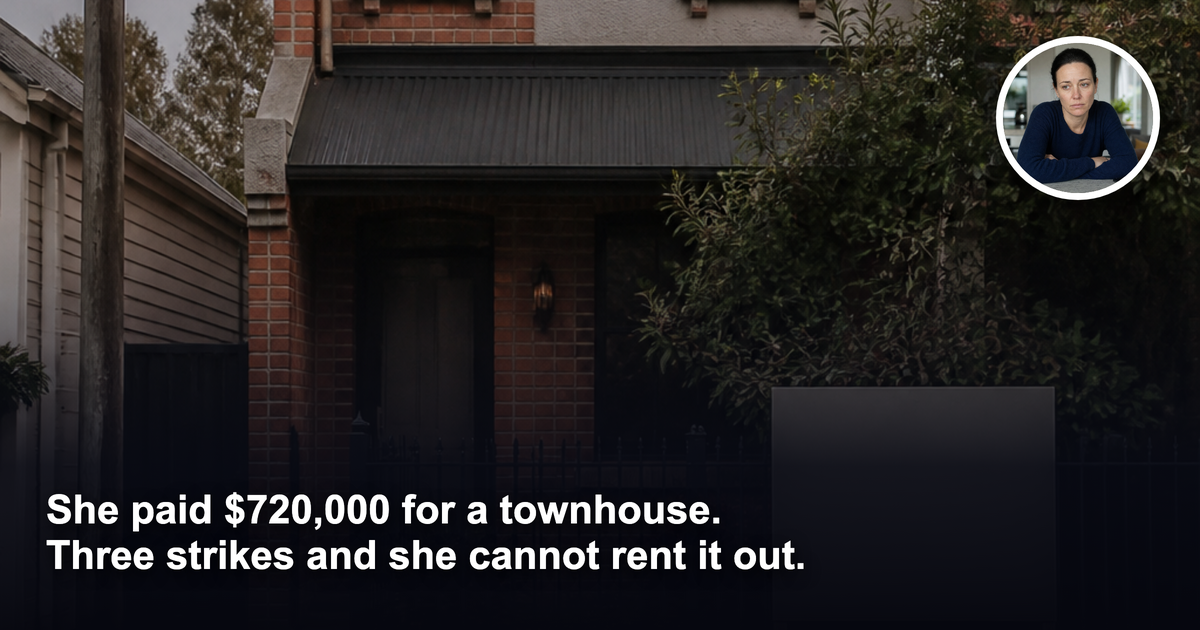
She is 39 and single, and she kept the two-bedroom Footscray townhouse she bought for $720,000 in 2019 when work moved her to Canberra. She manages it herself. Her brother does the inspections. The tenant pays on time and texts her when the hot water plays up.
On Monday she read that Victorian landlords could soon need a licence, with three strikes and then a ban.
She is a composite illustration, not a real person. But the situation is common, and the reaction is predictable.
The question
"I have one rental in Victoria and I manage it from interstate. If I need a licence and three mistakes mean I lose the right to rent it out, do I just sell before this gets worse?"
The answer: read what the story actually says
The licensing scheme is a policy call from the Victorian Greens ahead of a state election, as reported by realestate.com.au on 12 October. The party says licensed landlords would get three strikes before being banned from renting out homes. It estimates $50 million would be needed to establish an independent regulator to run it.
That is the whole of the proposal as reported. No strike criteria. No fee. No start date. No legislation. A party that does not form government has said what it would like to do.
It may become law. It may not. The same article notes the Greens took four rental policies to the last election and three have since been implemented, so this is a party with a record of getting rental ideas adopted. Treat it as a live risk. Do not treat it as a reason to sell a house this month.
Because selling on a headline about a proposal means paying agent commission, marketing, legal costs and possibly capital gains tax to escape a rule that does not exist yet.
The rules that did start this week
The part of the story almost nobody is sharing is the second half.
The Victorian government implemented new rental reforms on the same day. Landlords must now notify renters in advance, with evidence, that they intend to claim on the bond. Landlords and their agents must keep records proving the home was compliant with rental regulations before it was advertised. A gasfitter must check the property within six months before draughtproofing is done, and draughtproofing itself becomes a requirement from 1 July next year.
The minister said the state has now introduced more than 150 renter rights reforms.
Those rules already apply. She is renting under them today, from Canberra, with her brother and a phone.
So the licence is not her problem. Her problem is that she is a one-person compliance department 650 kilometres away, in the most heavily regulated rental jurisdiction in the country, and the paperwork obligations just grew again.
If a three-strike regime ever does arrive, the owners it will find first are the ones already struggling with the current rules. A missed gas check. A bond claim without the right notice. A listing with no compliance record behind it. Each one small. Each one, under a licence scheme, potentially a strike.
What it means for you
Industry groups quoted in the article warn the policy could push investors out of Victoria. One board member called it an overreach and said it could be the final straw for many investors. The Property Council said it would put a stop sign in front of people wanting to build rental homes.
Maybe. But an investor who sells a decent asset because of what someone else might do is handing the decision to a press release.
The better questions are the ones she has not asked yet.
- Is this property managed to a professional standard, with every compliance record kept, or is it managed on goodwill and text messages?
- Is this the right street? Two streets in the same Melbourne suburb can be having completely different outcomes on rent, vacancy and days on market, and the licence debate changes neither.
- Is the whole portfolio in one state, exposed to one parliament's mood?
A good property manager in Victoria already keeps the records the new rules demand. That cost is small next to a single compliance failure. For an owner living interstate, delegating the management is the difference between a rule change being a headache for someone else and a strike against her name.
And an investor whose assets are spread across several states does not have to care very much what one party promises in one election. A Victorian licence would be an inconvenience for one property, not a threat to the plan.
The Ripehouse reframe
Policy risk is real. The way to handle it is structure, not timing.
The right asset, on the right street, held under professional management, with the portfolio spread across jurisdictions, keeps going through rule changes. That approach is how Ripehouse client portfolios have delivered a +19.0 per cent median growth per year on a 5-year rolling basis, against roughly 4.3 per cent nationally (benchmark: CoreLogic/Cotality). Past performance is not a guarantee of future results.
She does not need to sell. She needs to stop being the compliance department.
Want to see how we test a decision like this street by street, state by state, before policy risk becomes a strike? Join Jacob's free live webinar.
If there's a specific street you're weighing up right now, check its Street Score first — it's free, takes ten seconds, and tells you whether that street is pulling the suburb average up or riding on it.
General information only. It does not take your objectives, financial situation or needs into account, and nothing here is legal, financial, taxation or investment advice specific to your circumstances.