News · 1 September 2026 · 4 min read
She paid $31,000 in rent while waiting for a promised home. Who was the promise for?
She paid $31,000 in rent while waiting for the affordable home Australia was promised. The answer reveals what national housing numbers miss at one exact address.
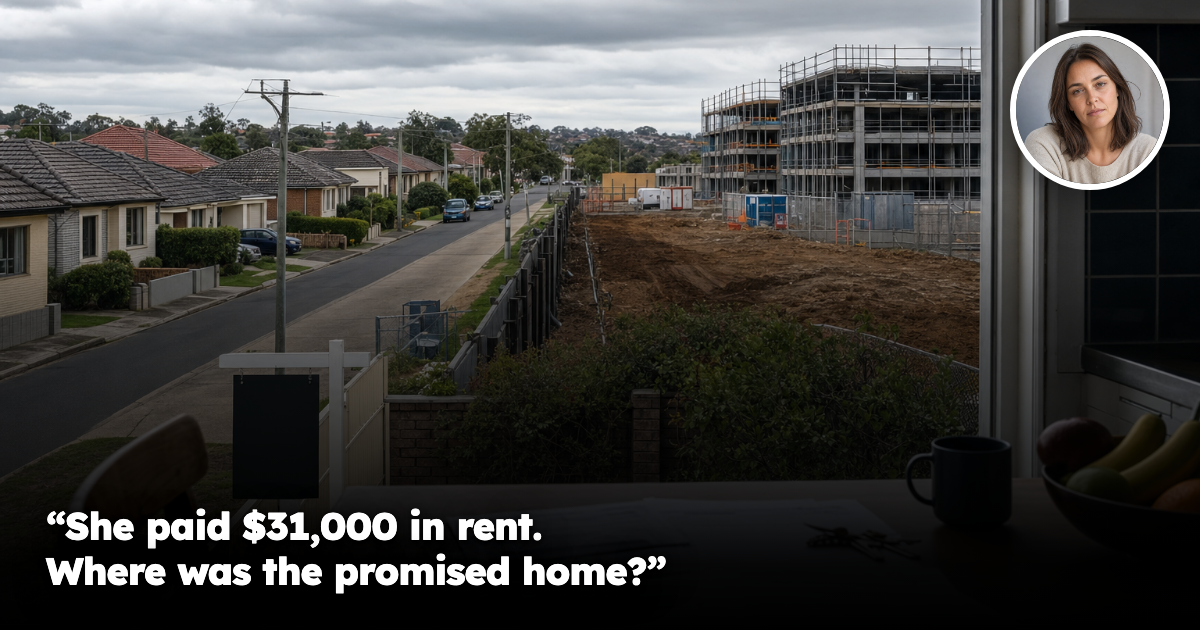
She paid $31,000 in rent while waiting for a promised home. Who was the promise for?
The question
She had done what every housing campaign tells people to do: saved, waited, kept her plans flexible and watched the announcements. Then another year passed. Her rent bill crossed $31,000, the target for new homes moved further away, and the “affordable” options she could actually reach were still on the wrong side of a suburb boundary.
Her question to Ripehouse Advisory was blunt: if governments promise more homes, why does the promise not help when a real household needs one?
The answer
Because a national housing target is a supply ambition, not a property at a usable address. It can measure whether enough dwellings are being added overall, but it cannot tell you whether the new stock is near a train line, within a realistic budget, suitable for a particular household or protected from another wave of price pressure.
That gap is where the politics becomes personal. A headline can say thousands of homes are planned while a household is still choosing between a $610 weekly lease and a long commute from the only cheaper pocket nearby. At $610 a week, 12 months of rent is $31,720 before utilities, moving costs or the next increase.
The target matters. Australia’s promised housing pipeline has been under pressure, with forecasts indicating the national goal is unlikely to be met on its original timetable. But even a successful national number would not distribute homes evenly. New supply can arrive in places with expensive land, weak transport, limited services or a buyer pool deep enough to absorb price rises.
That is why the useful question is not simply “How many homes were added?” It is “What changed on this street?”
The address-level test
Ripehouse Advisory’s research starts below the suburb headline. On one side of a boundary, a two-bedroom unit can attract a steady tenant pool because it is close to a school, shops and a frequent bus route. Six streets away, a similar-looking property can sit longer because the walk is less practical and competing stock is newer.
The difference appears in achieved rents, vacancy, days on market, buyer depth and the supply pipeline—not in a broad suburb median. A national program may increase dwelling numbers while the street-level market still splits into winners and losers.
For an investor, that distinction is not academic. If new housing is concentrated in one pocket, nearby older properties may face extra competition. If the new stock arrives where tenant demand is already deep, it can also improve the area’s services and make the surrounding streets more resilient. The result depends on the exact address, product and timing.
That is also why the political argument is often too simple. More supply is necessary, but “more” does not automatically mean “affordable”, and affordable does not automatically mean “well located”. A household paying rent today cannot use a future dwelling approval as shelter.
What should buyers and investors watch?
First, separate delivery from announcement. Check whether a proposal has land, approvals, funding, a builder and a credible completion path. A glossy pipeline is not the same as a finished home.
Second, test the local renter and buyer pool. Look at achieved—not advertised—rents, vacancy, days on market and the number of comparable properties competing for attention. A property that looks cheap against a city median may be cheap because its exact street has weaker demand.
Third, map the next wave of supply. Apartment approvals, townhouse projects and government-backed development can alter the tenant choice set. They may create opportunity for well-located properties, but they can pressure undifferentiated stock.
Fourth, price the holding period honestly. The household in this story spent $31,720 on rent in a year while waiting. An investor faces a different version of the same problem: every month a property is vacant, delayed or poorly positioned is a month the spreadsheet cannot recover.
The broader lesson is visible in Ripehouse Advisory’s work on why one street can outperform the suburb next door and how buyer depth changes an address’s resilience. Location is not a slogan. It is a measurable pattern of people, money, access and competing supply.
So who was the promise for?
It was for the whole market, which is precisely why it can feel useless to one household. National targets can push governments, unlock infrastructure and create a larger long-term housing base. They do not remove the need to assess the street in front of you.
For the renter, the practical answer is to judge every option by total cost, access and stability—not by the word “affordable” in a release. For the investor, the answer is to find the addresses where supply, transport and demand reinforce one another rather than simply buying the cheapest listing in a broad growth story.
Property remains one of the few assets where disciplined investors can benefit from population growth, rental demand and constrained land over time. The advantage belongs to the person who can identify the right asset on the right street before the headline catches up. More homes may be promised nationally; the opportunity is still decided locally.
If there's a specific street you're weighing up right now, check its Street Score first — it's free, takes ten seconds, and tells you whether that street is pulling the suburb average up or riding on it.
Frequently asked questions
Why did the promised affordable housing not help the renter in this story right away?
Because a national housing target is a supply goal, not a specific home at a usable address. The article says it cannot guarantee location, transport access, affordability for a particular household, or protection from further price pressure.
What is the main difference between a national housing number and what matters to a real household?
A national number shows whether enough dwellings are being added overall, but a household needs a home on a specific street that fits its budget and daily life. The article argues the useful question is not just how many homes were added, but what changed at the address level.
What should buyers and investors check instead of relying on a glossy housing pipeline?
They should separate delivery from announcement by checking whether a proposal has land, approvals, funding, a builder and a credible completion path. The article warns that a pipeline is not the same as a finished home.
How can new housing supply affect nearby properties in Australia?
If new stock is concentrated in one area, older nearby properties may face extra competition. But if the supply arrives where tenant demand is already strong, it can also support services and make surrounding streets more resilient.
What does the article say renters and investors should focus on when choosing a property?
They should look at total cost, access and stability, not just the word “affordable” in a release. The article also says investors should test achieved rents, vacancy, days on market and local buyer depth, because the exact street can matter more than the suburb median.
General information only. It does not take your objectives, financial situation or needs into account, and nothing here is legal, financial, taxation or investment advice specific to your circumstances.