News · 15 August 2026 · 5 min read
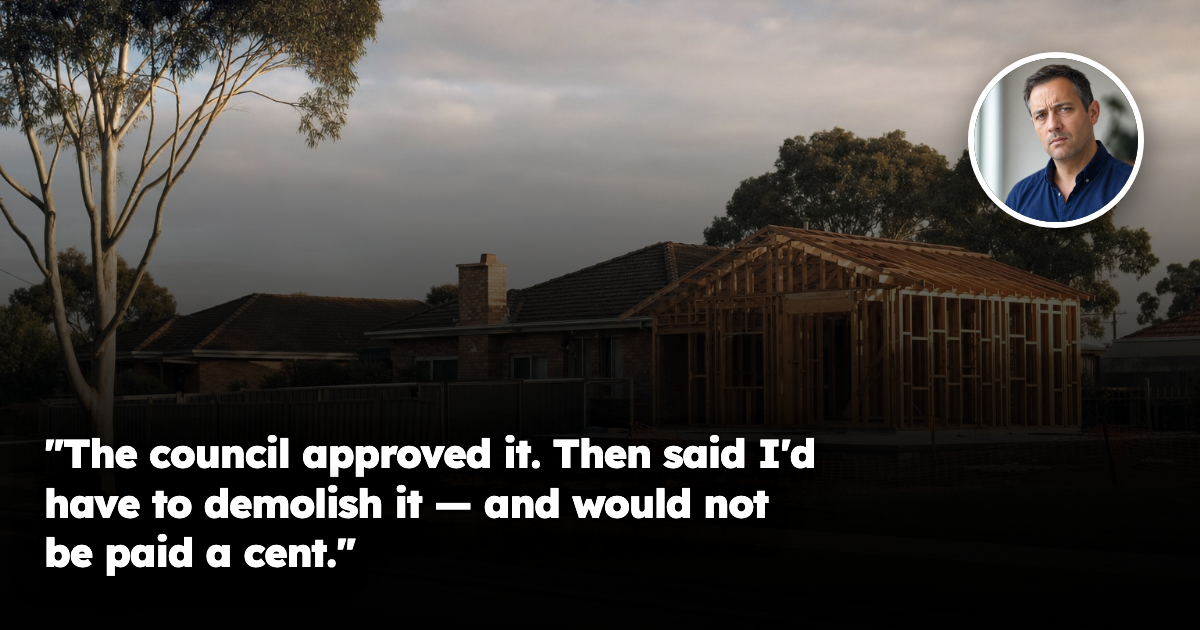
'The council approved my extension. Then I read the condition that said I would have to demolish it — and would not be paid a cent'
He spent nine months getting approval for a rear extension. The permit was granted — with a condition saying no compensation would be payable if the building ever had to be demolished. It was not a typo.
A client sent us a permit last month with a question attached: "Is this a typo?"
It was not.
He is 46, owns his home and one investment property two suburbs away, and had spent nine months getting approval for a rear extension. The permit was granted. And buried in the conditions was a line saying that if the buildings he was about to construct ever had to be demolished or removed, no compensation would be payable for them.
His question is one we get constantly in various forms: how can a council approve something and simultaneously tell me I might have to pull it down at my own cost?
The line on the map he never knew was there
His block sits inside a Public Acquisition Overlay.
It is one of the least understood controls in Australian property, and one of the most consequential. It appears on the planning scheme map as "PAO" and a number. Its purpose is to identify land that a state authority or council proposes to acquire, reserve it for a public purpose, and ensure nothing an owner does in the meantime prejudices that purpose.
Land inside one is formally reserved for a public purpose. There is a named acquiring authority. A permit is required to use or develop it. Any application must be referred to the acquiring authority itself — the very body that intends to buy the land gets a statutory say in what you may do with it first.
And when a permit is granted, it may be made conditional on the extent of alterations and extensions, the materials used, the design of new works, the demolition or removal of buildings, and — the condition that made him ring us — no compensation being payable for the demolition or removal of anything built under that permit.
None of this is a loophole or an error. It is the control working exactly as written. It belongs to the same family as an easement that quietly removes part of your buildable area — a restriction that lives on paper rather than on the ground.
The part that catches investors
Here is what almost nobody realises: this is not a rare, exotic control affecting a handful of doomed houses on a freeway route. Overlays like this sit over ordinary streets in ordinary suburbs — reserved for road widening, drainage, a future school, a park, a rail corridor. Some have sat there for decades. Plenty will never be acted on in the owner's lifetime.
The house looks like every other house on the street, and sells like one. The line is not visible from the footpath. It is visible in the planning scheme, on the certificate, and nowhere else — so the market frequently does not price it, until the moment somebody needs it to.
What changed this year
The compensation framework around reserved land was overhauled by legislation passed in 2026, and the changes matter far more to investors than the headlines suggested.
The rules are now tighter and considerably more procedural:
- Claims must be made in a prescribed form with supporting evidence, and lodged within two years of the right to compensation arising — on a permit refusal, or on a "loss on sale".
- A single-claim rule applies: one claim per reservation event. Further claims are only permitted if later controls are more stringent or affect a different part of the land.
- Compensation is limited to "actual financial loss" — narrowed from "financial loss" — suffered as the natural, direct and reasonable consequence of the reservation or refusal.
- If the authority requests further information, its response clock pauses, with no stated limit on what may be requested.
Then there is the provision written directly at people like our client: compensation for the intangible effect of a reservation on a residence is now confined to the claimant's principal place of residence, assessed by reference to the existing use.
An investment property is not a principal place of residence. Had the overlay landed on his rental instead of his home, that head of claim would not have been available to him at all.
The answer we gave him
Two things, in order.
First, establish which document you are actually in. A reservation is not an acquisition. Land can sit under an overlay for thirty years without anybody knocking. His right to compensation had not been triggered — no permit had been refused, and he had not sold at a loss. What he had was a permit with a condition, and a decision about whether to spend $180,000 on a structure the permit expressly declines to compensate him for. Conflating the two is what causes owners to panic-sell.
Second — and this is the part that decides money — read the street, not the suburb.
This is where a suburb median is structurally useless. An acquisition overlay does not follow suburb boundaries — it follows a corridor. It runs through a suburb, taking one side of a road, or the rear thirty metres of a single run of blocks, leaving everything around it untouched. Two houses 60 metres apart, same postcode, same median, same school, same station — one carries a named acquiring authority and a permit regime, the other does not.
The suburb number averages both and reports neither. It is the same dispersion we measure constantly at street level, where achieved rents, real days-on-market and actual vacancy duration routinely differ 20–30% between the best and worst streets inside a single suburb. The overlay is just the version of it that happens to be published — much like a covenant that blocks a subdivision two doors down from one that sailed through.
And the new rules quietly made street-level data legally relevant: when compensation is assessed, the zoning of adjoining land must be taken into account. What is happening next door is now part of the calculation.
What it means for you
This is the same lesson owners learned when flood mapping was redrawn over houses that had never taken water: a published line can reprice an asset without a single thing changing physically.
Check the planning certificate before you buy — not after. It costs almost nothing, it is available on any address, and it is the single most skipped piece of due diligence in Australian residential property. Read every permit condition in full, including the ones that look like boilerplate. And if you own inside a reservation, know that the clocks are now short and the forms are prescribed.
None of this is an argument against owning property. It is an argument against owning one you have never looked up. Controls like this do not make property a worse asset — they make it a less forgiving one to buy carelessly, because the discount they create is real, permanent, and invisible in every number most buyers rely on.
His extension went ahead, scaled back, with the condition understood rather than discovered. The investment property two suburbs away turned out to be clean.
He had owned both nine years before anyone checked. Almost everyone does it in that order.
If there's a specific street you're weighing up right now, check its Street Score first — it's free, takes ten seconds, and tells you whether that street is pulling the suburb average up or riding on it.
Frequently asked questions
What is a Public Acquisition Overlay in Australian property?
A Public Acquisition Overlay, or PAO, is a planning control shown on a planning scheme map that identifies land a state authority or council proposes to acquire for a public purpose. It means the land is reserved, and any use or development usually needs a permit and referral to the acquiring authority.
Why can a council approve an extension but still say it may have to be demolished at my cost?
Because land in a Public Acquisition Overlay can be developed only on conditions set by the authority. A permit may allow the work now, but include conditions covering demolition or removal later and state that no compensation is payable for buildings constructed under that permit.
When does compensation become available if my land is inside a reservation or overlay?
The article says compensation is triggered by specific events such as a permit refusal or a loss on sale. A reservation by itself is not the same as an acquisition, so the right to claim does not arise simply because the overlay exists on the land.
What changed in the 2026 compensation rules for reserved land?
The article says claims now must use a prescribed form, include supporting evidence, and be lodged within two years of the right arising. Compensation is also limited to actual financial loss, and only one claim is allowed per reservation event unless later controls are more stringent or affect a different part of the land.
Why does the article say I should check the planning certificate and street, not just the suburb?
Because overlays follow corridors and can affect one side of a street or part of a block while leaving nearby homes untouched. The article says suburb medians can hide these differences, so the planning certificate and street-level context are more useful for spotting a reservation or other restriction.
General information only. It does not take your objectives, financial situation or needs into account, and nothing here is legal, financial, taxation or investment advice specific to your circumstances.