News · 15 August 2026 · 5 min read
'I have to publish the lowest price I'd accept, seven days before my auction. Doesn't that just hand every buyer my floor?'
From 1 October, Victorian vendors must publish their exact reserve price at least seven days before auction. One owner asked whether that just hands every buyer her floor. The honest answer depends entirely on something the law never looks at.
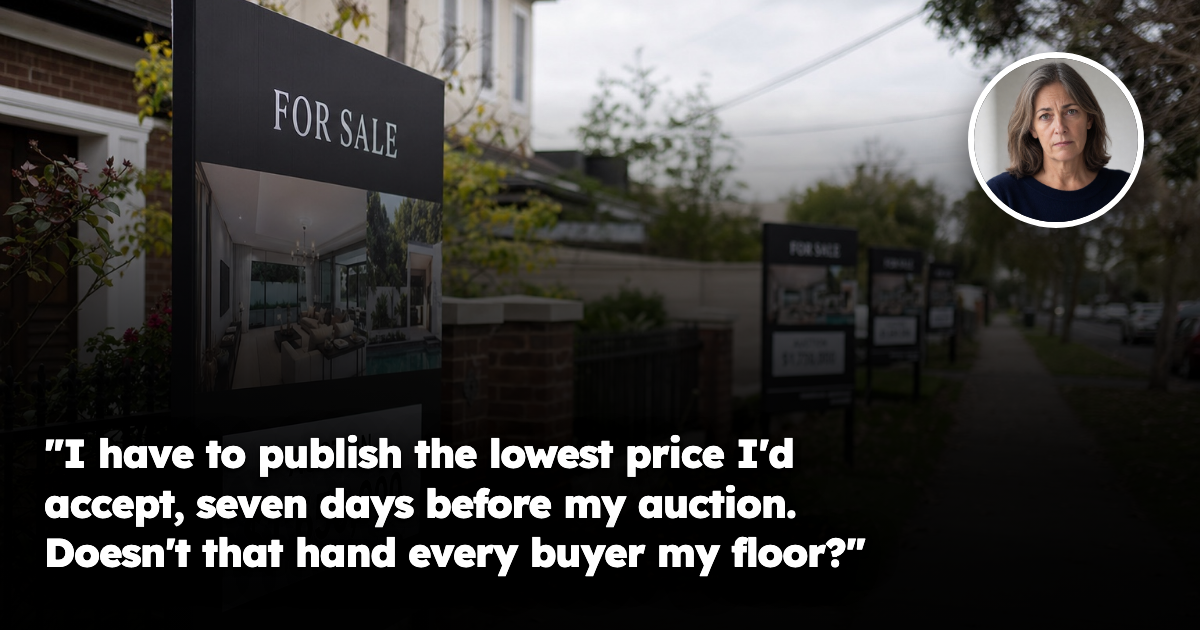
She has sold two properties in her life, both at auction, both in Melbourne's north-east. The third is booked for late October, and she has just been told she must publish the one number she has never told anybody except her agent.
Her exact reserve. The lowest price she will accept. Public, at least seven days before anyone raises a hand.
"I understand why they're doing it," she said. "I just can't work out how it's supposed to help me. Doesn't that just hand every buyer my floor and tell them to start there?"
It is a fair question, and about to be a live one for many Victorian owners.
What is actually changing
From 1 October, vendors selling at auction in Victoria must publish their exact reserve at least seven days before the auction, and sold prices are to be disclosed publicly. The stated purpose is to end the practice of advertising a property below the price the vendor would actually accept.
The industry objection is not about transparency — it is about timing. A reserve is normally set late, often the morning of, because the last week is when a vendor learns the most: how many contracts went out, who returned for a second inspection, who brought a builder. Locking the number a week early removes the ability to respond to that.
So her instinct is half right. Publishing a floor changes bidder behaviour, and many auctions will now begin at, or near, that number.
The part almost nobody has said out loud
A reserve is not a valuation. It is not what the property is worth. It is a negotiating position — a number chosen in private, in the hope that competition carries the price well past it.
So the anxiety about publishing it is really an anxiety about something else: that once the number is visible, the property sells for the number and not a dollar more. And that only happens when there is nothing else pushing the price up. Which is why the reform is far less dangerous to some owners than others.
If three buyers genuinely want your property, a published reserve is close to irrelevant. They are not bidding against your floor; they are bidding against each other. The floor sets where the contest starts, the buyer pool sets where it ends. Every owner who has watched a property run $200,000 past reserve has watched exactly that.
If there is one interested buyer — or none — the published reserve becomes the price, because nothing was ever going to lift it above the floor. The reform did not cause that. It revealed it.
An auction has always been a device for discovering how many people want the thing. What changes is only how early, and how publicly, that happens.
Two houses, one suburb, two completely different exposures
This is where it stops being a legal question and becomes a property one.
Take two houses in the same suburb. Same postcode, same median, same council, same station, same auction rules to the letter, same seven-day obligation. On paper, the identical asset carrying the identical new risk.
They are not. One sits on a street where stock is tightly held and the last four sales each drew multiple registered bidders. The other sits where four comparable homes are on the market this month.
Publish a reserve on the first and it is a starting line. Publish it on the second and it is a ceiling — any buyer who thinks the price might run simply walks 300 metres and bids on one of the other four.
Same suburb. Same median. Same law. Opposite outcome.
Suburb-level data cannot tell those two owners apart, because a median averages both streets and reports the mean. Yet that difference decides whether the new rule costs a vendor nothing or costs them real money. Across a single suburb we routinely see a 20–30% spread in effective yield between the best and worst streets, measured on achieved rents, actual vacancy duration and real days-on-market rather than advertised figures — and the dispersion that shows up in income shows up in how many buyers actually walk through the door.
Days-on-market matters most here. One street clears in a fortnight to a queue. The street behind takes eleven weeks and finishes with a discount. That was always true. From October it will simply be priced in public.
What we would actually do about it
Four things, in this order.
Establish buyer depth before choosing the method of sale. The question is not "auction or private treaty?" It is "how many buyers are realistically competing for this property on this street right now?" If the answer is three or more, auction still works and the published reserve costs you very little. If it is one, an auction was always going to expose that — disclosure just does it a week earlier.
Do not confuse this with the advertised range. How a property is marketed and what a vendor will accept are separate numbers with separate problems — the accuracy of quoted ranges is a different fight.
Set the reserve from evidence, not hope. A number chosen because it is what the owner needs, rather than what the street supports, was always going to fail. It will now fail publicly and in advance.
Know what survives the change. If a property passes in below reserve, the highest bidder must be invited to negotiate with the seller before it is offered to anyone else. Fictitious and late bids remain offences, and the auctioneer can still refuse a bid or withdraw the property.
Check competing supply on your own street for your own campaign window. Not the suburb. The street, and the fortnight either side of your auction date.
The part that should not be lost
A market that publishes more information rewards owners whose asset withstands the light and penalises those relying on the dark. If your property has depth behind it, disclosure costs you nothing — the bidders were always going to find each other. If it does not, you find out a week early rather than at 11am on a Saturday in front of your neighbours.
Property is not becoming a worse asset to own. It is becoming a harder asset to own carelessly — a different sentence entirely. Every rule of this kind widens the gap between a well-selected property and an average one, which is only a threat if you bought the average.
She checked her street. Two comparable homes within 400 metres, both campaigning through her window. That is the number deciding her October result — not the one she was worried about publishing.
The mistake was never selling at auction. It was setting a reserve without knowing how many people were coming.
If there's a specific street you're weighing up right now, check its Street Score first — it's free, takes ten seconds, and tells you whether that street is pulling the suburb average up or riding on it.
Market data & R-Scores for locations in this article
Drill Down Into the Markets Mentioned Above
Inspect live monthly R-Scores, median prices, rental yields, and street-by-street scores for the cities and council areas referenced in this article:
Frequently asked questions
What changes for Victorian auction vendors from 1 October?
Vendors selling at auction in Victoria must publish their exact reserve price at least seven days before the auction. Sold prices are also to be disclosed publicly.
Does publishing the reserve price automatically mean the property will sell for that amount?
No. If there are multiple genuine buyers, they bid against each other and the reserve mainly sets the starting point. It becomes much more important only when there is one interested buyer, or none.
Why are some owners more exposed by the new rule than others?
Because the impact depends on buyer depth on that street at that time, not just the suburb median. A tightly held street with several bidders is very different from one with competing listings nearby.
Why do industry groups object to the timing of the reserve disclosure?
They say reserves are usually set late, often on the morning of the auction, after the vendor has seen the strongest market signals. Locking the number in a week early removes that flexibility.
What should a Victorian seller focus on before deciding to auction?
The article says the key question is how many buyers are realistically competing for the property on that street during the campaign. It also says to check competing supply in the street and the fortnight around the auction date, not just the suburb.
General information only. It does not take your objectives, financial situation or needs into account, and nothing here is legal, financial, taxation or investment advice specific to your circumstances.