News · 10 August 2026 · 6 min read
'My tenant has never complained once in four years.' A landlord asked us why that suddenly worried him
A NSW landlord asked us this week whether the new portable bond scheme was something he needed to worry about. The honest answer was no — and then yes, but not for the reason he expected.
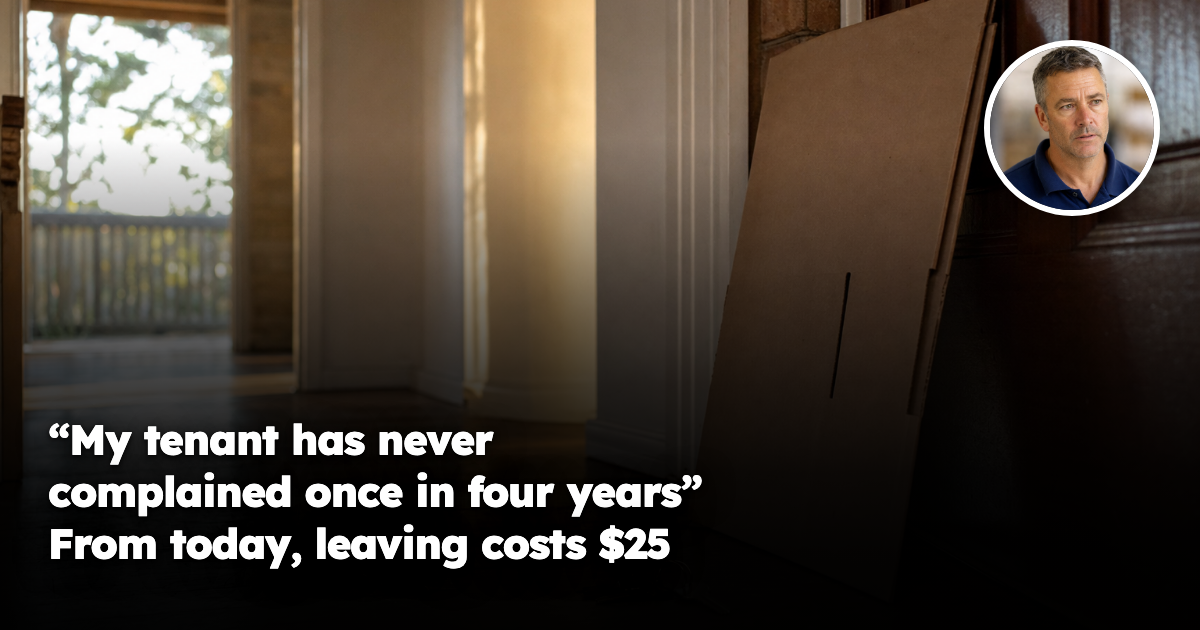
He owns one property. A three-bedroom house on the outer edge of Sydney's west, bought in 2019, rented to the same family since early 2022. He is fifty-three, he manages a distribution warehouse, and he is the kind of landlord who fixes the hot water system the same week he hears about it.
He rang us because a headline had unsettled him. New South Wales has switched on a scheme that lets renters carry their bond from one property to the next instead of finding a second one in cash. He wanted to know, plainly, whether it cost him money.
The first half of the answer was easy: no. The second half took longer, because the thing he should have been thinking about was not in the headline at all.
What actually changed
A renter can now transfer an existing bond to a new property through an online portal instead of scraping together a fresh one while the old is still tied up. It costs twenty-five dollars each time. If the new bond is higher, the tenant pays the difference — moving from a $2,400 bond to a $2,700 bond, they top up $300.
For the owner, claims are essentially unchanged. Unpaid rent or damage can still be claimed against the bond. Where the tenant agrees, the government pays the landlord and recovers the money from the renter within twenty-eight days. Where the tenant disputes it, the matter goes to the tribunal.
So on the narrow question he asked, he is fine — if anything the payment sequencing is marginally in his favour.
Two things before anyone panics or celebrates. It is not statewide: at launch it covers just three local government areas, with the rest to follow through the year. And it is not confined to one state — Victoria is rolling out its own version and South Australia has committed to one. This is a direction of travel, not a local curiosity.
The question he should have asked
Around 330,000 households move each year in New South Wales, and most rental tenancies run for less than two years. That is a market that already churns hard — roughly a million bonds on foot, worth about $2.3 billion.
Now ask what has actually been removed. Not a landlord cost. A barrier to leaving.
Until this week, a renter who was mildly unhappy — the place is fine, the commute got worse, the neighbour is a bit much — had to produce thousands of dollars for a new bond while their existing bond sat with someone else. For a household with no buffer that is not an inconvenience. It is a wall. People stayed put because moving was unaffordable, not because staying was ideal.
That wall has just come down to twenty-five dollars and a form.
Which is why "my tenant has never complained" is a weaker signal than most owners think. Silence is not satisfaction. Some tenants stay because they are happy; some stay because they are stuck. Both look identical on a rent ledger — and the machinery that made the second group indistinguishable from the first has just been switched off.
It matters most in exactly the market you would expect. New South Wales renters face the worst affordability in the country — through the second half of last year, a household on the state's median income could afford only about a quarter of advertised rentals. When choice is that constrained, mobility is theoretical. But affordability moves, and the moment a renter has real options, low friction turns a theoretical choice into a real one.
So what actually holds a tenant now
If it is no longer the cost of leaving, it has to be the property. Which sounds obvious until you try to work out whether yours qualifies — and find that almost every number you have been given is measured at the wrong resolution.
A suburb-level report gives you median rent, a vacancy rate and an average days-on-market for a postcode. Every one of those is an average of streets that behave nothing alike. When we run street- and suburb-level analysis across a single suburb — same postcode, same median, same school catchment, same council — the spread between the best and worst streets on effective yield, built from achieved rather than asking rents, actual vacancy duration and real days-on-market, routinely runs 20 to 30 per cent.
A suburb vacancy rate of 1.5 per cent is useful for deciding whether to look at a suburb at all. It is close to useless for predicting whether your house re-lets in nine days or thirty-four. That is decided street by street: what the property backs onto, how far the walk to the station really is, how much competing stock sits within a few hundred metres, and whether the street is where people want to live or merely where they end up.
Most owners do not find out which one they own until a tenant leaves. Retention has been quietly doing the work of due diligence for years — propped up by a friction now legislated away. It is the same blind spot that catches owners who assume a property that won't sell can simply be rented out instead — rentability is a property-specific trait, not a market-wide one.
For an owner on the better side of that spread, none of this is a threat: their tenant stays for reasons that survive a cheaper exit. For an owner on the wrong side, the reform shortens the runway. The vacancy that would have arrived in three years arrives next year instead.
What to do with this
Stop reading a long tenancy as proof. It is evidence, not proof. Ask what your tenant's alternatives actually look like at their budget, within their commute, right now — a close relative of what a rent increase says about your property.
Get an honest read on the street, not the suburb. Achieved rents, real days-on-market, actual competing supply within walking distance. If your property re-lets in a fortnight, you own resilience. If the honest answer is six weeks, you have found a number worth acting on while you still have a paying tenant — the cheapest possible time to find it.
Spend money where it changes the decision. A tenant who can leave for twenty-five dollars will not be held by a better light fitting. They will be held by a property that suits their life better than the alternatives they can reach — sometimes a second bathroom or off-street parking, often simply being on the right street, which you cannot retrofit. Worth being clear-eyed, because spending heavily on a property that has already hit its street's ceiling is one of the most expensive mistakes an owner can make.
The part worth keeping
It is easy to read a reform like this as one more thing tilted against people who own rental property. Look at it squarely and it is closer to the opposite. Lower switching costs make a rental market behave more like a market: tenants sort toward properties that suit them and away from ones that do not. That is uncomfortable for owners relying on inertia — and straightforwardly good for owners who bought well, because it stops their asset being priced as though it were interchangeable with the worst house on the worst street in the same postcode. Quality only gets rewarded where people are free to move toward it.
The reform changed the cost of leaving. It did not change what makes somewhere worth staying — and that was decided long before the tenant signed anything, on the day someone chose one street over another.
If there's a specific street you're weighing up right now, check its Street Score first — it's free, takes ten seconds, and tells you whether that street is pulling the suburb average up or riding on it.
Market data & R-Scores for locations in this article
Drill Down Into the Markets Mentioned Above
Inspect live monthly R-Scores, median prices, rental yields, and street-by-street scores for the cities and council areas referenced in this article:
Frequently asked questions
What is the new portable bond scheme in New South Wales?
It lets renters transfer an existing bond to a new property through an online portal instead of paying a brand new bond upfront. The transfer costs $25 each time, and if the new bond is higher, the tenant pays the difference.
Does the NSW portable bond scheme change a landlord’s right to claim for unpaid rent or damage?
No. A landlord can still claim against the bond for unpaid rent or damage, and if the tenant agrees the government pays the landlord and then recovers the money from the renter within 28 days. If the tenant disputes the claim, it goes to the tribunal.
Why does the article say a long tenancy is not proof that a tenant is happy?
Because some tenants stay because they are satisfied, while others stay because moving is too expensive. The portable bond scheme removes one of the main barriers to leaving, so silence or long occupancy no longer tells you as much as it used to.
What should a NSW landlord look at instead of just the suburb vacancy rate?
The article says to look at the street, not just the suburb. Useful signals include achieved rents, real days on market, actual competing supply within walking distance, and how the property compares with nearby alternatives.
What is the main risk for a landlord under the new bond scheme?
The main risk is that a tenant who was previously staying put because moving was costly may now leave more easily. That means a vacancy could arrive sooner for properties that are not strong enough to hold tenants on their own merits.
General information only. It does not take your objectives, financial situation or needs into account, and nothing here is legal, financial, taxation or investment advice specific to your circumstances.