News · 16 October 2026 · 5 min read
New home sales fell 17.5 per cent and prices are down 5.2. What does a buyer with equity do now?
New home sales fell 17.5 per cent in the September quarter.
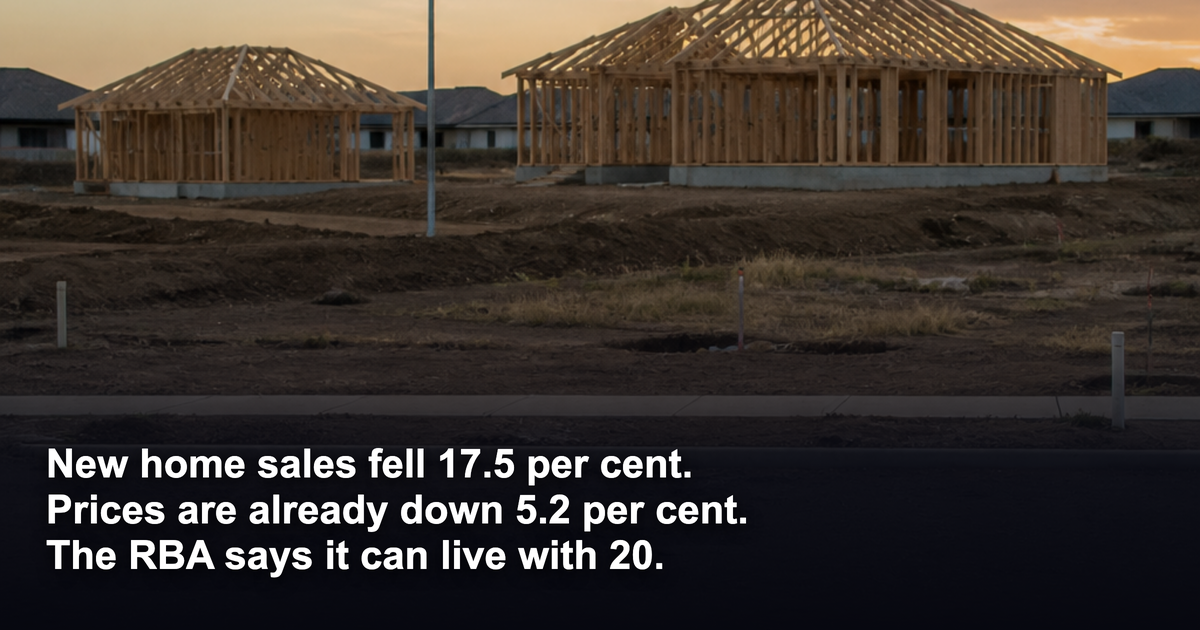
New home sales fell 17.5 per cent in the September quarter.
That is the HIA figure reported in the ABC's markets blog on Friday, and it reverses the recovery that started in 2025. On the same page, AMP economist My Bui said Australian home prices have already fallen 5.2 per cent and are likely to fall 10 to 15 per cent from top to bottom, out to the June quarter next year.
A few hours earlier, US Federal Reserve chairman Kevin Warsh told an IMF meeting in Bangkok that artificial intelligence would make economies wealthier, but that the path "is likely to be a very bumpy one".
The ASX 200 listened, shrugged, and closed the week 1 per cent higher at 8,806 points.
So the biggest central banker in the world is telling you to expect turbulence, the housing data is going backwards, and the share market is up. If you own a home with equity and you have been waiting for conditions to settle before you do anything, this is the week the waiting strategy got harder to defend.
What actually changed
Three things are pushing on prices at once, according to the AMP note the ABC reported.
The cash rate is 4.6 per cent after the Reserve Bank board voted unanimously to raise it in September.
Investor demand has been reduced by the winding back of negative gearing and the capital gains tax discount.
Confidence is poor. Jobs and sentiment data this week both fell to their lowest levels since COVID.
Builders respond to that the only way they can. A new home that does not sell this quarter is usually a home that does not get started next year. A 17.5 per cent drop in sales is a supply decision being made right now, and it will show up as fewer new homes for buyers to choose from in 2027 and 2028.
The sentence from the RBA minutes that matters more than the forecast
Here is the line most people skipped. The September minutes, as summarised by AMP, record that the board considers mortgage holders "financially stronger than others", with substantial savings buffers, and that they would remain resilient even if house prices fell 20 per cent.
Read that as a homeowner. The Reserve Bank has told you, in writing, that it is prepared to watch prices fall by a fifth without flinching. There is no rescue coming for the price of your house.
Read it again as someone with equity to deploy. The institution setting your borrowing cost has just described the stress test it is comfortable with. If your plan only works when prices rise, your plan is weaker than the RBA's own assumptions.
What a 5.2 per cent fall looks like in dollars
Put the percentages on a $1,000,000 property, purely as arithmetic.
A 5.2 per cent fall is $52,000 already gone from the peak.
If AMP's forecast lands at the bottom of its range, a 10 per cent fall from peak is $100,000. At the top of the range, 15 per cent is $150,000. Measured from today, that is somewhere between roughly $48,000 and $98,000 of further decline, if the forecast is right.
That is the honest cost of buying now rather than at the bottom. It is real money and nobody should pretend otherwise.
Now put the other side of the ledger next to it.
Nobody rings a bell at the bottom. The forecast says June quarter next year, but forecasts of turning points are the least reliable forecasts in finance, and the same blog carried a strategist saying investors are "poised to shift to an optimistic mood" within weeks. Both cannot be right.
A 17.5 per cent fall in new home sales means fewer competing buyers now, and fewer new dwellings later. The people who stepped back are the people you would otherwise be bidding against.
And the US Fed, which raised rates last month for the first time since 2023, saw bets on another October hike drop from over 25 per cent to 15 per cent after Warsh spoke. Rate expectations move in both directions, and they moved on a single speech.
The decision you are really making
Waiting for calm is a timing bet dressed up as prudence. It assumes you will recognise the bottom, act before everyone else does, and borrow at a cheaper rate than today. Three assumptions, each of them uncertain, stacked on top of each other.
The alternative is to stop asking "when" and start asking "what would have to be true for this to hold through a bumpy cycle".
Can the loan be serviced at 4.6 per cent and higher, without the rent covering the gap?
Is there a cash buffer that survives a vacancy and a repair in the same quarter?
Does the asset sit in a street where demand holds when the suburb average slips?
That last question is the one the national number cannot answer. A 5.2 per cent national fall is an average of thousands of suburbs, and each suburb is an average of its streets. Two streets in the same postcode can be having completely different years, one with sales still clearing in a fortnight and one with stock sitting for months. The headline tells you about neither.
The Ripehouse reframe
We do not time markets for clients and we do not forecast bottoms. We build portfolios to hold through the kind of cycle Warsh is describing, and then we publish what happened.
Across 997 client portfolios since 2021, the median portfolio has grown 19.0 per cent a year on a 5-year rolling basis, against roughly 4.3 per cent nationally over the same period. That five-year window includes the fastest rate rises in a generation, the falls that followed, and the recovery after that. Benchmark: CoreLogic/Cotality. Past performance is not a guarantee of future results.
We publish those figures including the portfolios that underperformed, because a result that only shows the winners is a highlight reel, and you have seen enough of those.
The lesson from the full distribution is consistent. The portfolios that held up were built on the right asset in the right street with the holding costs stress-tested before purchase. The ones that struggled were usually bought on a headline, in a suburb that was "going up", with no plan for the quarter when it stopped.
Bumpy was always the forecast. Structure is what you control.
Want to see how we test whether a street can carry a purchase through a cycle like this one? Join Jacob's free live webinar.
If there's a specific street you're weighing up right now, check its Street Score first — it's free, takes ten seconds, and tells you whether that street is pulling the suburb average up or riding on it.
General information only. It does not take your objectives, financial situation or needs into account, and nothing here is legal, financial, taxation or investment advice specific to your circumstances.