News · 16 October 2026 · 5 min read
Her ETF, her super and her home equity all lean on US tech. The cost of insuring it just hit a record
She is 41. She and her partner own a house in Adelaide's inner south with about $260,000 of usable equity, two kids in high school, and a plan that looked sensible on a spreadsheet.
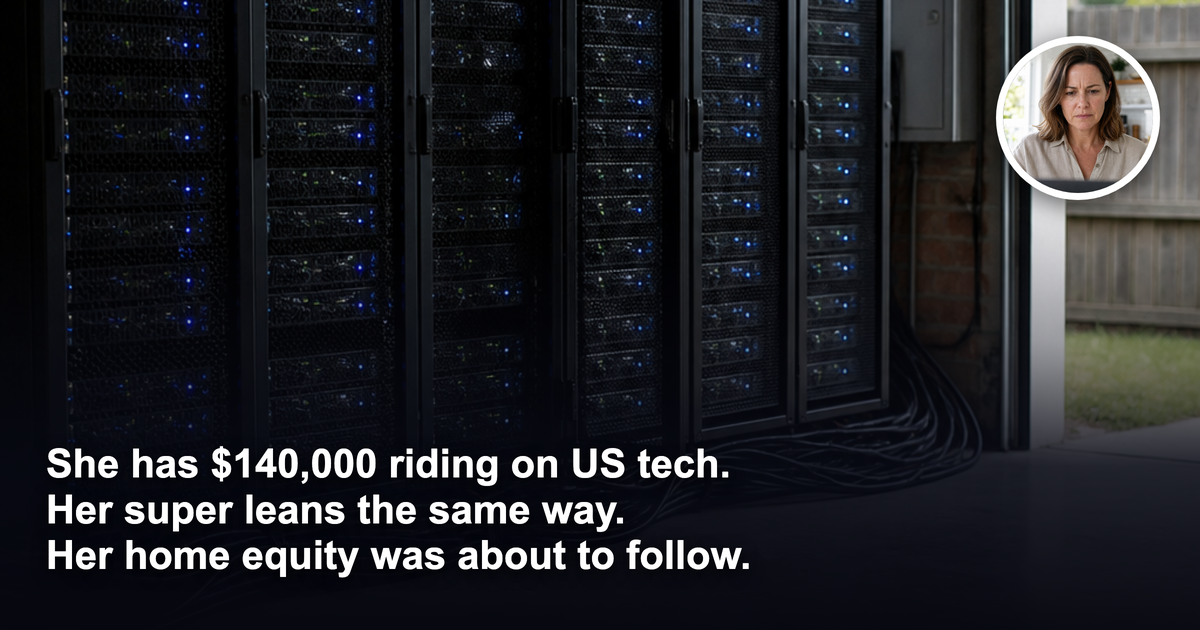
She is 41. She and her partner own a house in Adelaide's inner south with about $260,000 of usable equity, two kids in high school, and a plan that looked sensible on a spreadsheet.
Her super is in a high-growth option. Her $140,000 of savings outside super sits in a single global ETF. Both lean heavily on the same handful of American technology companies, because that is what the index does now.
The next step was to draw $200,000 against the house and buy more of the same ETF. Low fees, no tenants, no agents. Set and forget.
Then she read that the cost of insuring those companies against default had hit a record.
She is a composite illustration, not a real person. The numbers behind her worry are real.
The question
"Everything I own seems to end up in the same ten companies. My super, my ETF, and now I was about to borrow against the house to buy more. If the people lending to these companies are paying record prices for insurance, what are they seeing that I am not?"
What the record actually measures
Start with what a credit default swap is, because the headline skips it. It is insurance. A lender pays a premium so that if the borrower stops paying its debts, the lender gets made whole. When the premium rises, the people closest to the money are getting nervous.
The ABC, citing Reuters and data from LSEG and S&P Global Market Intelligence, reported on 16 October that credit default swaps on several of the largest US tech names, including Amazon, Alphabet and Meta, traded at record highs this week.
The sharpest move was in a company most Australians have never heard of. CoreWeave, a data centre operator that rents computing power to the AI build-out, has taken on more than US$50 billion (about $72 billion) in debt, according to the ABC. The yield on its bonds maturing in 2031 reached 15.7 per cent. The spread on its five-year credit default swaps jumped 16 per cent to a record 1.14 per cent before easing to 1.03 per cent.
Marcus Today senior markets analyst Henry Jennings told the ABC that CoreWeave was the "canary in the coalmine" for excessive big-tech debt on Wall Street, and said its swaps implied a 60 per cent chance of default within five years.
Hold the context next to that. Floodlines Research founder Anna Wu told the ABC this is "more sentiment than fundamentals for now". Deutsche Bank strategist Jim Reid said AI financing costs "aren't dramatic overall, but there are worrying themes at the edges".
Nobody in that report forecast a collapse, and we are not forecasting one. What has changed is a price. Lenders are charging more to carry the risk, because elevated inflation is pushing interest rates up and the AI build-out is now being funded with debt rather than cash flow.
The answer: how many shelves does she actually have
Here is what she can control.
Whether CoreWeave defaults is not her decision. Whether Nvidia's chief executive is right to defend it is not her decision either. What is hers is this: the next $200,000 of equity she pulls out of her house.
Count her exposure honestly.
- Her super: high growth, international shares, weighted to the same US mega-caps.
- Her ETF: $140,000, the same index, the same ten names at the top.
- Her home: Adelaide, one suburb, one street, one asset class. That part at least behaves differently.
If she borrows against the house and buys more of the ETF, she takes the one asset that moves to its own rhythm and uses it to lean harder on the one that does not. Three baskets. One shelf.
That is the expensive mistake. The ETF itself is fine. Adding to a concentration she never chose, because the default option made it feel like diversification, is the problem.
What this means for you
Most households in her income bracket have drifted into the same shape without noticing. Super default options have moved toward international shares. Popular ETFs are weighted by company size, so the biggest companies get the biggest slice, and the biggest companies are now a short list of American technology firms carrying a lot of new debt.
That is a reason to read your statements. Selling is a separate decision, and this article does not make it for you.
Pull up your super statement and your ETF holdings and read the top ten in each. If the same names appear in both, your "balanced" position is one bet with two labels.
Then ask the only question that matters about the next dollar: does it add to that bet, or does it spread it?
The Ripehouse reframe
Property, done properly, is the part of a portfolio that does not care what a bond trader in New York thinks about data centre financing. Rent is paid by a person in a house on a street. Value is set by local supply and local demand.
Done badly, it is just another concentrated bet. Two streets in the same suburb can be having completely different outcomes right now, and a headline about "the market" tells you nothing about either of them. Vacancy, days on market and the mix of owners to renters are decided street by street.
Across 997 client portfolios since 2021, Ripehouse clients have recorded median portfolio growth of 19.0 per cent a year on a five-year rolling basis, against roughly 4.3 per cent nationally. We publish the whole distribution, including the portfolios that underperformed. Benchmark: CoreLogic/Cotality. Past performance is not a guarantee of future results.
The number matters less than where it comes from: the right asset, on the right street, chosen on data. Structure beats timing. It also beats the index.
Her $200,000 does not have to go into property. It should not go onto the same shelf as everything else she owns, though, and this week the people who lend to that shelf told her, in dollars, how they feel about it.
Want to see how we test where the next dollar of equity should go, street by street? Join Jacob's free live webinar, "If I Were Buying an Investment Property in Australia Today".
If there's a specific street you're weighing up right now, check its Street Score first — it's free, takes ten seconds, and tells you whether that street is pulling the suburb average up or riding on it.
General information only. It does not take your objectives, financial situation or needs into account, and nothing here is legal, financial, taxation or investment advice specific to your circumstances.