News · 15 August 2026 · 6 min read
'My neighbours want me to help pay for a $3m wall to save our houses. I've just realised what it does to the house behind us'
A council fought a 90-metre seawall protecting three homes, and lost. The precedent now favours owners who want to protect their land - and quietly reprices the property standing behind, beside or downdrift of someone else's wall.
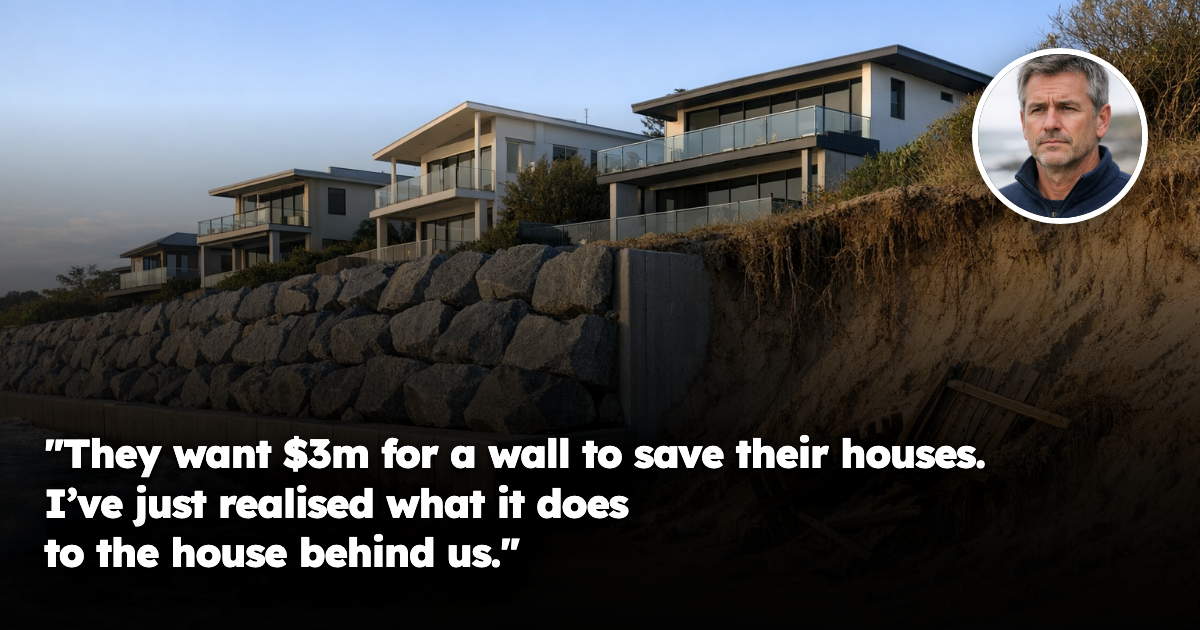
He is not the one losing the house. That is the part he keeps coming back to.
A client called us about a beachside property he has owned for eleven years. Three houses on his run are in trouble — the sand in front of them has been going backwards for four seasons and the engineering advice is blunt: without protection, those homes will eventually be undermined. The owners want a wall. The estimated cost is around three million dollars, and they want the neighbouring owners to contribute.
His question was not the one we expected. He did not ask whether the wall would work. He asked: "If this wall saves their houses, what does it do to mine?"
It is the sharpest question anyone has asked us this year, and almost nobody buying near a coast, river, escarpment or floodway ever thinks to ask it.
The wall is now much easier to build than it used to be
Something shifted in the last few weeks, and most owners have not registered it. A council went to court to stop a ninety-metre seawall protecting three homes. The council lost.
The reasoning matters far more than the outcome. Both sides' experts agreed on the underlying problem — that without protection the houses would eventually be undermined and, in the court's words, catastrophically damaged. Where they disagreed was the fix: the council's expert argued renourishing the beach with sand might remove the need for a hard structure altogether, while the applicant's expert argued the wall was the optimal answer.
The court sided with the wall. Its logic was that where there is no government offer of retreat with compensation on the table, and the land was zoned for housing, owners should reasonably be empowered to protect their homes — irrespective of when they moved in, or what risks they were aware of. The only real question was what kind of protection, not whether protection was allowed.
Read that again, because it cuts both ways. It is powerful protection for an owner whose house is at the front. It is also a precedent that makes it harder for a neighbour to object.
Elsewhere, three similar applications were refused by a planning panel earlier this year — different process, different result. The precedent now sits there, waiting.
The line nobody reads
Here is the part that answered our client's question, and it is not buried in a court transcript. It is in a plain-language government fact sheet, published free, written for exactly this audience.
Coastal protection works, it says, do not guard against the impacts of all coastal hazards into the future. They are engineered to protect assets during a storm of a specified magnitude, or over a specific timeframe, and they require ongoing maintenance to be effective.
Then the sentence that matters most:
Coastal protection works can have unintended short and long-term consequences, such as causing erosion or accretion in other areas.
That is the regulator saying, in writing, that a structure built to hold sand in front of one property can take sand away from another. A wall does not remove the energy hitting the coast. It redirects it. The house that is saved and the house that is exposed can be a hundred metres apart, on the same street, sharing a postcode, a median, a council and a view.
Our client thought he was being asked for a contribution. He was actually being asked to make a decision about somebody else's asset — and, potentially, his own.
The answer: this is a property-by-property risk wearing a suburb-shaped costume
This is where most owners get it structurally wrong, and it is the same error we see when a house is newly mapped as flood risk despite never flooding, or when two homes on one street draw bushfire attack level ratings that differ by more than $100,000 in build cost.
Risk of this kind gets discussed at the level of a suburb or a beach — "that area has an erosion problem" — because that is the only resolution the public conversation has. But the risk does not exist at that resolution. It exists at the level of a single title.
Two houses on the same beachfront street can have entirely different exposure based on where they sit relative to a headland, the orientation of the shoreline, the natural drift of sand along the coast, the height of the land, the depth of the dune in front, and — increasingly — whether the property beside them has built a hard structure. One of those factors is now a legal and financial variable, not a geological one. Your neighbour's building decision has become an input into your risk.
No suburb median can see any of that. A suburb median takes the protected properties and the exposed ones, adds them together, and reports the average of two assets that are behaving in opposite directions. It is the same failure we measure everywhere: inside a single suburb, the gap between the best and worst streets routinely runs to 20–30% on effective yield once you use achieved rents, real vacancy duration and true days on market rather than the advertised numbers. On a coastline, that dispersion is not a nuance. It is the difference between an asset with a permanent structural discount and one without.
The practical sequence for anyone in this position is short:
1. Establish which document you are in. A hazard map, a planning overlay and a certificate notation are three different things with three different consequences. Only one restricts what you may build.
2. Read the maintenance obligation, not just the construction cost. A wall is not a purchase, it is a subscription. Ask who is liable in twenty years, and what happens when one contributing owner sells.
3. Ask what the structure does to the properties either side. The regulator has already conceded this can happen. Almost no buyer asks, and no seller volunteers.
4. Price the insurance before you assume the risk. An underwriter is the only participant who has to put their own money behind an opinion about your specific address — which is exactly why a renewal notice can tell you more about your property than any appraisal.
What this actually means
It would be easy to read this as a reason to avoid the coast. It is not.
What the ruling really did was remove ambiguity. Owners of land zoned for housing now have a clearer, judicially-tested path to protecting it. That is value-positive for well-positioned coastal property — and a genuine risk for the property standing behind, beside or downdrift of someone else's wall. Those two outcomes will occur in the same suburb, under the same median, in the same year.
Which is the whole argument. Property is not becoming more dangerous. It is becoming more differentiated — and differentiation is only a threat if you are buying an average. If you are measuring at the level of the individual street and the individual title, differentiation is the entire opportunity, because it means the market is mispricing assets it cannot be bothered to tell apart.
Our client is not being asked to fund a wall. He is being asked to make a capital decision about a risk he has never had measured. Almost everybody in that street is in the same position. Almost nobody knows it.
If there's a specific street you're weighing up right now, check its Street Score first — it's free, takes ten seconds, and tells you whether that street is pulling the suburb average up or riding on it.
Frequently asked questions
What did the court decision change for coastal homeowners who want to build a seawall in Australia?
The court made it easier for owners of housing-zoned coastal land to protect their homes with a wall, even if they knew the risks when they bought. The key point is that, where there is no government retreat offer with compensation, the question becomes what kind of protection is allowed, not whether protection is allowed at all.
Why can a seawall that saves one house affect the house next door or behind it?
The article says coastal protection works can cause unintended short- and long-term consequences, including erosion or accretion in other areas. In other words, a wall can redirect coastal energy and sand movement, which may protect one property while increasing exposure for another.
Should buyers and neighbours look at coastal erosion risk as a suburb-wide issue or a property-by-property issue?
The article argues it is a property-by-property risk, not something that can be understood just from a suburb average. Two homes on the same street can have very different exposure depending on their exact position, and a neighbour’s wall can become part of that risk.
What should an owner ask before agreeing to help pay for a coastal protection wall?
They should ask which document governs the property, what the maintenance obligation is, and what the structure does to the properties either side. The article also says it is important to price the insurance before assuming the risk.
Does the article say coastal property should be avoided altogether?
No. It says the ruling removes ambiguity and makes the risks and benefits more differentiated by individual title. The practical issue is not avoiding the coast, but understanding the specific risks and how a nearby protection structure may change them.
General information only. It does not take your objectives, financial situation or needs into account, and nothing here is legal, financial, taxation or investment advice specific to your circumstances.