News · 29 August 2026 · 5 min read
She inherited a house, then the $180,000 renovation quote became $252,000
A renovation quote looked fixed at $180,000 before allowances, engineering and hidden site work pushed the project to $252,000. The real investment question was the value of the finished home on its exact street.
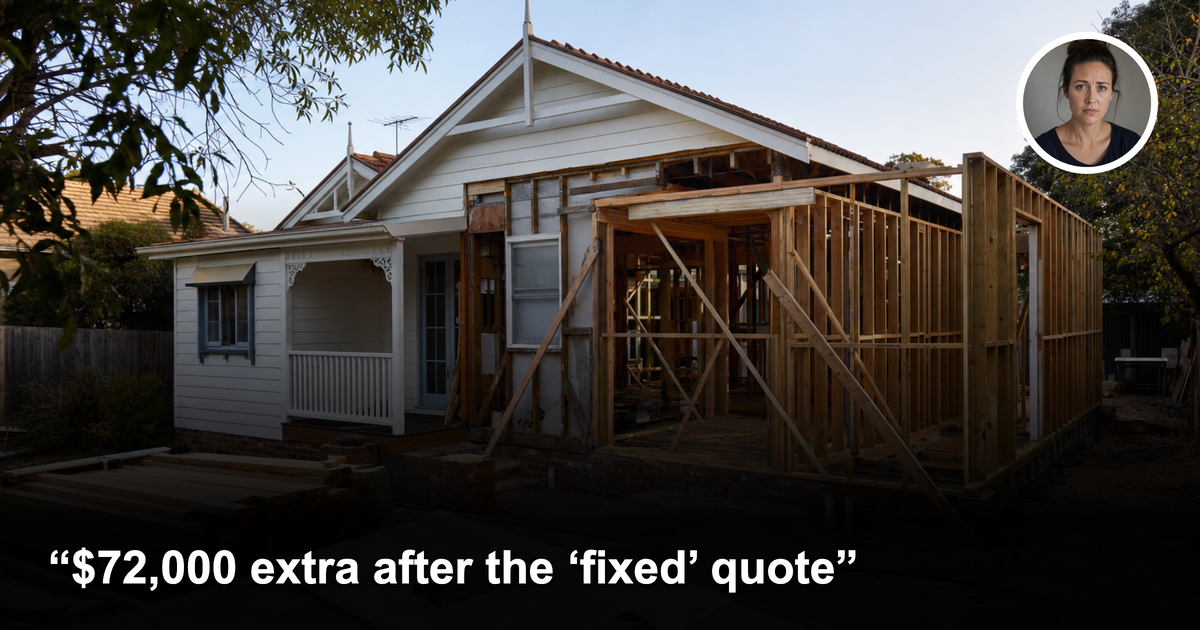
When a 36-year-old woman inherited a tired weatherboard house, the plan seemed straightforward: repair the structure, open up the kitchen and create a second bedroom before moving in. The builder's quote came back at $180,000. It was a large number, but at least it was a number.
By the time the work was ready to start, the price had climbed to $252,000.
The extra $72,000 did not arrive as one dramatic bill. It appeared in smaller pieces: a provisional allowance that no longer covered the required work, an engineering change, drainage hidden under the old slab and a series of variations approved under pressure. The house was still worth saving. The question was whether the renovation had quietly become a bad investment.
The question: is a “fixed” renovation quote really fixed?
Usually, only part of it is fixed.
A building contract can contain fixed-price work alongside provisional sums, prime-cost items and exclusions. A provisional sum is an allowance for work whose scope or cost is not fully known. A prime-cost item is an allowance for something to be selected later, such as appliances, tapware or tiles. If the allowance is too low, the owner pays the difference, often with labour and margin added.
That is why the headline quote is not the same thing as the maximum cash the project can consume. The real number is the contract price plus the value of every uncertain allowance, excluded item and likely site risk.
For this house, the $180,000 headline was built around optimistic allowances. The demolition exposed a damaged section of subfloor. The engineer required additional footing work. The owner also upgraded several finishes after discovering that the cheapest selections did not suit the existing house. None of those events was unusual. Together, they changed the investment equation.
Why older houses create the biggest gap
Age is not automatically a defect. It is a signal to investigate.
Older properties often hide the work that is hardest to price from a quick inspection: uneven floors, outdated wiring, stormwater problems, poor access, deteriorated framing and previous alterations that were never properly documented. A builder can price what is visible. The owner carries much of the uncertainty below the surface.
The risk is also higher when the renovation brief is vague. “Modernise the house” is not a scope. A measured plan, engineering advice, inclusions schedule, allowances and a written process for variations are what turn an idea into something that can be compared.
The owner should ask four questions before signing:
1. Which line items are genuinely fixed, and which are allowances? 2. What is excluded, including design, approvals, service upgrades, waste removal and site access? 3. What margin is applied to a variation? 4. Can work begin on a variation without a written price and written approval?
The answer to the last question matters most. A project can be delayed by refusing every change, but approving changes verbally makes the final cost almost impossible to control.
The suburb is not enough to price the decision
Even a carefully controlled renovation can be a poor property decision if the finished value is judged at suburb level only.
Two houses in the same postcode can have different resale ceilings because of their street, frontage, slope, parking, noise exposure, school-catchment boundary or buyer access. A renovated home does not receive a reward simply because the owner spent more money on it.
Ripehouse Advisory's street-level approach tests that gap before the first demolition day. Achieved sale prices, days on market, buyer depth, vacancy, achieved rents and nearby supply are read at the address and street level, then compared with the likely finished product. In a recent assessment pattern, nearby streets in the same suburb showed a five-figure difference in achievable value once frontage, traffic and buyer demand were separated from the suburb median.
That is the crucial distinction: a renovation is not automatically value-adding. It is value-adding when the right buyers on that precise street will pay for the finished outcome.
For owners weighing a costly project, the street-level data question is often more important than the colour of the kitchen. The cost shock on a $300,000 build is a reminder that even a modest scope needs a buffer and an exit test.
What should an investor do with a renovation risk?
Start with three numbers: total project cost, finished value and the value of the next-best property that could be bought instead.
Then add a contingency that reflects the building, not a generic percentage copied into a spreadsheet. A clean, accessible newer house may need less uncertainty allowance than a steep, altered weatherboard with unknown drainage. If the contingency is consumed before the kitchen is installed, the project is not “nearly done”; it is underfunded.
The right comparison is not between a $180,000 quote and a $252,000 invoice. It is between the all-in finished property and alternative assets with comparable rent, demand, resale depth and risk. That comparison can show that the renovation should be redesigned, staged or abandoned. It can also show that the original house is still the better asset because the street is scarce, the finished product solves a genuine buyer problem and the cost is supported by evidence.
The answer
A fixed-price label is not a guarantee that a renovation cannot rise. The protection is a precise scope, realistic allowances, written variation control and an address-level test of the finished value.
The inherited house did not become a bad property because the first quote was wrong. It became a difficult decision because the owner treated an uncertain project as a certain number. Once the full cost, street-level ceiling and alternative investments were visible, the emotion came out of the calculation.
Property investment still works when the asset, the renovation and the location are tested together. The edge is not spending the most. It is buying the right property, on the right street, with the right data before the expensive decisions become irreversible.
If there's a specific street you're weighing up right now, check its Street Score first — it's free, takes ten seconds, and tells you whether that street is pulling the suburb average up or riding on it.
Frequently asked questions
Why did the $180,000 renovation quote end up at $252,000?
The extra cost came from allowances that were too low, an engineering change, hidden drainage work under the old slab and several variations approved during the build. The article says none of these issues was unusual, but together they pushed the project well above the original headline figure.
Is a fixed-price renovation quote in Australia really fixed?
Usually only part of it is fixed. Building contracts often include provisional sums, prime-cost items and exclusions, so the headline quote is not the maximum cost the project can reach.
What should I check before signing a renovation contract on an older house?
Ask which items are genuinely fixed, what is excluded, what margin applies to variations and whether any variation can start without written price and written approval. The article also says older houses can hide risks such as uneven floors, drainage problems, outdated wiring and undocumented alterations.
Why does the article say suburb-level value is not enough when renovating?
Because two homes in the same suburb can have very different resale ceilings depending on the exact street, frontage, slope, parking, noise and buyer demand. A renovation only adds value if buyers on that specific street will pay for the finished result.
What is the main investment test before starting a costly renovation?
Compare three numbers: total project cost, finished value and the value of the next-best property you could buy instead. If the all-in cost is not supported by the street-level value of the finished home, the project may need to be redesigned, staged or abandoned.
General information only. It does not take your objectives, financial situation or needs into account, and nothing here is legal, financial, taxation or investment advice specific to your circumstances.