News · 6 August 2026 · 12 min read
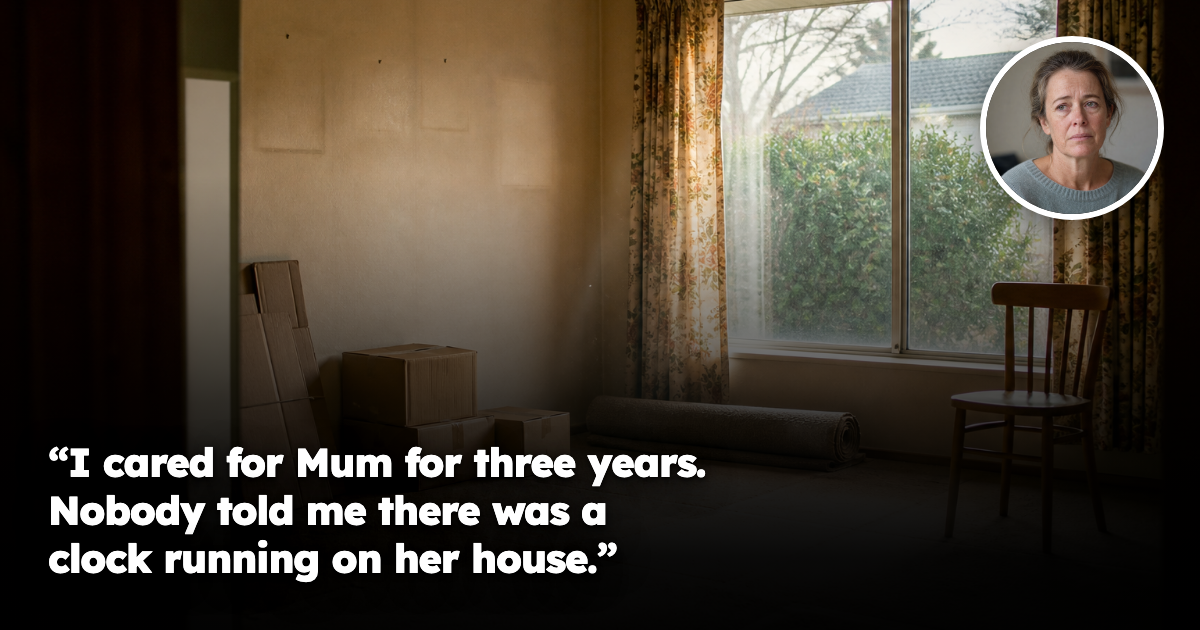
‘I moved in to care for Mum. Eighteen months after the funeral I found out there was a clock running on her house — and nobody told me’
She left her job, moved back into her mother’s house to care for her, and stayed on after the funeral. Eighteen months later an accountant asked when her mother died — and explained what happens at the two-year mark. Australia has no inheritance tax, but there is a clock, and a recent tightening means informal family arrangements may no longer be enough. The bigger trap is not the tax rule — it is whether the house can actually be sold well inside a deadline you do not control.
She did everything right, and that is exactly what makes this question so uncomfortable.
She is 51. She left a job in Adelaide in 2022 and moved back into her mother's house in the eastern suburbs of Melbourne — the house she grew up in — because her mother had a diagnosis and neither of them wanted the alternative. She was there for three years. She was there at the end.
Her mother died in early 2025. There are two other siblings, both interstate, both with their own homes, and none of them were in a hurry. The will divides everything three ways. Nobody is fighting. She stayed on in the house afterwards because she had nowhere else to be and because packing up fifty years of someone's life is not a weekend job.
Eighteen months later, an accountant asked her a question that stopped the conversation: when did your mother die, exactly?
Then he explained what happens at the two-year mark.
She sent us the question that same week, and it is one we get asked constantly in one form or another — usually by someone who is grieving, generally by someone who has been the family member who showed up, and almost always far later than they should have asked it.
The question
"Do we actually have to sell Mum's house within two years of her death to avoid capital gains tax? I've been living in it the whole time. Doesn't that count for something?"
The short answer
The two-year rule is real, and it has not changed. What has changed — or more precisely, what is being read more strictly — is what happens to families who go past it.
Start with the thing that gets misreported constantly, because it matters: Australia does not have an inheritance tax. There is no estate duty and no death tax. When people use that phrase, they are describing something narrower and more technical. Inheriting a house is not itself a taxable event. The tax question arises through capital gains tax, and only when the property is eventually sold.
Here is the mechanism. When someone dies and leaves the home that was their main residence, the estate — or the beneficiaries — can generally sell that home within two years of the date of death and pay no capital gains tax on it. The deceased person's main residence exemption effectively carries through the sale. That is long-standing, it is unambiguous, and it is untouched.
There is a second, separate path: if a surviving spouse continues living in the property as their own main residence, the exemption generally continues for as long as that remains true. A widow living in the family home is not on a clock.
The pressure point is the third case, and it is the most common one in real families: the property is held beyond two years by someone who is not a surviving spouse.
Past that point, the exemption only continues in narrow circumstances — broadly, where a beneficiary has an express right to occupy the dwelling granted under the will, and actually lives there. And the tax office has recently issued a draft determination that reads those words tightly.
Two things in it matter enormously to the woman in this story.
The first is that an informal arrangement is not a right to occupy. A family that all agreed she should stay in the house has not created anything the tax law recognises. The daughter who moved home, gave up her job, provided care for three years and stayed on afterwards is, in this framework, a person living in a house she part-owns with her siblings. Her name is not on the title. The will does not grant her the right to live there. Everybody's decency toward each other is not a legal instrument.
The second is that a testamentary trust is not automatically enough either. The draft draws a sharper line than most families realise between a deceased estate — which arises on death — and a testamentary trust, which is created under the will after the estate has been administered. They are legally distinct, and simply parking the house in a trust does not, by itself, preserve the exemption.
Three honest caveats, because this is exactly the sort of question where the caveats are the useful part.
It is a draft determination, not settled law. It may change. But it is not a new tax and it should not be treated as a scare campaign either — the tax office's position is that it clarifies existing law. What makes it consequential is that it replaces several long-standing interpretations with a stricter reading, which means families relying on how this was handled a decade ago may be relying on something that is quietly no longer there.
Second, the two-year window can sometimes be extended by the Commissioner, in limited circumstances — a contested will, a delay in probate, genuine obstacles outside the family's control. "We weren't ready" has never been on that list.
Third, going past two years does not mean the whole gain is taxed. There are partial exemptions and cost-base rules that can substantially reduce the exposure. It means the certainty is gone, and the number becomes a calculation rather than a zero.
None of which is advice to her, or to you. This is precisely the moment to pay a tax adviser and an estate lawyer, early, and in that order.
The part nobody discusses — and it is the expensive part
Here is what we told her, and it is not about tax at all.
Every conversation about this rule is a conversation about a deadline. Sell inside two years. Beat the clock. And so the entire family energy goes into the calendar.
But a deadline is only half a problem. The other half is whether the house can actually be sold well inside it.
That is not a tax question. It is a property question, and it is the one nobody in the family is qualified to answer — including, very often, the agent who values the place, because a market appraisal tells you what the house might be worth. It does not tell you how long it will take to find the buyer who agrees.
And right now that gap is widening. Combined capital city prices have just recorded their first quarterly fall in more than three years. Listings are at their highest level in over a year. Buyers who would have competed twelve months ago are hesitating, walking away from auctions, waiting to see whether next month is cheaper. A property that has to sell inside a fixed window is being sold into a market that has stopped being in a hurry.
If you are forced to transact by a date, you have surrendered the single most valuable thing a property owner has, which is the ability to say no thanks and wait. Everybody on the other side of the table knows it, too. A deceased estate with a visible deadline is one of the most legible negotiating positions in residential real estate.
So the real question is not "when is the clock up." It is: on this particular street, what does a sale actually look like inside a window I don't control?
Where the street data comes in
This is the work we do, and it is the reason this piece is worth reading past the tax section.
Take the most recent national resale figures. Around 97.4% of house resales in the first half of this year made a profit, at a record median gain of about $458,000, on a typical hold of roughly nine years. On the face of it, selling an inherited family home held for decades looks like a guaranteed win.
Now look inside the average, which is where it always gets interesting.
Perth recorded the highest share of profitable house resales in the country — 99.6%. Almost nobody loses. But when a Perth seller did lose, the median loss was −$213,500 — the largest median loss of any capital city in Australia. Brisbane: 99.5% profitable, and a median loss of −$180,000 when it goes wrong. Melbourne loses far more often — 5.7% of house resales — but for a much smaller median loss of about −$68,500. And more than one in four Melbourne apartment resales recorded a loss outright.
Read that again, because it is the whole argument. How often something goes wrong and how badly it goes wrong are two completely different numbers, and the average tells you neither. A national figure of "97.4% profitable" is true and almost useless to a person with one specific house and a fixed date.
Now scale it down another level, which is where we actually operate. The same divergence that separates two cities separates two streets inside one suburb — same postcode, same median, same school catchment, same council, often the same station. We routinely measure gaps of 20–30% in effective yield between streets that a suburb report treats as identical, using achieved rents rather than advertised ones, actual vacancy duration and real days-on-market.
Days-on-market is the number that matters most here, and it is the one almost nobody looks up before they need it. One street clears in a fortnight to a queue of buyers because the stock is tightly held and rarely comes up. The street behind it — same suburb, same median, same everything in the brochure — takes eleven weeks and finishes with a discount, because there are four comparable houses for sale at the same time and the buyer pool knows it.
For an ordinary owner, that difference is an inconvenience. For an estate with a two-year deadline, that difference is the entire outcome. It is the difference between selling well inside the window at a number the family is happy with, and arriving at month twenty-two with no offer, a tax exposure crystallising, and three siblings who now disagree about the price.
Which produces the practical sequence we gave her, and it is not the order most families use:
1. Establish the date, immediately. Not the funeral, not probate — the date of death. That is when the clock started. Do this in week one, not month eighteen. 2. Get the tax position properly advised before any decision about the house. Whether an express right to occupy exists under the will is a question for a lawyer reading the actual document, not a family consensus about what Mum would have wanted. 3. Then get the street-level picture — real days-on-market, buyer depth, competing supply and achieved prices for that street, not that suburb. This tells you how much of the window the sale itself will consume, which is the only way to know how much runway you truly have. 4. Work backwards from the deadline, not forwards from today. If your street realistically needs four months to sell properly, your decision date is sixteen months in, not twenty-four. Nearly every estate that ends up in trouble made this one arithmetic error. 5. Decide as a family early, while everyone is still being reasonable. Grief has a shelf life on family unity, and so does a deadline.
If you want a sense of how far apart two apparently identical locations can sit, our breakdown of why national home value falls tell you almost nothing about individual suburbs works through the same measurement on live data.
Why this keeps happening
The uncomfortable thread here is that this is not a story about tax law being harsh. It is a story about a family making a series of entirely reasonable human decisions — let her stay, don't rush, we'll deal with it later — none of which were wrong, and all of which had a financial consequence nobody costed.
That pattern is going to repeat at a scale Australia has never seen. Trillions of dollars in property is moving between generations over the next two decades, and most of it will be handled by people who have never sold an investment-grade asset under a deadline in their lives, advised by nobody, at the worst possible emotional moment.
The families who come through it intact will not be the ones who found a clever structure. They will be the ones who worked out early that an inherited house is not a keepsake with a value attached — it is an asset with a market, a buyer pool, a realistic selling timeframe and a hard date, and those four things have to be understood together.
This is the same trap we mapped in what happens when the tax treatment of a jointly-owned property changes on death, and in why separating couples so often sell badly. Different laws, identical failure mode: a life event imposes a timeline, and the property was never chosen — or understood — with any timeline in mind. It is worth knowing, too, that the obvious fallback of renting it out instead when the sale doesn't happen is not always available either.
What it means for you
If you own property and you have children, the version of this that costs your family the most is the one where you assumed it would sort itself out. A will that says "the house goes to the three of them" and a will that grants a named child an express right to occupy it are two very different documents, and only one of them protects the child who moved home to look after you. That costs a conversation with a lawyer, once.
If you are the beneficiary, the date of death is the most important number in your inheritance, and almost nobody writes it down.
And if you are an investor watching all of this from the outside: the lesson is not that property is a tax minefield. It is that the ability to sell well, quickly, when you have to is an asset characteristic — as real as the yield, and priced by almost nobody. You cannot buy it after the event. You buy it, or fail to, on the day you choose the street.
Which is the reason we keep pulling the conversation back down to that level. Nationally, 97.4% of sellers are still making money and the median gain is at a record high. That is a genuinely good market to own an asset in. But the same dataset shows the median loss, when it happens, ranges from about $60,000 to over $213,000 depending on where you are standing — and the market has just started to sort winners from losers more aggressively than it has in three years.
None of that is an argument against owning property. It is an argument against owning an average one. The families that will look back on this wealth transfer as the thing that set them up are the ones holding assets that a buyer wants on a Tuesday in a soft month — and that has never been decided by the suburb on the letterhead. It is decided by the street, and it is knowable in advance, by anyone willing to actually look.
She has about four months of clean runway left, on our reading of her street. That is enough. It would not have been in six weeks' time.
If there's a specific street you're weighing up right now, check its Street Score first — it's free, takes ten seconds, and tells you whether that street is pulling the suburb average up or riding on it.
Market data & R-Scores for locations in this article
Drill Down Into the Markets Mentioned Above
Inspect live monthly R-Scores, median prices, rental yields, and street-by-street scores for the cities and council areas referenced in this article:
Frequently asked questions
Do you have to sell an inherited house within two years in Australia to avoid capital gains tax?
Generally, yes: if a deceased person’s main residence is sold within two years of death, the capital gains tax exemption can still apply. Australia does not have inheritance tax, so the issue is capital gains tax on sale, not on inheriting the property.
Does living in your mum’s house after she dies stop the two-year clock?
Not by itself. The article says the two-year period starts on the date of death, and simply staying in the house because family agreed to it is not the same as having a legal right to occupy it.
When can the exemption continue after the two-year mark?
The article says it can continue in narrow cases, including where a surviving spouse keeps living in the home as their main residence. It may also be extended in limited circumstances by the Commissioner, such as probate delays or other genuine obstacles outside the family’s control.
Why is a family agreement not enough to protect the house from tax issues?
Because the tax law looks for an express right to occupy under the will, not just an informal family understanding. The article says decency between siblings is not a legal instrument, so a lawyer needs to read the actual will.
What should a family do first if they inherit a home and may need to sell it?
First, establish the date of death, because that is when the clock starts. Then get legal and tax advice on the will and the occupancy rights, and only after that assess the street-level sale timing, because the house may need to sell well before the deadline.
General information only. It does not take your objectives, financial situation or needs into account, and nothing here is legal, financial, taxation or investment advice specific to your circumstances.