News · 21 October 2026 · 4 min read
He checked the licence and it was real. Investors still fear $138m is gone. What was he checking?
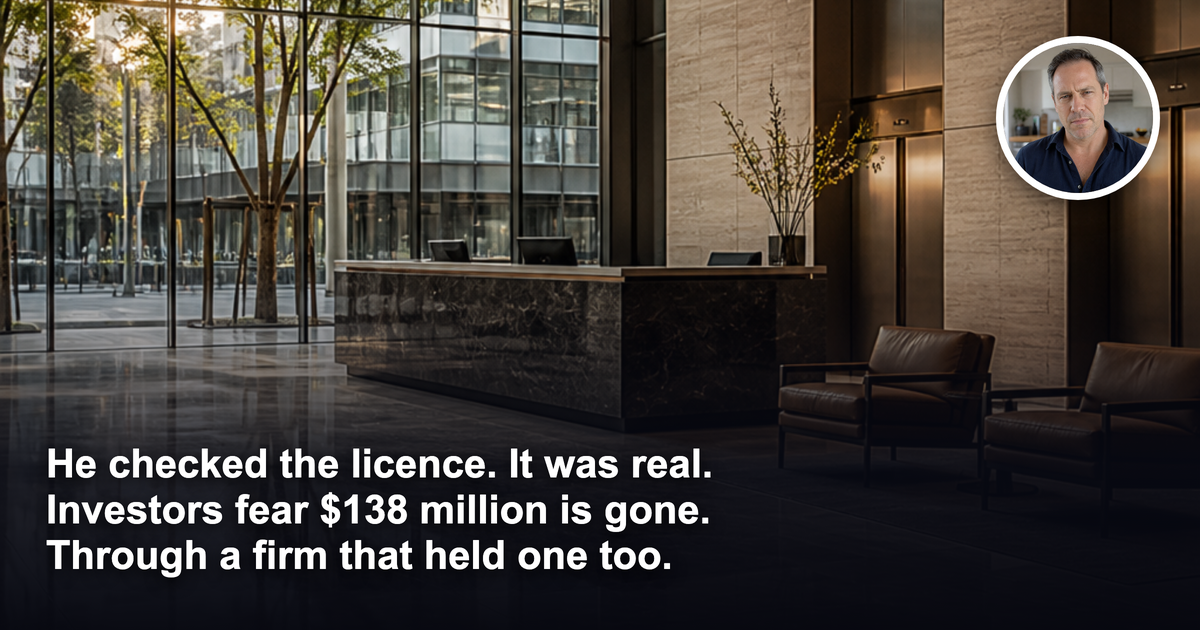
He is 43. He is three months out of a divorce settlement, has his daughter every second week, and has about $220,000 sitting in a bank account that did not exist in March.
He is 43. He is three months out of a divorce settlement, has his daughter every second week, and has about $220,000 sitting in a bank account that did not exist in March.
He is a composite illustration, not a real person. The decision in front of him is common enough that he could be a dozen people.
He did what careful people do. He found a firm that holds an Australian Financial Services Licence. He looked it up on the regulator's register. The licence number matched. The office was in a decent building. The engagement letter is on his kitchen bench, signed, waiting for a stamp.
Then on Tuesday the ABC reported that a Sydney firm holding the same kind of licence is being investigated over its links to suspected scammers, and that investors fear as much as $138 million may have been lost.
The question
"I checked the licence. It was real. If a licensed firm can be linked to an alleged scam without anyone catching it, what was I actually checking?"
The answer: a licence is where due diligence starts
A licence tells you one thing. It tells you the firm was granted permission to give financial advice or deal in financial products. It does not tell you who is running the money today, how they are paid, what they did with the last client's capital or whether anyone outside the firm has ever checked their results.
The Sydney case is still under investigation. Nobody has been found guilty of anything. The $138 million is a figure investors fear may be lost. It has not been proven. Those caveats matter and we are keeping them.
But the shape of the story is already clear, and it is the shape that should worry him. A licence was held. Money moved. The people who handed it over believed the licence meant something it never meant.
The three things the licence never checked for him
How the firm gets paid. If the adviser earns more when you buy a particular product, a particular development or a particular fund, the advice is a sales pitch with a disclaimer attached. Ask for the fee in dollars. Then ask whether a developer, a builder or a fund manager is also paying them for access to your capital.
Whether the results exist in public. Any firm can show you a brochure. Very few publish the full spread of client outcomes, including the ones that went badly. If the only evidence on offer is awards, a charismatic founder and a review count, you are being asked to take results on faith.
Who holds the title. This is the one that decides whether a bad outcome is painful or catastrophic. If your money goes into an account the firm controls, or a pooled vehicle you cannot withdraw from, or a product where you never see a title deed with your name on it, you have given away control along with the capital. If you own the asset in your own name, on your own title, with your own lender, the worst an adviser can do is give you a mediocre recommendation. They cannot make the asset disappear.
The $220,000 on his kitchen bench was about to go into the first category.
What it means for you
Most readers of this page are at the same fork. Household income is good. The home has equity. The super is doing its thing. They are short on time rather than money, and so the temptation is to hand the whole decision to someone with a licence and a nice office.
Delegation is a good idea. Surrendering control is a different idea, and the gap between the two is the whole game.
A delegated process looks like this: someone else does the research, the shortlisting, the negotiation and the management, and you keep the title, the loan and the right to say no. A surrendered process looks like this: you sign an authority, the money leaves, and you receive a quarterly statement.
The first can be audited at any point by anyone you like. The second can only be audited once it is too late.
Where the money actually goes wrong
Investors who lose large sums rarely lose them in a single bad decision. They lose them because they had no way to see the decision being made. Two streets in the same suburb can be having completely different outcomes, and an investor who holds the title and the data can see that and act. An investor who holds a unit in someone else's fund sees whatever the fund chooses to report.
That is the Ripehouse reframe, and it is deliberately unglamorous. The right asset, on the right street, in your own name, chosen on data you can check, beats a headline and it beats a licence. Structure protects you. Trust on its own does not.
We publish our client results, including the portfolios that underperformed, because an investor should never have to take an adviser's word for it. Across 997 client portfolios since 2021, median portfolio growth has been +19.0 per cent a year on a 5-year rolling basis, against roughly 4.3 per cent nationally (benchmark: CoreLogic/Cotality). Past performance is not a guarantee of future results. The point of publishing the number is that you can check it, and that you can see the portfolios below it.
He has not posted the letter. He still holds the $220,000. He is going to ask the three questions first.
Want to see how a decision like this is tested asset by asset and street by street, with you keeping the title? Join Jacob's free live webinar.
If there's a specific street you're weighing up right now, check its Street Score first — it's free, takes ten seconds, and tells you whether that street is pulling the suburb average up or riding on it.
General information only. It does not take your objectives, financial situation or needs into account, and nothing here is legal, financial, taxation or investment advice specific to your circumstances.