News · 4 August 2026 · 7 min read
'I bought my first home in February with a 5% deposit. I've just been told I owe $41,000 more than it's worth — do I sell before it gets worse?'
He bought in February with a 5 per cent deposit, on a 30-year loan, in an estate that was still selling stage seven. Five months later a bank valuation came back $41,000 short of what he paid. He is now one of tens of thousands of Australians being described in headlines as a wipe-out statistic — and the advice he is getting is the most expensive advice he could take.
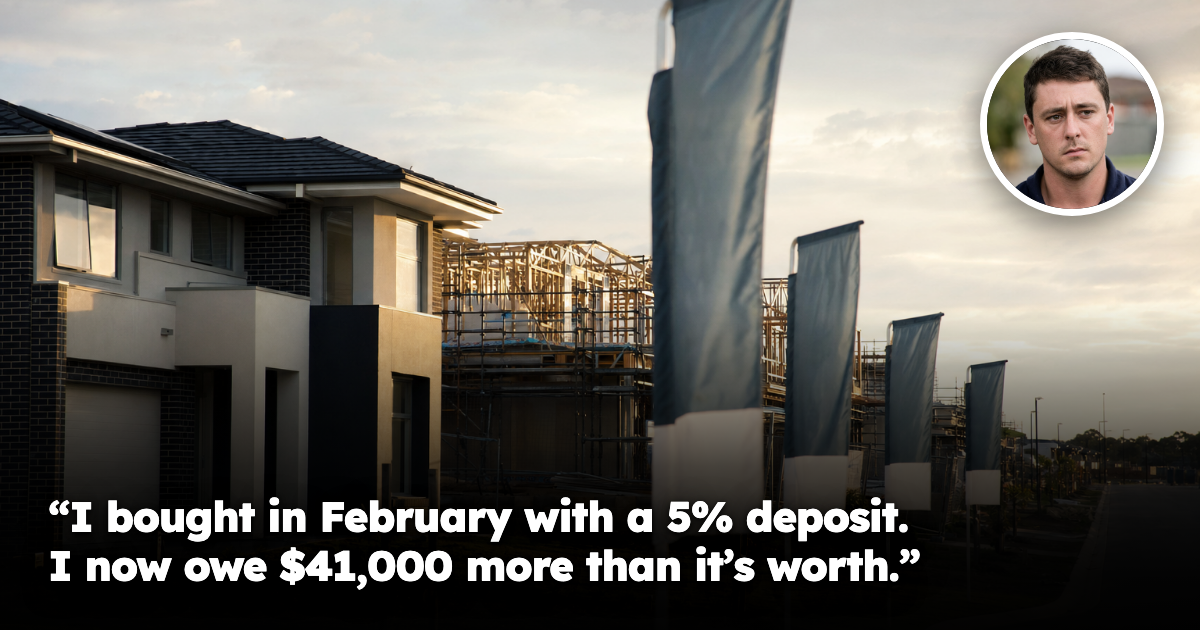
He is 29. He is a diesel mechanic. He and his partner had saved for four years, missed out on eleven properties, and finally got a contract signed in February on a four-bedroom house-and-land package in an outer-ring growth corridor — three bedrooms plus a study, double garage, still smelling of paint.
They got in with a 5 per cent deposit under a government guarantee scheme. Their parents cried. They posted the key photo.
Five months later they went to refinance off the builder’s rate, and the bank’s valuation came back at $41,000 below what they paid.
The question he sent us
“I bought my first home in February with a 5 per cent deposit. I’ve just been told I owe $41,000 more than it’s worth. The news is saying tens of thousands of us are in the same boat and it’s going to get worse. Do I sell now before it does?”
We are getting this question, in various forms, several times a week at the moment. It arrives with a particular tone — not curiosity, something closer to nausea. And it is almost always accompanied by a screenshot of a headline with a very large number in it.
So let’s deal with the number first, because the number is doing a lot of work it hasn’t earned.
The answer: you have not lost anything yet
Here is the part nobody puts in a headline. Negative equity is not a loss. It is a snapshot of a ratio.
A loss is an event. It happens on one day, at one moment: settlement, when you sell. Until that moment, the gap between your loan balance and someone’s estimate of your property’s value is an accounting position, not a transaction. It costs you nothing. It does not change your repayment. It does not trigger a margin call — residential mortgages in Australia don’t work that way. Your bank cannot ring you up and demand the $41,000.
The only way that $41,000 becomes real money is if he sells. Which is precisely why the advice to “sell before it gets worse” is the single most expensive thing he could do: it would convert a paper number into a crystallised loss, plus agent commission, plus marketing, plus the stamp duty he paid in February that he will never see again — and it would put him back into a rental market where rents are at record levels in every single capital city.
He would be swapping a theoretical $41,000 into a real loss of something closer to $80,000, and then paying record rent for the privilege.
The numbers behind the panic, in context
The falls are real. National prices have now declined for four consecutive months. Across the five major capitals values fell around 0.9 per cent in July alone, and about 2.0 per cent across the July quarter. Sydney is down roughly 1.4 per cent for the month and Melbourne 1.2 per cent, with both cities now around 5 per cent below their peak. Auction clearance rates have sat under 50 per cent for nine straight weeks. This is a genuine, broadening correction and it is silly to pretend otherwise.
But hold two other facts next to those.
First: in the six months to June, 97.4 per cent of houses resold in this country made a profit — with a record median gain of around $458,000. The share of loss-making resales did tick up, and that is a real early crack worth watching: in Sydney it moved from 2.0 to 2.4 per cent, in Melbourne from 4.4 to 5.7 per cent. Those are meaningful moves. They are also, still, a very small tail of a very large distribution.
Second: the share of borrowers actually in negative equity nationally sits below 1 per cent. Not 20 per cent. Not 10. Below one.
So how do we reconcile “below 1 per cent” with headlines about tens of thousands of people and hundreds of billions wiped out? Easily — both are true, and they are measuring different things. Hundreds of billions in paper value can evaporate from a multi-trillion-dollar asset class without most owners moving an inch, and tens of thousands of underwater buyers is simultaneously a large, distressing human number and a tiny fraction of the market.
The people genuinely exposed are a narrow, specific group: buyers who purchased near the peak, with a very small deposit, in a very particular kind of location. Which brings us to the only part of this that actually predicts anything.
Where the real answer lives: the street, not the headline
Everything above is a national average. National averages have never once told an individual owner whether they are in trouble.
When we run our research engine, we score at street level, and the divergence inside a single postcode right now is the widest we have seen in years. The gap between the best and the worst street inside one suburb is routinely wider than the gap between two suburbs buyers agonise over choosing between.
Here is what that looks like in this exact scenario. Take one outer-ring growth suburb. On one side sits an established pocket built out fifteen years ago: no remaining developable land, deep owner-occupier ownership, tight days-on-market, low vacancy, and buyers who compete on the street’s reputation. Two kilometres away, in the same suburb, on the same portal median, sits an active greenfield estate still releasing stages — where the developer is the competition, where a buyer can choose a brand-new house at today’s price instead of a two-year-old one at yesterday’s, and where every new stage release resets the comparable sales your valuation is built on.
Those two addresses are indistinguishable in a suburb report. They are not remotely the same asset. The established pocket is holding. The estate mid-release is where the valuations are coming back short — not because the suburb is bad, but because you cannot outrun your own supply pipeline. It’s the same effect we mapped when we compared five NSW towns and found the real story was in the streets, and the same reason a headline national figure of −0.4 per cent can hide suburbs that are still running hard.
That’s the diagnosis he actually needed, and it’s the one no headline could give him. His question wasn’t “is the market falling”. It was “am I in trouble” — and those are completely different questions with completely different answers.
What this means for you
If you’re underwater on a home you live in and can afford: do nothing. Genuinely. Negative equity only matters if you are forced to sell, and the two things that force a sale are job loss and rate shock. Unemployment is low, and further rate rises are off the table for now after a softer-than-expected inflation print. Your job is to protect your serviceability buffer, not your valuation.
If you’re underwater and you might need to move within three years: this is where you need actual analysis, not a headline. Whether you’re looking at a two-year problem or a seven-year problem depends almost entirely on the supply pipeline within a few kilometres of your front door. That is knowable. Get it modelled.
If you’re a buyer or investor watching this: understand what is being handed to you. The auction clearance rate is under 50 per cent, listings are climbing in Brisbane, Perth and Adelaide, and vendor expectations are finally moving. Meanwhile investor mortgage applications have fallen sharply — which means less competition in the exact window where negotiating leverage is at its highest.
The bottom line
There is a supply floor under this market and it is made of concrete and labour costs. Building a new home now costs around 51 per cent more than it did at the end of 2019. When established housing gets cheaper than the cost of delivering new supply, projects stop stacking up, construction slows, fewer homes get built, and the shortage that caused all of this gets worse — pushing buyers back into established stock. That is the mechanism that has ended every Australian housing correction of the modern era, and nothing about it has been repealed.
So no, he should not sell. He should hold the asset, protect the buffer, and stop reading the number.
And the deeper lesson in his story isn’t that property is dangerous. It’s that the property was never the risk — the selection was. He bought a fine house in an average position in an estate competing against its own next stage, at the top of a cycle, with a 5 per cent deposit and no analysis underneath the decision. Same suburb, different street, different outcome entirely. Plenty of people who bought in the same month are perfectly fine.
Property remains the most reliable wealth-building asset most Australians will ever touch, precisely because it rewards preparation over timing. The buyers who get hurt are the ones who bought a postcode and a floorplan. The ones who do well — through this correction and every one before it — are the ones who knew, street by street, exactly what they were buying and why. The headlines have already been wrong more than once this year. The data underneath them hasn’t been.
If there's a specific street you're weighing up right now, check its Street Score first — it's free, takes ten seconds, and tells you whether that street is pulling the suburb average up or riding on it.
Market data & R-Scores for locations in this article
Drill Down Into the Markets Mentioned Above
Inspect live monthly R-Scores, median prices, rental yields, and street-by-street scores for the cities and council areas referenced in this article:
Frequently asked questions
If a bank valuation comes in below what I paid for my Australian home, does that mean I’ve already lost money?
No. The article says negative equity is a snapshot of your loan-to-value ratio, not a real loss unless you sell. Your repayment doesn’t change, and your bank cannot demand the shortfall on a residential mortgage.
Should I sell my home now if I’m $41,000 underwater?
The article argues no, not if you can afford to keep the home. Selling would turn a paper gap into a real loss, plus selling costs and the stamp duty you already paid.
Who is actually most at risk of negative equity in Australia right now?
The article says it is a narrow group: buyers who purchased near the peak, with a very small deposit, in specific outer-ring growth areas or estates still releasing new stages. Nationally, the share of borrowers in negative equity is still below 1 per cent.
Why can a new estate be valued below purchase price even if the suburb itself is okay?
Because the issue can be the supply pipeline, not just the suburb. In a greenfield estate still releasing stages, new stock competes with your home and resets comparable sales, which can pull valuations down.
What should I focus on if I’m underwater but staying in the property?
The article says to protect your serviceability buffer and avoid panic selling. If you may need to move within three years, the important next step is to look at the supply and demand around your specific street, not the national headlines.
General information only. It does not take your objectives, financial situation or needs into account, and nothing here is legal, financial, taxation or investment advice specific to your circumstances.