News · 11 August 2026 · 9 min read
'They're building it behind my back fence.' A homeowner asked us what it does to his property — and the answer wasn't the noise
A homeowner found out a data centre is being built behind his back fence. He asked us about noise and power bills. The number that actually matters is the one describing how many buyers will still turn up.
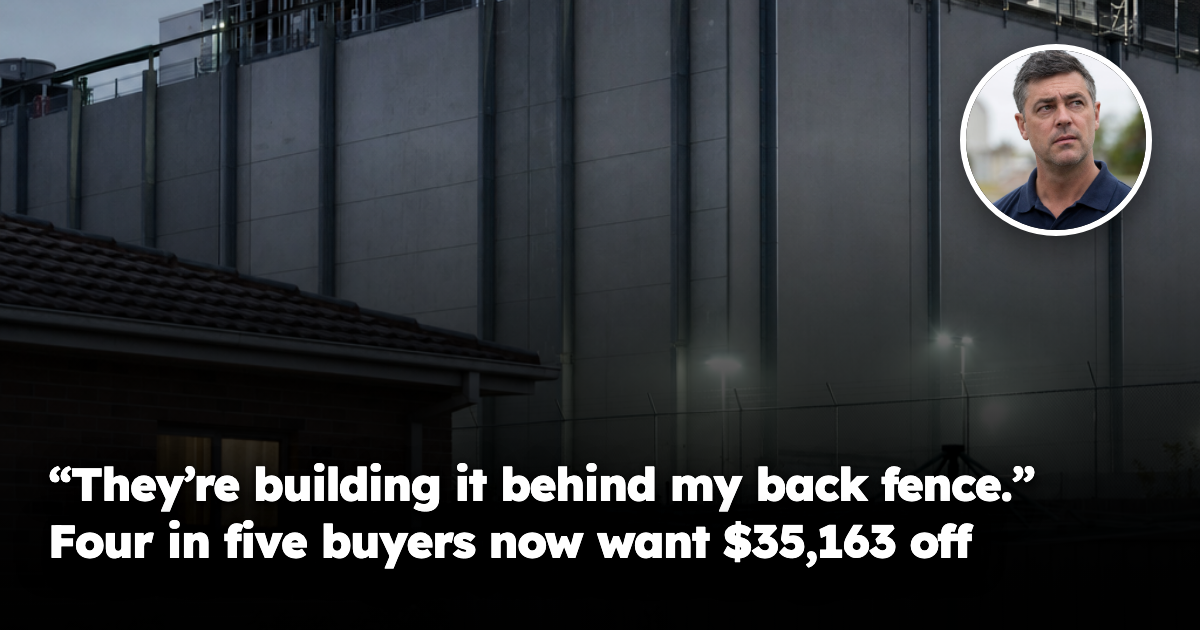
He found out from a letterbox drop, which is how most people find out.
The man who wrote to us is 47, works in logistics, and has owned the same house in an outer-middle-ring suburb of a major capital for nineteen years. He also kept his first home when he upgraded — a smaller place fifteen minutes away — and rents it out, which makes him something he has never really thought of himself as: an investor.
Nothing has gone wrong for him. He has not lost a dollar. His mortgage is comfortable, his tenant is good, and his house is worth roughly three times what he paid.
Then a notice arrived about a development application for a data centre on the industrial-zoned land backing onto his street.
His question was the one almost everybody asks first: how loud is it going to be, and is it going to push my power bill up?
Reasonable questions. They are also the least expensive ones. Because what will most likely determine the value of his family's largest asset is not the noise, the water pressure or the electricity price.
It is how many people will still show up to bid.
The number that should have his attention
New national research put the question directly to buyers rather than to economists. In a sample of a thousand Australians, 83 per cent said they would need a discount before they would consider buying a property near a data centre. The average discount required was $35,163, and the overwhelming majority of those who wanted one wanted more than $30,000.
Sit with the first number rather than the second, because the first one is doing almost all of the work.
$35,163 is a headline figure, and headline figures invite an argument about whether they are right. Perhaps in his suburb it is $12,000, or $60,000. Reasonable people can disagree about the size of a discount.
83 per cent is a different kind of number entirely. It is not a price. It is a description of the buyer pool — and it says that better than four in five buyers now attach a condition to a property in that location that they would not attach to an identical property somewhere else.
That is the mechanism. Australian residential property is not priced by valuation formulas. It is priced by competition on the day — by how many finance-ready buyers turn up and how badly they want it against each other. Remove four in five of them and you have not reduced the price by a formula. You have removed the contest, and the contest is what produces strong results.
Compressed buyer pools do something worse than lowering a price. They lower its reliability. A property with deep demand has a range of outcomes. A property with thin demand has a lottery: it depends entirely on whether the one or two buyers comfortable with it happen to be in the market the month you need to sell. That is a fundamentally different asset to own, and almost nobody prices it until they are the one standing at the auction.
Why this is not the usual "bad neighbour" story
Australian buyers have discounted proximity to things for as long as there has been a housing market. Main roads, flight paths, rail lines, high-voltage easements, substations, industrial land, waste facilities. None of this is new, and there is nothing unique about a data centre as an object.
It is also worth separating this from the kind of story it superficially resembles. When a house is newly mapped as flood risk despite never having flooded, nothing physical has changed — a model got better and an administrative line moved. This is the opposite. Nothing on paper has changed at all. Something is being built, in the physical world, that a person can stand in their yard and look at.
What is new is the pace and scale of the rollout, and the fact that most people affected have no prior experience to draw on.
As at March 2026 there were around 162 data centres operating in Australia, the majority in New South Wales, with roughly 90 more in the national pipeline. One proposal now before planners would be among the largest single electricity users in the country. Money is moving into this asset class faster than community understanding of it is forming, and it is landing on industrial and semi-industrial land — which in Australian cities is very often directly adjacent to established, affordable, family housing.
Overseas, where the rollout started earlier, residents near large facilities have reported persistent low-frequency noise from cooling plant, concerns about water use and pressure, and anxiety about what large new electricity loads do to their bills. We would be careful about importing that experience wholesale — different climates, grids, planning regimes and building standards. But it is a fair guide to what Australian buyers will have read by the time they are standing in the driveway deciding whether to bid.
And that is the part worth being clear-eyed about: the buyer discount is not a measurement of the harm. It is a measurement of the perception of the harm. Those are different things, and for the owner of the house they have the same effect on the sale price.
The part that gets missed: this is measured in metres
Here is where the standard advice fails people, and it fails them expensively.
If you look up his suburb today you will find a median price, a growth chart, a rental yield and days-on-market figure. Not one of those numbers is capable of answering his question — because a data centre does not affect a suburb. It affects a radius.
The house whose back fence adjoins the site and the house eleven streets away share a postcode, a council, a median, a school catchment, a train station and a census profile. Every suburb-level metric will report them as the same asset. The market will not. It will treat one as carrying a condition that four in five buyers want compensating for, and the other as an ordinary house. The suburb median averages both — which means that as the effect appears, the median will move gently and tell almost nobody the truth about their own address.
This is the same structural point we make about streets in every market we research, and it is why we work below suburb level as a matter of course. In the ordinary case, the best and worst streets inside a single suburb routinely differ by 20 to 30 per cent on effective yield once you use achieved rents rather than advertised ones, real vacancy duration rather than a headline vacancy rate, and true days-on-market rather than the number an agent quotes. Same postcode. Same median. Materially different assets.
It is the same arithmetic that decides whether a $210,000 renovation adds anything at all — a spend can move a house within its street's range, but it cannot move the range — and the same reason a school catchment boundary can be worth $380,000 inside one suburb. Different instruments, one finding: the things that most move an individual property's value do not average.
A large physical externality is simply the loud, visible version of what is normally invisible: aspect, slope, road hierarchy, lot geometry, what backs the rear fence, how deep the local buyer pool actually is. Most of the time these things are subtle and the suburb average buries them. Occasionally something arrives that is four storeys tall and impossible to miss — and the useful thing about the obvious case is that it makes the principle undeniable.
If you accept that a building behind one back fence can be worth $35,000 and not affect a house eleven streets away, you have already accepted that suburb-level data cannot answer a question about an individual address.
So what did we tell him?
Four things, in order.
First: establish what is actually proposed, from the planning documents rather than the letterbox drop. A development application is a proposal, not a building. It may be refused, scaled down, heavily conditioned on acoustic treatment and operating hours, or withdrawn when the power connection proves unavailable — which in several Australian markets right now is a genuine constraint rather than a formality. The application will tell him the footprint, the height, the setbacks, the plant locations and the noise conditions. It is free and public, and worth more than every conversation he will have about it over the fence.
Second: work out which of his two properties this is actually about. This is the question he had not asked. His home backs the site. His rental is fifteen minutes away and completely unaffected — and it is the rental, not the home, that he was quietly thinking of selling in a few years. He had spent a fortnight worrying about the wrong asset. Establishing that took ten minutes and changed the entire decision.
Third: understand that a discount, if it comes, is a one-time repricing rather than an ongoing decline. This is almost always misunderstood. If the buyer pool narrows, the market adjusts to that fact once; it does not adjust again every year forever. An owner who panics into selling during the repricing pays the whole cost in a single transaction. An owner who holds through it, somewhere otherwise sound, holds an asset with a lower floor but the same growth drivers — the same city, the same jobs, the same undersupply of housing. Forced sellers pay for externalities. Patient owners frequently do not.
Fourth: don't buy the house next to it without checking. The reverse of his problem is someone else's opportunity, or someone else's mistake, depending entirely on whether they knew. Land use adjacent to a residential street is public information, free, and available before contracts are signed. Zoning maps, application registers and planning portals are open to anyone. The most common way Australians acquire a problem like this is not bad luck. It is not looking.
What this actually says about property
It would be easy to read this as a reason for caution. It isn't one.
Strip it back and what the story really demonstrates is that Australian residential property is priced with enormous precision at the level of the individual address, and with almost none at the level of the suburb. Four in five buyers can distinguish between two houses in the same postcode and put a five-figure number on the difference. That is not a market failing. That is a market working extremely well — and it is only frightening if you are on the wrong side of it without knowing.
The corollary is the part investors should sit with. If the market can price a negative that precisely, it prices positives just as precisely — the quiet street off the arterial, the side of the road with the northern rear aspect, the pocket where nothing can ever be built behind you because it already is built, or it is reserve. Those advantages are just as real, just as local, and just as invisible in a median. They are simply less newsworthy, so nobody writes about them.
None of this makes property a worse asset. Around 162 facilities exist and 90 more are coming, and the overwhelming majority of Australian houses will never be near one. What it makes is a stronger case for the thing that has always been true: the returns in this asset class come from selection, and selection happens below the suburb. The headlines are national, the medians are suburban, and the money is made and lost within a few hundred metres.
He hasn't lost anything. He has been handed something most owners never get — advance notice, in writing, before it is priced in, with time to check the documents and decide deliberately rather than react.
He had owned that house for nineteen years before he ever looked at what the land behind it was zoned for. Almost everyone does it in that order.
If there's a specific street you're weighing up right now, check its Street Score first — it's free, takes ten seconds, and tells you whether that street is pulling the suburb average up or riding on it.
Frequently asked questions
If a data centre is being built behind my house in Australia, what is the main thing that could affect my property value?
The article says the biggest issue is not noise or power bills, but how many buyers will still turn up when you sell. If most buyers want a discount to live near a data centre, the buyer pool shrinks and that can weaken the sale price.
Does a data centre nearby affect an entire suburb the same way?
No. The article says a data centre affects a radius, not a suburb, so homes right next to it may be treated very differently from homes several streets away. Suburb-level medians can hide that difference.
What should a homeowner check first if they receive a notice about a data centre proposal?
They should look at the actual planning documents, not just the letterbox drop. The application will show the footprint, height, setbacks, plant locations and any noise conditions, and it may still be refused, scaled down or withdrawn.
Is the price impact from a nearby data centre usually ongoing every year?
The article says it is usually a one-time repricing, not a permanent annual decline. If the market adjusts to the new information, owners who sell during that repricing can bear the cost immediately.
How can a buyer avoid accidentally purchasing a property next to a data centre site?
By checking zoning maps, application registers and planning portals before signing contracts. The article says land use adjacent to a residential street is public information and should be checked in advance.
General information only. It does not take your objectives, financial situation or needs into account, and nothing here is legal, financial, taxation or investment advice specific to your circumstances.