News · 12 August 2026 · 9 min read
A tower went up 200 metres away. My agent says it just cost me $87,500 — for something I can only see from the driveway
He can't see the tower from the kitchen, the lounge or either bedroom. He can see it from the driveway, and an agent has told him that alone is worth $87,500. The question he asked us cuts to something bigger than towers — because the same research that measures the discount also found buyers punish the opposite problem harder. Both effects are invisible to every suburb metric ever published.
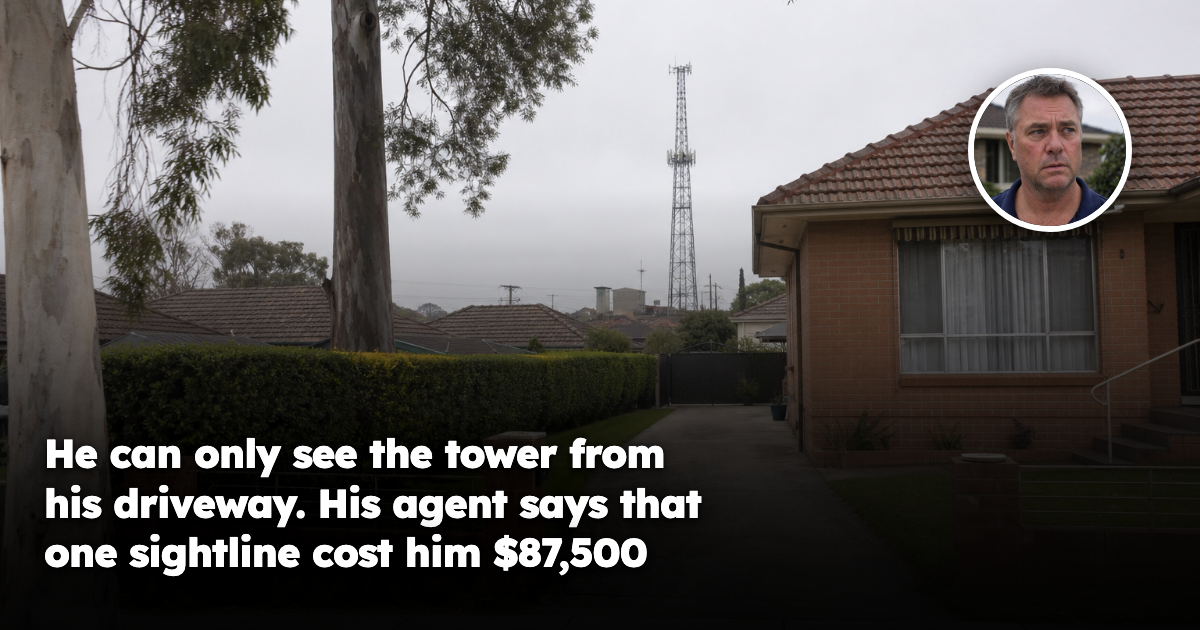
You can't see it from the kitchen. You can't see it from the lounge, or either bedroom, or the back deck where he spends most of a Sunday.
You can see it from the driveway, standing at the letterbox, looking north-east over next door's roofline. A lattice mast about 200 metres away that wasn't there two years ago.
An agent walked through his house last month, stood in that exact spot, and told him it had cost him around five per cent.
The question
He wrote to us with a version of a question we're now getting most weeks:
"There's a mobile tower about 200 metres from my house. You can only see it from the driveway — not from inside. An agent told me it takes about five per cent off, which on my place is something like $87,500. Nothing about my house has changed. Is that real, or is he softening me up for a low offer before I list?"
It's a fair suspicion. Agents have been known to pre-condition a vendor. But in this case the number he was quoted is close to what the research says, and the honest answer is more uncomfortable than either of us would like.
The short answer: yes, it's real — and it's bigger than most people expect
Recent Australian research put a figure on exactly this. On an average Sydney home valued at $1.75 million, a 5G tower visible from the property was associated with a loss of at least $87,500 from the asking price. That's the five per cent his agent quoted, and it wasn't invented on the driveway.
The behavioural numbers underneath it are the more interesting part:
- 55% of buyers said they would not pay full market value for a home with a visible tower.
- 23% said they would refuse to buy a property with one in sight at any price.
- Younger buyers are the harshest. Around 62% of millennials reported an overall aversion, and roughly 27% of both boomers and gen X said they would never buy at all.
Read that second number again, because it is the one that actually matters, and almost nobody reads it correctly. Twenty-three per cent will not buy at any price. That is not a discount. That is a quarter of the buyer pool deleted before your first open home.
And this is not a rare or shrinking problem. There are now more than 15,000 5G-capable towers across Australia. One carrier alone operates over 6,400 of them, and its installations in 2025 ran more than 250% above the year before. Whatever you think about the technology, the infrastructure is arriving faster than the market's opinion of it is settling.
The part nobody mentions: the same research found the opposite problem is worse
Here's where it stops being a story about towers.
The same body of research asked buyers about homes with no signal. The result:
- 61% said they would not buy a property at all if they found it was in a mobile blackspot.
- Another 14% would buy, but only at a discount.
Sixty-one per cent versus twenty-three per cent. Buyers punish the absence of the infrastructure roughly three times harder than they punish the sight of it.
And it runs further in the same direction. Around 39% of buyers said they'd pay more for a home with the best available fibre connection — on average about $2,000 more, and more than $5,000 in the case of around one in seven millennials. Gen Z valued a fast connection at nearly triple the rate of baby boomers.
So the same category of infrastructure is a liability when you can see it and an asset when you can use it. The tower that costs you $87,500 from the driveway is part of the network whose absence costs a seller more.
Nobody is being irrational here. People are pricing two different things — how a property looks and how it works — and they are pricing them independently.
What's actually being priced
Let's be careful about one thing, because it's where this conversation usually goes wrong.
We're not going to litigate whether the towers are safe. The World Health Organisation's position on that is public, and it isn't ours to relitigate. It also isn't the point, because a valuation doesn't measure whether a concern is justified. It measures how many buyers hold it.
That distinction matters enormously. If half of your buyers are wrong about something, your property still sells for what the remaining half will pay. Sentiment you disagree with spends exactly the same as sentiment you share.
Which brings us to why this factor bites harder than its size suggests. There's a line we've heard from owners in this position more than once, and it's the cleanest summary of the whole problem: you can renovate a kitchen or repaint a house, but you can't do anything about a tower that's already there.
That's the real divide in property, and it has nothing to do with towers. Every attribute of a property is either fixable or fixed. Kitchens, bathrooms, carpet, paint, landscaping, even floor plans are fixable — they're a budget and a timeline. Aspect, slope, road hierarchy, what backs onto the rear fence, what you can see from the driveway: fixed. You inherit them at settlement and you hand them to the next buyer.
Buyers discount fixed attributes far more aggressively than fixable ones, because a fixable problem is a negotiation and a fixed one is a permanent condition of ownership. That is also why the discount is so uneven. A tower behind a mature stand of trees is a non-event; the same tower on a clear sightline over a low roofline is a five per cent conversation. Same suburb. Same street. Sometimes the same side of the street.
We've made this argument before in a different setting — a property on a busy road can sell for materially less than its suburb median while a house 100 metres back doesn't, and the mechanism is identical.
Why your suburb report will never tell you this
Here is the part that should genuinely bother anyone who researches property by postcode.
Every micro-factor we've written about is measured in distance. Within ten metres of a street tree. Within a hundred metres of an arterial. Within a radius of a data centre. Distance is at least mappable — you can draw a circle and know who's inside it.
This one is measured in line of sight, and a sightline cannot be drawn on any map.
It depends on the height of the mast, the fall of the land, the pitch of the roof next door, whether the neighbour's liquidambar is forty years old or was taken out last winter, and which way the block faces. Two houses forty metres apart on the same side of the same street can have entirely different answers. One vendor has a five per cent conversation; the other has no conversation at all.
There is no suburb median that sees that. There is no postcode-level growth chart, no days-on-market figure, no census profile, no school catchment and no vacancy rate that sees it either. Both houses sit inside every identical metric, and they are not the same asset.
This is why we keep coming back to the same uncomfortable arithmetic: the gap between the best and worst streets inside a single suburb routinely runs to 20–30% on effective yield — measured on achieved rents, real vacancy duration and true days on market, not asking rents. The gap between two addresses on one street is smaller, but it is not zero, and on a $1.75 million asset five per cent is $87,500. That's a deposit.
It's the same lesson as a $210,000 renovation that added almost nothing to a home's value: the suburb sets the conversation, the street sets the range, and the individual address decides where in that range you land.
What we'd actually do about it
If you own one:
Establish whether you have a sightline problem or a map problem. Stand where a buyer stands — the driveway, the front door, the main living space, the primary bedroom window, the outdoor entertaining area. If a tower is invisible from every room a buyer will care about and only appears from the letterbox, you have a far smaller problem than the headline number implies, and you should not accept a five per cent haircut without argument.
Price the screening before you accept the discount. This is the same calculation we'd run on any position problem. Advanced screening planting, a repositioned deck, or a rebuilt sightline from the main living area can be a four-figure exercise against a five-figure discount. Sometimes it doesn't work. But it should be a calculation, not an assumption.
Test your signal, then say so. If the discount runs on connectivity anxiety, connectivity data is your rebuttal — and if you're in a blackspot instead, you now know you're facing the bigger of the two penalties and should plan a fix rather than discover it at the third open home.
If you're buying:
Do the driveway test on every property on your shortlist, and do it before you fall in love with the kitchen. It costs nothing and takes eleven seconds.
Then ask the far more valuable question: is this property discounted for a problem it genuinely has, or for a category it merely belongs to? Because those are not the same property, and the market frequently cannot tell them apart.
The bit that's actually good news
It would be easy to read all this as one more reason to be nervous. We'd argue the opposite, and fairly hard.
A researcher in this field summed the whole thing up without meaning to when he said the technology works but the perception doesn't. That's a complaint if you're selling the technology. If you're buying property, it's the entire opportunity, because it means the discount is being set by perception rather than measurement — and perception is not evenly applied.
Think about what that produces. Some properties near towers are genuinely impaired: clear sightline from the main living space, no screening possible, and a real problem you will hand to the next buyer. Others are 200 metres away, screened by two mature trees, invisible from every room anyone lives in — and are wearing the same discount for a problem they don't really have. Both are described identically by a suburb report. Both get labelled "near a tower" by a market that never went and stood in the driveway.
A risk everybody can see gets priced in and disappears. A risk that everybody assumes but nobody measures gets priced wrong — in both directions. Some properties are cheap for a reason. Others are cheap for a category. Telling those two apart is not forecasting, it's not timing the market, and it doesn't require a view on interest rates. It requires someone to go and look, at the address, from the angles a buyer will actually stand at.
That's a research problem. Research problems have answers. Market-timing problems don't — which is why we'd rather own the first kind, and why the owner who does the eleven-second driveway test on twenty properties will find the one the market mispriced long before the person reading the median does.
The mistake isn't buying a property near a tower. The mistake is buying — or selling — a sightline you never bothered to stand in.
If there's a specific street you're weighing up right now, check its Street Score first — it's free, takes ten seconds, and tells you whether that street is pulling the suburb average up or riding on it.
Market data & R-Scores for locations in this article
Drill Down Into the Markets Mentioned Above
Inspect live monthly R-Scores, median prices, rental yields, and street-by-street scores for the cities and council areas referenced in this article:
Frequently asked questions
Does a visible mobile tower really reduce a house price in Australia?
According to the article, recent Australian research found that a 5G tower visible from a property was associated with at least a five per cent loss on an average Sydney home. In the example given, that worked out to about $87,500 on a $1.75 million property.
If I can only see the tower from the driveway, is that still a problem?
The article says the impact depends on whether the tower is visible from the parts of the property buyers care about, such as the main living space, bedrooms or outdoor areas. If it only appears from the driveway or letterbox, the problem is much smaller than if it is in clear sight from inside.
What matters more to buyers: a tower in view or poor mobile coverage?
The article says buyers punish poor coverage more harshly than they punish seeing a tower. About 61% said they would not buy a property in a mobile blackspot, compared with 23% who would never buy a home with a visible tower.
Why won’t a suburb report show this kind of value impact?
Because the issue is about line of sight, not distance alone. Two houses on the same street can be affected differently depending on rooflines, land slope, trees and block orientation, and those details are not captured in suburb-level metrics.
What should an owner do if they think a tower is affecting their sale price?
The article suggests first checking whether it is really a sightline problem or just a map problem by standing where buyers stand. It also says screening planting, repositioning a deck or testing the property’s signal can help you judge whether the issue is worth pricing in.
General information only. It does not take your objectives, financial situation or needs into account, and nothing here is legal, financial, taxation or investment advice specific to your circumstances.