News · 27 August 2026 · 5 min read
Coastal owners were staring at a $3m seawall bill. Who is actually responsible when the beach moves?
A coastal owner asks who carries the cost when erosion threatens homes and a multi-million-dollar seawall divides a neighbourhood.
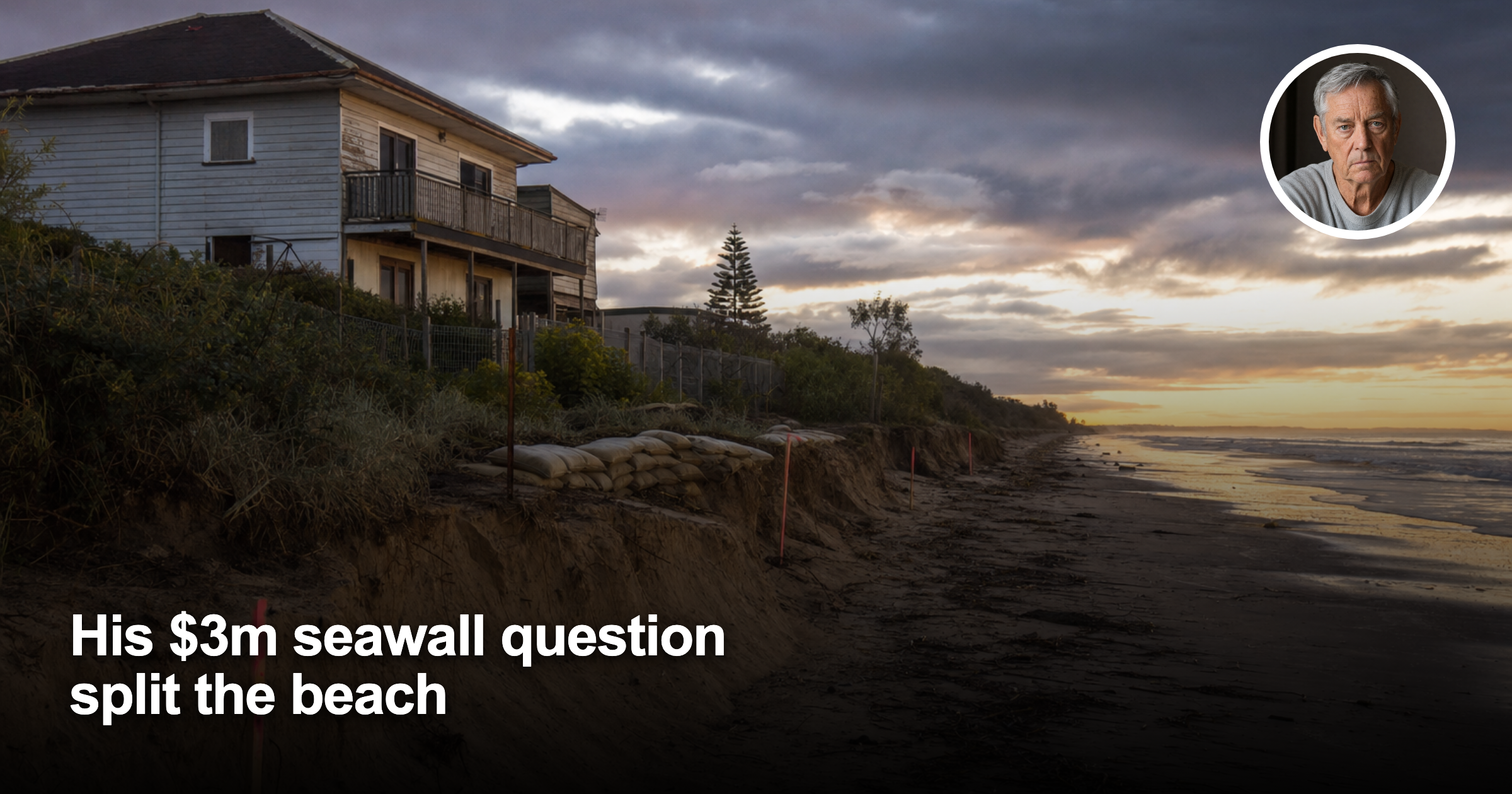
A 71-year-old man began questioning the value of his coastal home after watching the shoreline retreat and hearing that a proposed seawall could cost about $3 million.
He had bought the property for a simple reason: it was where he wanted to spend the next chapter of his life. The house was comfortable, the street was established and the view had always felt like a permanent asset. Then the conversation changed. Would owners pay? Would the council? Could a wall protect one group while shifting erosion onto the next stretch of beach? And what happens to the value of a home if the answer remains unresolved?
“If the ocean reaches the houses, how can an owner be expected to carry a problem that affects an entire coastline?” he asked.
It is one of the most uncomfortable property questions in Australia because it exposes a risk that a suburb median can hide: a home can look secure on paper while its exact frontage, planning status and exposure create a completely different investment outcome.
The question behind the seawall fight
The immediate argument is about responsibility. A private owner may want protection for a particular house, while authorities and neighbouring owners have to consider the effect of a structure on the wider beach. A hard barrier can protect one section in some circumstances, but it can also alter how sand and water move along the coast.
That creates a genuine public-policy conflict. The owners see a home at risk. Other residents may see a private solution with public consequences. Government may have to weigh emergency protection, environmental rules, public access and the long-term cost of defending an area that natural processes are reshaping.
The injustice is easy to understand: two homes may be only a few doors apart, yet one owner could face a much larger exposure because the lot sits closer to the active erosion zone or depends on a protection decision that has not been made.
Why a $3 million headline is not the whole risk
The figure is attention-grabbing, but the investment question is broader than dividing a construction cost between owners. A coastal property can be affected by planning restrictions, insurance availability, financing conditions, maintenance requirements, access rules and the market’s perception of future resale risk.
A buyer does not need to wait until the sand reaches the back fence to feel the effect. If insurers narrow cover or lenders become more cautious about a hazard-exposed address, the buyer pool can shrink first. Fewer qualified buyers can mean longer selling periods and a larger discount between asking prices and achieved sales.
This is where Ripehouse Advisory’s street- and address-level data matters. A suburb-wide coastal median cannot show whether a particular property is exposed to a hazard overlay, sits behind a vulnerable section of beach, has a history of longer days on market or attracts a thinner buyer pool than homes a few streets inland. The useful comparison is between exact addresses: achieved sales, buyer depth, days on market, rental demand, vacancy, nearby supply and the relevant physical risk indicators.
Two homes can share the same postcode and broad view premium while being different assets. One may have multiple practical access routes, stronger surrounding housing and a deeper resale audience. Another may be dependent on one protection decision and have fewer comparable sales to support its value. The market often prices that distinction gradually, then reprices it sharply when a ruling, storm or insurance change makes the risk visible.
Can the owner simply sell before it becomes a problem?
That is the question many owners ask, but timing matters. Selling quickly may limit exposure, yet selling into a market where buyers are already aware of the issue can crystallise the discount. Holding may preserve income or lifestyle value, but it leaves the owner carrying policy, physical and financing uncertainty.
The answer is not to assume that every coastal home is a bad investment. Waterfront and near-water property can have enduring demand, scarce land and strong lifestyle appeal. The answer is to distinguish irreplaceable location from unpriced risk.
An investor should test four things before treating a coastal discount as an opportunity:
- What is happening at the exact frontage, not just the nearest suburb?
- What planning, hazard and protection rules apply to this lot?
- How deep is the buyer and tenant pool when comparable homes are listed?
- Can the holding costs be carried if insurance, repairs or resale timing deteriorate?
The last question is especially important. A property can remain desirable and still become a poor investment if the owner has no margin for a delayed sale or a large unplanned cost.
What should he do before making a coastal decision?
The recently widowed retiree should obtain current planning and hazard information for the exact address, review insurance terms rather than relying on a renewal assumption and ask for a clear record of any proposed protection works or access changes. He should also compare recent achieved sales on both sides of the affected area, not just advertised prices.
Then he should model two scenarios: the property remaining broadly stable, and the address taking longer to sell with higher holding costs. If the investment only works in the optimistic scenario, the view is doing too much of the financial work.
The same discipline applies to a buyer who sees a discounted coastal home. A lower price may be compensation for a risk that the market understands perfectly well. A genuine opportunity exists when the risk is measurable, financeable and adequately reflected in the price—not when a buyer hopes a future public decision will erase it.
The answer
When the beach moves, responsibility is never just a private property question. A $3 million seawall debate can expose how differently two neighbouring addresses may perform, even when they share the same suburb, view and headline median.
Property investment still rewards ownership of scarce, high-demand assets. The winning approach is to identify the right asset on the right street, understand the physical and policy risks at address level and buy with enough margin to withstand uncertainty. Street-level evidence beats a postcard view—and disciplined data can turn a frightening headline into a decision an investor can actually price.
If there's a specific street you're weighing up right now, check its Street Score first — it's free, takes ten seconds, and tells you whether that street is pulling the suburb average up or riding on it.
Frequently asked questions
Who is usually responsible for paying for a seawall when erosion threatens a coastal home in Australia?
The article says this is often disputed and is not just a private issue. A private owner may want protection for one home, while councils and neighbours have to consider wider beach impacts, public access and environmental rules.
Why can a coastal home’s value be at risk even before the beach reaches the house?
The market can react earlier if insurance becomes harder to get, lenders become more cautious, or buyers worry about future erosion and protection decisions. That can shrink the buyer pool and affect resale value before any physical damage occurs.
What should a buyer check before treating a discounted beachside property as a bargain?
The article says to check the exact frontage, the planning and hazard rules for that lot, how deep the buyer or tenant pool is, and whether holding costs can still be managed if insurance, repairs or resale timing worsen.
Can selling a coastal property quickly solve the erosion problem for an owner?
Not necessarily. Selling sooner may reduce exposure, but if buyers already know about the risk, the sale price may reflect that uncertainty. Holding the property can also mean carrying policy, physical and financing risk.
What is the most practical next step for an owner facing a proposed seawall or erosion issue?
The article recommends getting current planning and hazard information for the exact address, reviewing insurance terms, and checking any proposed protection works or access changes. It also suggests comparing achieved sales on both sides of the affected area.
General information only. It does not take your objectives, financial situation or needs into account, and nothing here is legal, financial, taxation or investment advice specific to your circumstances.