News · 24 August 2026 · 6 min read
'The trees on my block earned $190,000. I own the land, I pay the rates — and I'm not allowed to touch a branch'
She bought forty hectares for the ridge of native regrowth — then found the previous owner had sold the carbon rights off it, registered against her title, for the next twenty-five years.
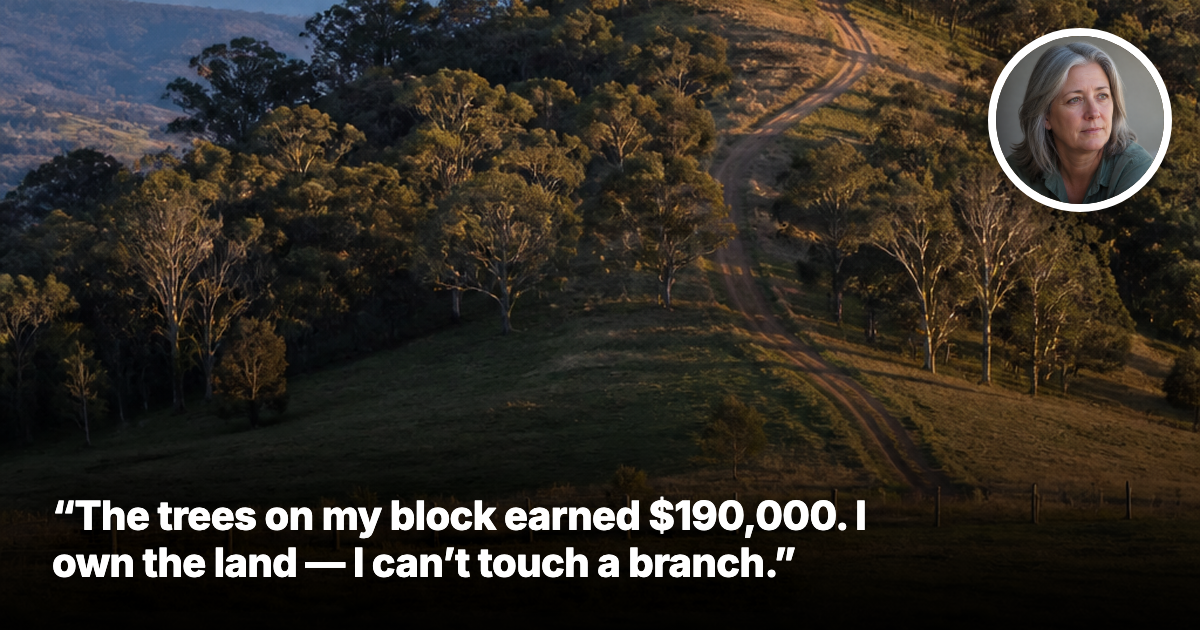
She is 55, and she bought the block for the trees.
Forty hectares an hour and a half from the city, half cleared pasture, and along the back ridge eighteen hectares of established native regrowth. She was buying that ridge.
Seven months after she settled, a surveyor rang to book the annual site visit.
He worked for a carbon farming company, and the visit was one the company is entitled to make — because two years before the property was listed, the previous owner had signed the ridge over to them.
Not the land. She owns the land, pays the rates on it, her name on the title for all forty hectares. What the previous owner sold was the exclusive right to the economic benefits of the carbon stored in those eighteen hectares — the living trees, the dead timber, the soil, and everything they pull out of the atmosphere for the next twenty-five years.
The company had already collected roughly $190,000 in carbon credits off her ridge. And the document that gave it away was registered against her title, so it did not end when the previous owner sold. It transferred to her.
"I searched the title. My solicitor searched the title. How can somebody sell the trees off a block, pocket the money, and then sell me the block as if the trees came with it?"
The answer is that the trees and the land are two separate assets — and the law lets you sell them separately
You can sell the land and keep the right to graze it or take timber from it — and you can sell the land and keep, or sell on, the right to the carbon stored on it.
It is a registered interest, created much like an easement: the owner signs an instrument, it is lodged, and it goes on the title. From that moment it is a property right in its own right, running for the fixed period the instrument states — and twenty-five years and longer is standard, because that is how carbon contracts are written.
The first thing that surprises buyers is what it covers. Not the trees as timber — the exclusive right to the economic benefit of the sequestration: the living biomass, the dead organic matter, the soil, and the carbon stored in all three. Depending on how the instrument is written, the owner may not be able to clear the vegetation, change the land's use, or claim any credit for the carbon herself.
Because it is registered, it is not a private contract that ends at settlement. It attaches to the lot. She signed nothing, consented to nothing, and inherited the obligation in full — including the site visits. It is the same mechanism that lets a registered management statement bind every future owner of a townhouse to levies they never agreed to: the register, not the contract, is what carries the obligation to the next owner.
And the person who grants the interest and the person who receives it can be the same party splitting the right off their own title ahead of a sale — so the land can be sold with the carbon value already stripped out and banked. The vendor collected the $190,000. She bought the ridge.
Nobody hid it — and that is precisely the problem
Nobody behaved badly. The interest was registered, as the law requires. It appeared on the title search. The company is exercising a right it paid for.
She searched the title. Her solicitor searched the title. The reference was there — a line recording a registered interest over part of the lot, with a survey plan designating the eighteen hectares. What neither did was open the instrument and read what it was, what period it ran for, and what it stopped her doing. A title search tells you a registered interest exists. It does not tell you what it costs you. That gap — between seeing the line and understanding the line — is where the $190,000 lives.
Carbon interests exist so landholders can be paid to store carbon. The problem is meeting it after you have paid for the land it sits on.
Two identical blocks, and the dataset cannot tell them apart
Take her block and the one four hundred metres down the road — same size, same zoning, same council, same median sale price. Run both through any standard property research and the reports come back identical. Same median, same growth rate, same vacancy rate, same rental estimate.
One of those blocks carries a twenty-five-year registered interest that strips the economic value out of half of it and restricts what the owner can do on it. The other does not. The market prices them as the same asset, and they are not — a valuer put the encumbrance at roughly $155,000 against an unencumbered comparison. Nothing in a suburb-level dataset will flag it, because a suburb median has never once read a registered instrument.
We see this constantly in our own data work: the best and worst streets in a single suburb routinely show a 20 to 30 per cent spread in effective yield, for properties sharing a postcode and a median. Two lots can be identical in every published metric and different by six figures in reality — and the difference sits in a document that costs a few dollars to retrieve. It is the same gap we wrote about when a council code amendment quietly cut a subdividable block's yield: the loss was real, published and readable, and invisible in every average.
What she does now — and what you should do before you are her
A registered interest does not disappear because the new owner did not expect it. It can be surrendered if the holder agrees, or removed when the period ends — but a company that paid $190,000 for a twenty-five-year income stream does not surrender out of sympathy. She will keep the land, keep paying the rates, and watch the ridge do its work for someone else until the interest runs its course.
A title search is the start of due diligence on a bush block, not the end. Before you exchange on any property with significant vegetation, ask one question in writing: what registered interests affect this lot, what does each entitle its holder to do, and what does each stop me doing — and get the instruments themselves, not a summary. Read the period clause and the restriction clause first, because those two decide whether you are buying a ridge or the view of someone else's income. The same habit catches the orders and obligations that sit on a register keyed to the land rather than on the title a buyer actually reads.
None of this is an argument against property, or against carbon plantings, or against the bush. It is an argument for reading what you are buying. A registered interest is not a hidden defect — it is a published one, free to retrieve and free to read before you sign. Risk you cannot see is a threat. Risk you can read before you exchange is a line item — and a priced line item is an advantage over every other buyer who walked the same ridge, felt the same pull, and never thought to ask who owned the trees.
She walks the ridge most evenings, careful to stay on the track. "It's still beautiful," she says. "I just own it differently than I thought I did."
If there's a specific street you're weighing up right now, check its Street Score first — it's free, takes ten seconds, and tells you whether that street is pulling the suburb average up or riding on it.
Frequently asked questions
How can someone sell the carbon value from trees on land in Australia without selling the land itself?
The article says the land and the carbon rights can be treated as separate assets. A previous owner can register an interest that gives another party the exclusive right to the economic benefit of the carbon stored on part of the land for a fixed period.
If a carbon interest is registered against a title, does it still bind a new owner after settlement?
Yes. The article explains that because the interest is registered on the title, it transfers to the new owner and continues for the period stated in the instrument, even if the buyer did not sign it.
What does a title search show when a block has a carbon farming agreement on it?
A title search shows that a registered interest exists, but not necessarily what it allows or restricts. The article says buyers need to read the actual instrument to understand the period, the restrictions, and what the interest stops them doing.
What practical restrictions can a registered carbon interest place on a property owner?
According to the article, depending on how it is written, the owner may not be able to clear vegetation, change the land's use, or claim any carbon credit for themselves. The holder of the interest may also be entitled to site visits.
What should you check before buying a bush block with significant vegetation in Australia?
The article says a title search is only the start of due diligence. You should ask in writing what registered interests affect the lot, what each one allows, what each one restricts, and obtain the actual instruments before you exchange.
General information only. It does not take your objectives, financial situation or needs into account, and nothing here is legal, financial, taxation or investment advice specific to your circumstances.