News · 11 August 2026 · 8 min read
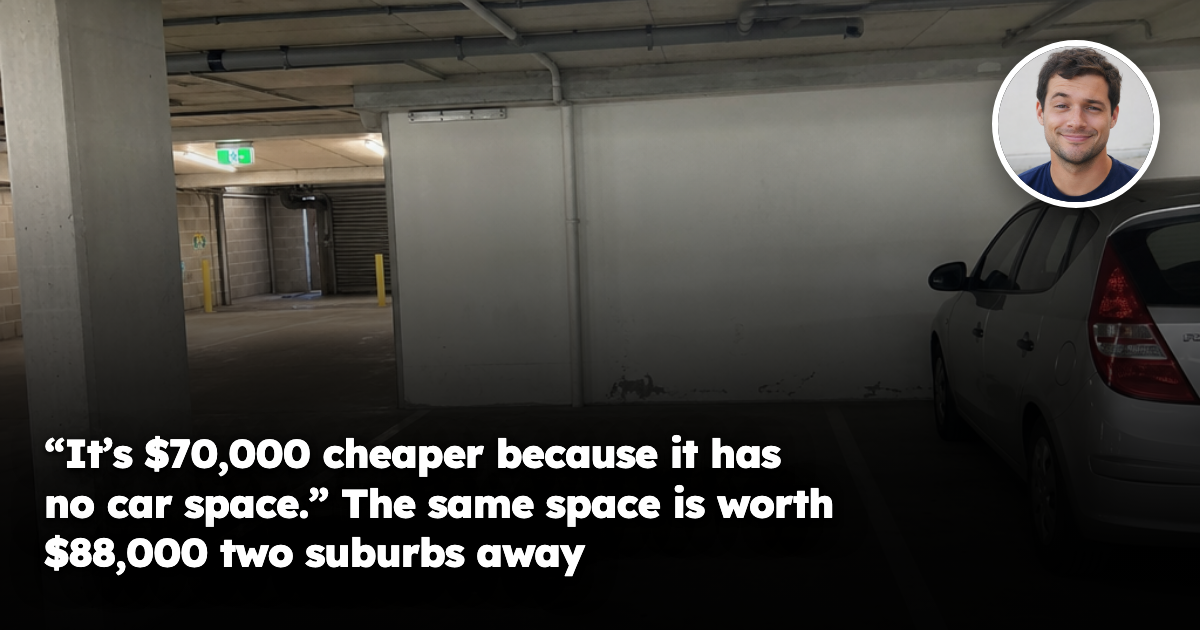
'It's $70,000 cheaper because it has no car space.' A buyer asked us whether he'd found a bargain
He doesn't own a car, and the unit without a parking space was $70,000 cheaper. He thought he'd found free money. The research says the value of one car space swings more than two-fold across a single city — and almost nobody checks which side of that swing they're standing on.
A buyer in his late twenties came to us last week sounding pleased with himself, which is not the usual way these conversations start.
He already owns one property. He's now looking at a small two-bedroom unit as an investment, and he thought he'd found free money. Two units, same suburb, same era, near enough to the same floor plan. One comes with a basement car space. One doesn't. The one without is about $70,000 cheaper.
He doesn't own a car. He catches a tram to work. As far as he could see, the market was charging $70,000 for something he'd never use, and he'd found the version without the tax.
His question was short: "Is that a bargain, or am I missing something?"
Better question than he realised — because the honest answer is both are possible in the same suburb, and the difference between them is worth more than the discount.
The bit he got right
He was right that the number is real, and right to be suspicious of it.
Off-street parking is one of the largest single line items hiding inside the price of an apartment, and almost nobody prices it deliberately. A basement car space in a major Australian city typically costs between $55,000 and $178,000 to build; in difficult ground conditions a single space has been costed as high as $250,000. A garage on a townhouse costs $40,000 to $137,000 once you count the land it sits on — and the striking part is that the garage itself only costs about $24,000. The rest is land.
Wrapped into a finished apartment, meeting the standard planning requirement adds roughly $70,000 to a two-bedroom apartment in Sydney, $62,000 in Melbourne, $95,000 in Adelaide, $113,000 in Brisbane and $137,000 in Perth. For three-bedroom apartments it exceeds $100,000 in most capitals.
So the discount he found isn't a rounding error or an agent's negotiating position. It's roughly the true cost of the thing that isn't there.
He was also right that plenty of people don't want it. Around 40% of studio and one-bedroom apartment households own no car at all; 19% of two-bedroom households own none. In Melbourne, 41% of apartment households within 5km of the city are car-free, falling to 15% once you're 20km out. Across Sydney and Melbourne there are now more car spaces in apartment buildings than cars belonging to the people living in them, and as much as 40% of that parking sits empty every night.
The bit that decides whether he's right
Here's where it turns, and it turns on one question: not what the car space costs, but what the next buyer in that specific location will pay for it.
Those are not the same number — and they're not the same number within the same city.
The most useful research on this analysed apartment transactions and resolved the answer down to areas of about 10,000 people, smaller than most people's mental picture of a suburb. The median amount buyers will actually pay for a first basement car space in Melbourne ranges from about $88,000 in one affluent inner coastal area down to about $58,000 on the outer urban fringe. In parts of western Sydney, it's about $37,000.
The same physical object — one basement car space, same concrete, same roller door — is worth $88,000 to the buyer pool in one part of a metropolitan area and $37,000 in another part of the same metropolitan area. More than a two-fold swing. Not between cities. Between suburbs you could drive between in under an hour.
It gets sharper. A second car space in the same building is worth about $46,000 in that strongest area and about $30,000 in the weakest — the second space is routinely worth around half the first. In a handful of wealthy inner-eastern Sydney pockets, buyers pay more for a car space than it costs to build. Across most of the rest of Sydney, they pay tens of thousands less.
There is no such thing as "what a car space is worth." There is only what one is worth there, to those buyers, on that kind of dwelling.
Research from a completely different direction lands in the same place: a separate analysis of valuation data put the average uplift from a parking space at around $80,000 in greater Melbourne and about $63,000 in greater Sydney, with the strongest premiums in inner-city terraces, villas and townhouses where off-street parking is scarce. The people behind that work put the warning more bluntly than we would have dared: if you're adjusting a comparable sale in an inner-city market and you treat parking as a minor feature, you can materially misprice the property.
Two research efforts, two different methods, two different purposes — one measuring planning economics, the other valuation accuracy. Same conclusion. The value of a car space is local, it is large, and it is almost never checked.
Why the suburb report can't answer this
This is the part most buyers never see, and it's why we build our research from street- and suburb-level data rather than headline medians.
A suburb median tells you what dwellings sold for. It cannot tell you what a feature is worth inside that suburb, because it has already blended every dwelling with a car space and every dwelling without one into a single number and handed it to you as though it described both.
Our buyer's two units illustrate it. In the same suburb, on the same day, one of these is true:
- The buyer pool there values a car space near $90,000 — in which case the unit without one is discounted by less than it's worth, and he's taking a $70,000 discount on something worth $88,000 and calling it free money.
- Or the buyer pool values it closer to $40,000 — in which case the $70,000 discount is generous, the market has overcharged for the space, and he's found exactly what he thought.
Same suburb. Same median. Same two listings. Opposite decisions. Nothing in a suburb report, a median chart or a growth forecast tells him which one he's standing in — because the answer lives below the suburb, in the composition of the local buyer pool: how many households own cars, whether the street has any parking left, whether the building is ringed by permit zones, and what kind of buyer competes for that dwelling type in that pocket.
It's the same lesson from a new direction — why a renovation can cost $210,000 and add almost nothing when the street has already set the ceiling, and why a busy road can knock 20% off a property otherwise identical to one two streets back. The difference here is that parking is the first of these factors sitting inside the property boundary. It's on the title. It's yours. And it's still priced entirely by everyone else.
Five things we told him to check
1. Work out what the local buyer pool is, not what you are. He doesn't own a car — but he isn't buying it to live in. His tenant and his eventual buyer set the price. In an area where most households run two cars and the street is full by 6pm, his tram habit is irrelevant to the valuation.
2. Check the street, not just the basement. A unit with no car space in a street with free, uncontested parking is a very different asset to the same unit in a permit-only street where visitors can't stop. Invisible from a listing; obvious after ten minutes on the kerb at 7pm on a Tuesday.
3. Price the second space separately from the first. They aren't worth the same — the second is often worth roughly half. Paying a symmetrical premium for both is a straightforward overpayment.
4. Ask the lender before you fall in love. Some banks are noticeably more reluctant to lend against an apartment with no dedicated car space. A discount you can't finance, or can only finance at a worse loan-to-value ratio, isn't a discount — it's a smaller pool of future buyers, which is the thing that actually hurts you at resale.
5. Check whether the rules are about to change around you. Several states and councils have recently cut or abolished minimum parking requirements near frequent public transport. Where they have, new buildings provide markedly less parking — inner Melbourne apartments built under a minimum average 1.2 spaces, those with no minimum just 0.7. If a wave of new no-parking stock is about to land near his unit, the scarcity value of an existing space can move either way, and it's worth knowing which.
What we actually told him
We didn't tell him not to buy the cheaper unit. We told him he'd asked the right question and was one data point away from answering it — and that the data point wasn't "what does a car space cost," which he'd already found, but "what does this buyer pool pay for one," which is entirely knowable.
The same kind of gap sits behind a land tax valuation that tripled overnight and an objection process one owner discovered had a procedural trap built in — a number nobody questions until it moves. Because the encouraging part is that a $70,000 gap between two nearly identical units isn't a problem. It's an opportunity that exists precisely because the factor creating it is measurable and almost nobody measures it. If the value of a car space really does swing from $37,000 to $88,000 across one city, then in some pockets the market is charging far too much for one and in others far too little — and both are buyable, in opposite directions, by someone who knows which pocket they're standing in.
That's the argument for property done properly. The headline numbers — medians, growth forecasts, capital city rankings — are the starting point everyone already has. The returns sit underneath them, in the difference between two listings on the same street that a median can't see and a suburb report was never built to explain. The mistake isn't buying a unit without a car space. The mistake is buying a category — "car space, good" or "no car space, cheaper" — instead of a property, and never once asking what the thing is actually worth to the only people whose opinion will ever matter: the ones who buy it from you. The same line-item discipline is what separates a renovation that adds resale value from a $19,320 kitchen priced out room by room before the tradesman was booked.
If there's a specific street you're weighing up right now, check its Street Score first — it's free, takes ten seconds, and tells you whether that street is pulling the suburb average up or riding on it.
Market data & R-Scores for locations in this article
Drill Down Into the Markets Mentioned Above
Inspect live monthly R-Scores, median prices, rental yields, and street-by-street scores for the cities and council areas referenced in this article:
Frequently asked questions
If a unit without a car space is $70,000 cheaper, does that automatically mean it’s a bargain?
Not necessarily. The article says the real test is what the next buyer in that specific location will pay for the missing car space, which can be more or less than the discount.
Why can the same car space be worth so much more in one part of a city than another?
Because its value depends on the local buyer pool, not just the physical space. The article says the same basement car space can be worth about $88,000 in one Melbourne area and about $37,000 in parts of western Sydney.
What should I check before buying an apartment without a parking space in Australia?
The article says to check the street, the local parking situation, the building’s buyer mix, and whether the lender is comfortable with no dedicated car space. These factors affect both resale value and how many buyers you may have later.
Do all apartment buyers actually want a car space?
No. The article says many apartment households are car-free, including around 19% of two-bedroom households, and car-free rates are higher in inner-city areas like Melbourne’s inner 5km.
Can a car space affect resale value enough to matter in an inner-city apartment?
Yes. The article says parking is one of the largest line items in apartment pricing and can materially affect valuation, especially where off-street parking is scarce.
General information only. It does not take your objectives, financial situation or needs into account, and nothing here is legal, financial, taxation or investment advice specific to your circumstances.