News · 11 August 2026 · 7 min read
'The agent said the road knocks 20% off.' A buyer asked us whether that was a warning or a bargain
A first-time investor was told a main-road house was 20% cheap for a reason. The reason turned out to be measurable, and it disappears within a hundred metres. Here is what actually decides whether a busy-road discount is a warning or the best-value asset on the map.
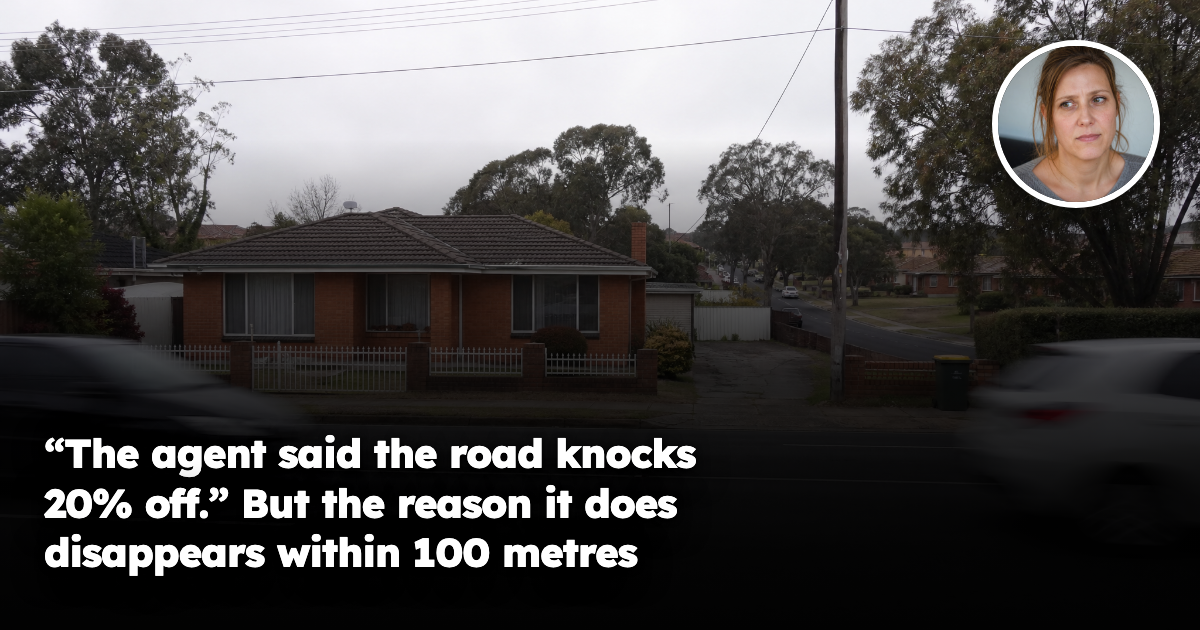
She had done everything right, which is why she was stuck.
A buyer in her mid-thirties, hunting her first investment property, sent us a question last week about two houses she had shortlisted. Same suburb, same era, near enough the same house — three bedrooms, similar land, both tidy. One sits on a four-lane road. The other is two streets back on a quiet loop. The main-road house is around 20 per cent cheaper: roughly $150,000 at her price point.
The selling agent told her, cheerfully and honestly, that the road takes about 20 per cent off. A friend told her never to buy on a main road. A relative told her it was the best value on the market and everyone else was being precious.
Her question was the right one, and almost nobody asks it:
"Everyone agrees the road makes it cheaper. Nobody can tell me whether it makes it worse. Which is it?"
Those are two completely different questions, and the gap between them is where money is made and lost.
The question: is a main-road discount a warning, or a bargain?
Start with the honest part. The discount is real, well established, and buying agents will quote it without hesitation: a house on a busy road can sell for up to 20 per cent less than an equivalent house on a quiet street in the same suburb.
Read that phrasing again — an equivalent house on a quiet street. The people who quote this number are, without noticing, describing the entire thesis of how we do research. They are not comparing suburbs. They are comparing two streets inside one suburb and reporting a 20 per cent difference.
The reasons behind it are the obvious ones: noise, traffic, air quality, nowhere safe to park, nowhere safe for a child to ride a bike. But those reasons behave very differently to how most buyers assume — and that is where the opportunity is.
The answer: the effect is a gradient, and it is spent within about 100 metres
Here is the finding that should change how you look at every main-road listing you ever see.
Traffic pollution does not fill a suburb. It falls away sharply with distance from the kerb. Nitrogen dioxide — the standard marker for traffic-related air pollution — returns to ordinary urban background levels within roughly 100 to 250 metres of the road, and the steepest drop happens in the first 100 metres. Only the largest highways have been recorded influencing air quality as far out as 500 metres.
Now hold that against the geography of an actual suburb, which is typically one to three kilometres across. The entire effect is spent in the first hundred-odd metres. The thing driving a 20 per cent price difference resolves at a scale of metres, inside an area that suburb-level data reports as a single number.
This is not a subtle failure of suburb averages. It is a total one. A median takes the house eight metres from four lanes of traffic and the house six hundred metres back on a quiet loop, adds them together, divides by two, and hands you the result as though it described either of them.
We know the gradient is real because it has been watched moving. When a road tunnel opened in Sydney and traffic was pulled off the surface roads above it, measured pollution along those arterials fell — out to about 100 metres, and no further, while rising near the tunnel entrances. The gradient is not a theory. It is a live, measurable thing that shifts when traffic shifts.
And almost none of this is in the listing. Australian planning guidelines for building near busy roads already recommend setbacks, stepping building façades, avoiding street canyons, planting between the road and the dwelling, and putting bedrooms and living areas as far as practicable from the traffic. Some developments follow that carefully. Many do not. In one reported road widening — four lanes to seven, and about 6,000 vehicles a day to 50,000 — the gap between the traffic and the apartment buildings ended up at 1.4 metres, with residents advised about air conditioning, acoustic insulation and sealing air vents.
So two buildings can sit on the same arterial, in the same suburb, on the same day, and be entirely different assets. One set back 30 metres behind mature planting with bedrooms at the rear; the other 1.4 metres from the traffic with the main bedroom facing it. No suburb report in Australia distinguishes between them. No median even tries.
The trap: "everyone knows" is usually two variables wearing one coat
Now the part that makes this genuinely hard, and the most useful thing in this article.
Ask around about flight paths and you will be told, correctly, that homes under them are worth less. Ask a Brisbane buying agent and you will be told, also correctly, that flight paths there barely faze buyers — because a long-running study found suburbs under existing flight paths in the inner and middle rings still delivered higher average annual capital returns than less well-located suburbs.
Both statements are true, and they are not in conflict. The reason is the single most expensive misunderstanding in property research.
The first measures noise holding location constant — the same house, in the same place, louder. The second measures raw returns without holding location constant — and the homes under those flight paths happen to sit close to the city, which is worth far more than the noise costs. The location effect is bigger than the noise effect, so it swamps it in the headline number.
If you cannot separate two variables that travel together, you will reach confident conclusions that are exactly backwards — paying a premium for a quiet street that is quiet because nothing is near it, or refusing a well-set-back arterial property in a location you could not otherwise afford.
Separating those variables is, more or less, the job — the same mechanism as what a single street tree ten metres from a house does to its value, the same reason transport noise has to be measured facade by facade rather than suburb by suburb, and the same reason a $210,000 renovation can add almost nothing on the wrong street.
What this means for you
Five practical things.
1. Measure the setback, then walk back. Distance from the traffic lane to the front of the dwelling is the number that matters, and it is free to obtain. Then walk 100 metres back and notice how much of the effect has already gone.
2. Read the orientation, not just the address. Bedrooms and living areas at the rear, screened by the building itself, is a fundamentally different asset to a balcony and bedrooms facing the traffic. Same street, different property.
3. Price the fix before you assume there isn't one. Noise is rarely eliminated but it is routinely reduced — secondary glazing on brick homes is the cost-effective option, acoustically rated door seals make a real difference, and roof treatments help where the noise arrives from above. If a $150,000 discount is partly answered by a five-figure treatment, that is a calculation, not a compromise.
4. Check the buyer pool, because that is the real risk. The discount is not the danger — you are being paid for it going in. The danger is exit. Some position problems don't shave a price, they delete buyers: a flood-affected property can lose an estimated 70 per cent of its buyer pool, and research puts a 2 per cent value fall on each increase in a property's bushfire rating. Ask which one you are buying — a discount, or a smaller crowd at the auction.
5. Get the insurance quote before you buy, not after. It is free, it takes minutes, and it is the only opinion of a property you will ever get from someone who has to put their own money behind being right.
The bottom line
A main-road discount is not a warning label. It is a price — and a price set by a crowd who are, on average, reacting to the road rather than measuring it.
That is precisely why the opportunity exists. If the market applies a broad 20 per cent haircut to "main road" as a category, some of those properties are genuinely impaired and some are 140 metres back, screened, rear-facing and wearing the same haircut for a problem they do not really have. Both sit in the same suburb, under the same median, under the same label.
The mistake is not buying near a busy road. The mistake is buying a category instead of a property — paying the quiet-street price for one, or walking away from the other, because nobody ever measured the hundred metres in between.
If there's a specific street you're weighing up right now, check its Street Score first — it's free, takes ten seconds, and tells you whether that street is pulling the suburb average up or riding on it.
Market data & R-Scores for locations in this article
Drill Down Into the Markets Mentioned Above
Inspect live monthly R-Scores, median prices, rental yields, and street-by-street scores for the cities and council areas referenced in this article:
Frequently asked questions
Is a house on a main road in Australia always a bad buy, or can the discount be a bargain?
It depends on the actual property, not just the street label. The article says busy-road homes can sell for up to 20% less than an equivalent quiet-street home, but some of that discount is driven by factors that fade within about 100 metres of the road.
How far from a busy road does traffic pollution usually drop back to normal levels?
The article says nitrogen dioxide, used as a marker for traffic-related air pollution, returns to ordinary urban background levels within roughly 100 to 250 metres of the road. The steepest drop happens in the first 100 metres.
What should I look at first if I’m comparing two similar houses, one on a main road and one on a quiet street?
Measure the setback from the traffic lane to the dwelling, then check the layout. Bedrooms and living areas at the rear, with the building screening the road, are materially different from rooms facing the traffic.
Why can suburb-wide property data be misleading for main-road homes?
Because it averages houses that are very different in exposure. A suburb median can combine a home eight metres from traffic with one 600 metres back and make them look the same, even though the road effect is spent over a much smaller distance.
What practical risks matter most before buying a discounted main-road property?
The main risk is not the discount itself, but the exit and the buyer pool. The article also says it is worth checking whether noise can be reduced, and getting an insurance quote before buying.
General information only. It does not take your objectives, financial situation or needs into account, and nothing here is legal, financial, taxation or investment advice specific to your circumstances.