News · 11 August 2026 · 9 min read
My body corporate fees went from $5,200 to $7,500 — because of a shop I don't own
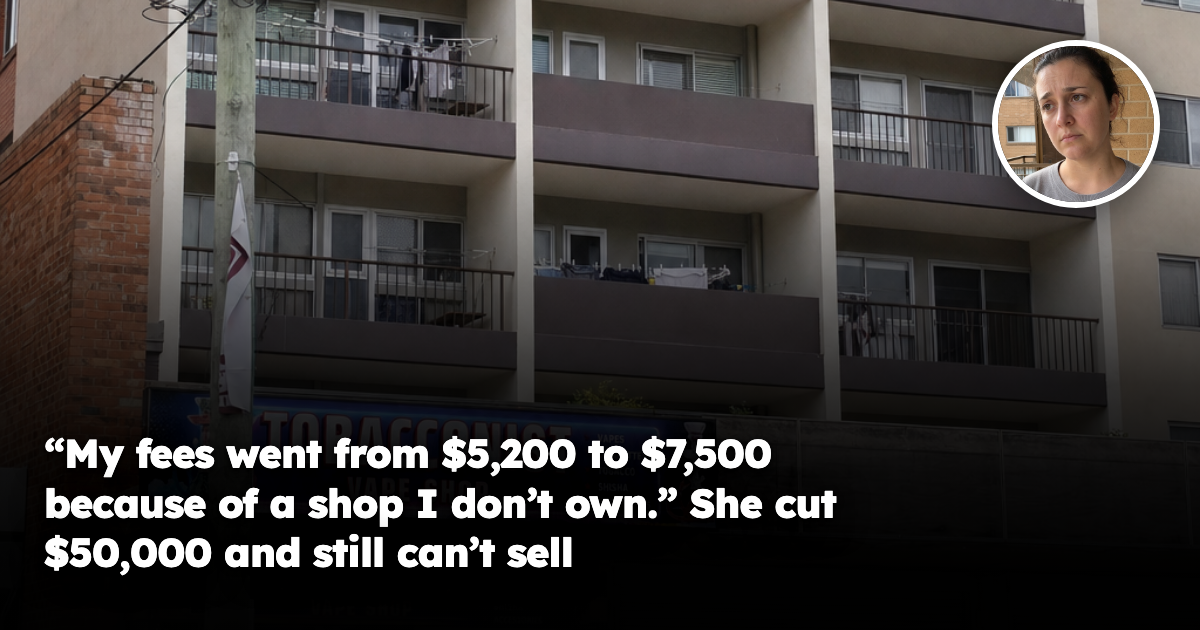
She bought a two-bedroom unit in an affordable inner-city pocket. Then the ground-floor tenant changed her insurance bill, and her fees went from $5,200 to $7,500 a year. She's now $50,000 below her purchase price and still can't find a buyer. The question she asked us is the one almost nobody asks before they sign: what is the building worth, as opposed to the apartment?
She did everything the median told her to do.
A two-bedroom unit, inner city, walking distance to a river, in one of the few pockets of an Australian capital where an apartment still has a four in front of it. She bought in 2022. On every metric a suburb report card can measure, it looked like a sensible entry point.
Four years later she has cut her asking price to between $385,000 and $415,000 — more than $50,000 below what she paid. It still hasn't sold.
Nothing has gone wrong with her apartment. The problem is downstairs.
The question
She wrote to us with a version of a question we now get most weeks, and it's worth quoting the shape of it: "My body corporate fees have gone from about $5,200 a year to $7,500. The building has no parking, no gym, no pool, no on-site manager — nothing that explains it. I've been told it's the insurance. There's a vape shop on the ground floor. As soon as buyers hear the fees, they're out. How was I supposed to know this before I bought?"
The honest answer is that she could have known. Almost none of it was hidden. But none of it appears in a suburb report, a median chart, or a price guide — and those are the three things most buyers look at.
What actually happened
The ground floor of her building is commercial. One of the tenancies is a tobacconist and vape retailer. A wave of firebombings targeting those businesses in that city has pushed commercial insurance premiums for buildings containing them to extraordinary levels. The excess attributable to that single retail tenancy runs to $150,000.
The owners' corporation has to insure the building. The building contains that shop. So every residential owner above it pays for the risk profile of a business they don't own, can't control, and in most cases didn't notice on the way to the open home.
Layer on water damage and construction quality the original build didn't get right, and you have a fee that has climbed roughly 44% while delivering owners nothing in return. That's the part buyers react to. A $7,500 annual levy attached to a building with a pool, a gym, a lift and a concierge is a purchase. The same $7,500 attached to a building with no amenity at all is a tax. Buyers tell the difference instantly, which is why her listing has stalled. At least one other owner in her building is trying to sell for the same reason.
The other version of the same problem
A second case makes the point from the opposite direction — there the building is fine, and it's the owners who are the risk.
A nurse on a Sydney beachside peninsula bought a small unit in a nine-lot block in 2010 for $450,000. The block has developed concrete spalling — "concrete cancer" — and the balconies need genuine structural repair. Her share of that necessary work is around $115,000, and to her credit she doesn't dispute it. Buildings age. Concrete fails. That bill is real.
What she disputes is the other $250,000.
Seven of the nine lots are owned by investors, and those seven want their ocean-facing balconies extended — by up to nearly 16 square metres each — because a bigger balcony with a water view lifts the value of their asset. It's rational for them to want it, and they have the numbers to vote for it. The full package comes to $3,128,384.
Her balcony is on the ground floor. She'd gain about 3.6 square metres, and the extended balcony above hers would take her ocean view and much of her light with it. The works may therefore reduce her unit's value. Her total exposure, on a property she bought for $450,000, is roughly $365,000.
Here is the mechanic that surprises almost everyone: because the balconies are common property and a majority voted for it, she has to pay. In New South Wales, where work is done on common property, every owner contributes through their levies whether or not they benefit. Victoria applies what's known as a benefit principle — broadly, those who gain from an improvement fund it. Same kind of building, materially different exposure, decided by which side of a state border the block sits on.
She has taken it to a tribunal seeking a repair-only outcome, and is waiting for a hearing date she fears will arrive after the scaffolding does.
The answer: you are not buying an apartment
This is the reframe that matters, and it's the thing we say to every client looking at strata.
You are not buying an apartment. You are buying a share of a building, plus a share of a set of obligations, plus a set of co-owners you did not choose and cannot remove. The apartment is the smallest and most visible part of what you're acquiring, and it's the only part most buyers actually inspect.
Which is exactly why suburb-level data fails so badly here — and it's where our work lives. Ripehouse Advisory's research engine scores markets down to the street, because a suburb median blends assets that behave nothing alike. In strata that blending problem is worse than anywhere else in residential property, because the resolution you need isn't even the street. It's the individual address.
Two apartment buildings can sit on the same street, in the same postcode, sharing a median, a vacancy rate, a days-on-market figure, a school catchment and a transport score — and be completely different investments. One has a healthy capital works fund, a well-run committee, a benign ground-floor tenant and a majority of owner-occupiers who fix small problems while they're still small. The other has an underfunded sinking fund, a retail tenancy that has quietly doubled the insurance bill, deferred maintenance, and a majority of absentee investors who won't vote for a levy until the damage is structural. Every metric a suburb report can produce is identical for both. The 10-year outcome is not remotely comparable.
It's the same argument we make about why a $210,000 renovation added nothing to a home's value — spending doesn't create value on its own, and neither does a good postcode. The asset is more specific than the label on it.
How to actually price a building
Experienced buyers' agents already do this, and the checklist isn't secret. It works precisely because it's all building-specific — none of it is available at suburb level.
1. Read the sinking fund relative to the size of the complex. A $200,000 capital works fund is generous for eight units and negligible for 120. The figure in isolation is meaningless; the figure per lot, against a 10-year plan and the building's age, is the whole story. As one buyer's agent puts it: "An underfunded capital and admin fund with no indication of money invested into the complex is a red flag."
2. Read the last two to three years of AGM minutes — properly, not the summary. The minutes are where you find issues discussed but never budgeted, and disputes that have escalated to legal action. In one agent's words, they hold "hidden items that may not need to be disclosed upfront but can always be found through further investigation of the full body corporate records." A building's real problems are usually written down years before they become your special levy.
3. Look at who else owns the building. The owner-occupier to investor ratio is a genuine risk metric in both directions. A high proportion of absentee landlords means nobody is present for the small issues that snowball into expensive ones — but as the nine-unit block shows, a concentrated investor majority can vote in works that suit their strategy and not yours. Ask for the unit entitlement schedule; it sets both your voting power and your share of every bill.
4. Look at the ground floor. Almost nobody runs this check. What commercial tenancies are in the building, and what do they do to its insurance? Restaurants, gyms, licensed venues and tobacco retailers all carry premium and excess implications that land on residential owners upstairs. Ask the owners' corporation for three years of insurance history, not just this year's premium.
5. Walk the building, not the apartment. A facade needing a full repaint, tired common areas, a clunky lift, water staining in the basement, an untidy bin area — these are financial statements written in concrete. Read the noticeboard in the stairwell; it says more about how a building is run than any brochure. Check the age of the roof and lift, fire-safety certification, water ingress history, and whether combustible cladding has been identified. That last one carries a specific trap: if non-compliant cladding needs replacing and no special levy has been raised, the liability passes to the buyer. Sellers can and do exit ahead of the bill.
6. Ask what's due, not what's been paid. Waterproofing runs on a roughly 25-year cycle; roofs, lifts and repaints have cycles too. A building that hasn't had a major levy in 20 years isn't necessarily well-run — it may simply be one that hasn't paid yet.
What this means for you
If you own in strata, the most useful hour you'll spend this year is reading your own AGM minutes and capital works plan and working out what's coming and whether the fund covers it. Owners who know the number early can plan for it — the ones who don't are the people who open an email one morning to a bill for tens of thousands of dollars they never voted for.
If you're buying, price the building before you fall in love with the apartment. Ask for the strata records — every state gives you a right to inspect them — and if the vendor is reluctant, that reluctance is itself the answer.
If you're selling in a building with a problem, understand what our Melbourne owner learned the expensive way: buyers don't discount for high fees, they disappear. A high levy shrinks your buyer pool rather than your price, which is why she has cut $50,000 and still has no offers. It's the same buyer-pool mechanic that makes a property on a busy road sell for materially less than its suburb median — the question isn't what the property is worth to you, it's how many people are left willing to buy it.
The part that's actually good news
It would be easy to read all this as a case against apartments. It isn't — we'd argue the opposite.
Everything described here is knowable before settlement. The insurance history exists. The minutes exist. The sinking fund balance exists. The ownership mix exists. The ground-floor tenant is visible from the footpath. None of it is a market movement you have to forecast or a rate decision you have to predict. It is documentary evidence about a specific address, sitting in a filing cabinet, available to anyone who asks.
That is precisely why it's an opportunity rather than a threat. A risk everybody can see gets priced in and disappears. A risk that is fully documented but almost nobody reads does not get priced — which means buildings are routinely mispriced in both directions. Some apartments trade at a premium they haven't earned, sitting on a hollow capital works fund and a bill nobody has been told about yet. Others trade at a discount they don't deserve — well-run, strongly funded, fixed early — penalised only for sharing a suburb median with a problem block down the road.
Both are buyable, in opposite directions. The second is one of the better asymmetries left in residential property, because the work required to find it is reading, not forecasting.
The mistake isn't buying an apartment. The mistake is buying a median — and then discovering that the thing you actually bought was a building, a balance sheet, and eight strangers with a vote.
If there's a specific street you're weighing up right now, check its Street Score first — it's free, takes ten seconds, and tells you whether that street is pulling the suburb average up or riding on it.
Market data & R-Scores for locations in this article
Drill Down Into the Markets Mentioned Above
Inspect live monthly R-Scores, median prices, rental yields, and street-by-street scores for the cities and council areas referenced in this article:
Frequently asked questions
What is the main thing buyers need to assess when looking at a strata apartment in Australia?
You are not just buying the apartment itself. You are buying a share of the building, the obligations attached to it, and the decisions of the other owners.
Why did the body corporate fees in the article rise so sharply even though the unit itself was fine?
The building has a commercial ground-floor tenancy that is a tobacconist and vape retailer. Insurance for buildings containing those businesses has become much more expensive, and that cost is shared by the residential owners above.
Can high strata fees make an apartment harder to sell?
Yes. The article says buyers often disappear when they hear a high levy, especially if the building has no major amenities to justify it. That can shrink the buyer pool rather than just reducing the price.
What records should I check before buying a unit in a strata building?
The article says to inspect the strata records, including the last two to three years of AGM minutes, the sinking fund or capital works fund, and the insurance history. Those documents can reveal problems, disputes, and future costs that are not obvious from a suburb report.
Why does the article say you should look at the building, not just the apartment?
Because two apartments in the same suburb can have very different costs and risks depending on the building’s maintenance, funding, ownership mix, and ground-floor uses. The article argues that the individual address matters more than suburb-level median data.
General information only. It does not take your objectives, financial situation or needs into account, and nothing here is legal, financial, taxation or investment advice specific to your circumstances.