News · 25 August 2026 · 5 min read
The apartment was almost finished. Then the developer collapsed — what happens to the buyer now?
A near-complete apartment can still carry construction, contract and developer risk. Here is what buyers need to check before treating nearly as safe.
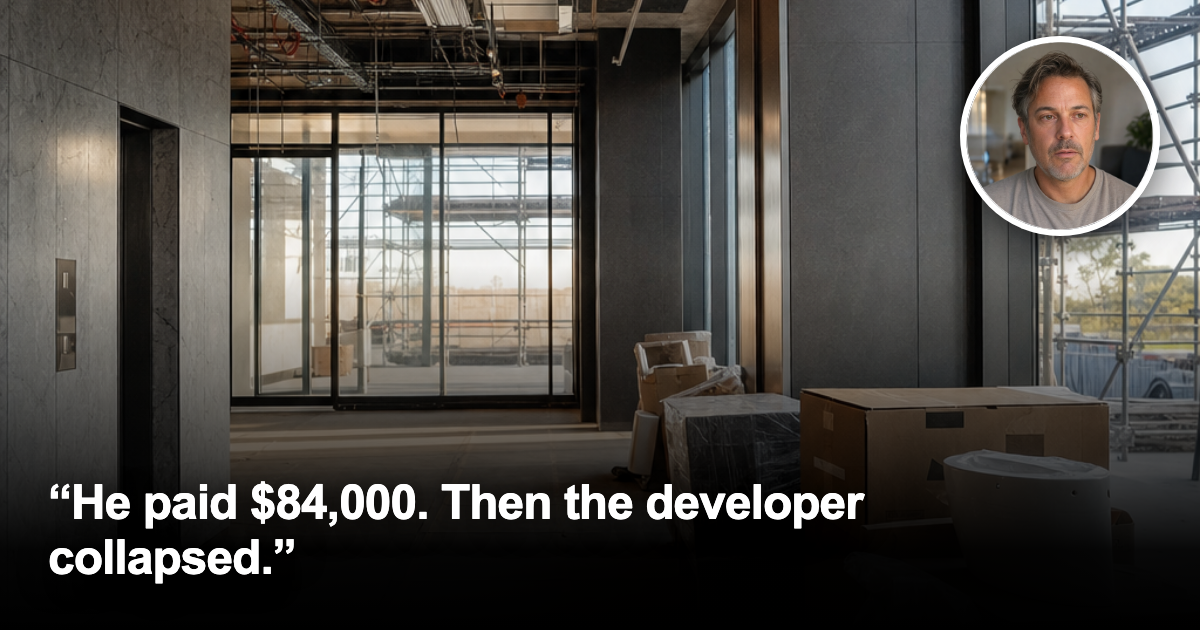
A 51-year-old man thought the hard part was over. The apartment had been inspected, the kitchen was fitted, the balcony doors were in and settlement was approaching. He had transferred $84,000 in deposits and was arranging the final loan documents.
Then the developer stopped trading.
The building did not look abandoned. There were lights in some windows and scaffolding still wrapped around one elevation. But the people who were meant to finish the common areas, correct the defects and hand over the keys were suddenly gone. His question was brutally simple: “I have paid most of the deposit for a home that is nearly finished. Why can’t someone just complete it?”
It is the question many buyers ask only after a project becomes visibly distressed. By then, the important decisions were made months earlier — when they chose the building, signed the contract and assumed “nearly complete” meant “almost certain”.
The answer is that a building and a contract are different assets
A completed apartment is a physical asset. An off-the-plan or unfinished apartment is also a promise about a future asset, made by a particular developer, funded through a particular structure and dependent on a chain of builders, certifiers, lenders and contractors.
If that chain breaks, the buyer may not simply be able to appoint another builder and collect the keys. The replacement builder must understand what has been done, what has been certified, what has been paid for, what remains defective and who owns the work already sitting on the site. There may be disputes over subcontractors, unpaid claims, insurance, title, finance and the practical right to enter the project.
“Almost finished” is therefore not a percentage. It is a collection of separate questions.
Has the relevant unit reached legal completion? Have the common areas been completed? Are essential services operational? Has the building received the approvals needed for occupation? Are defects documented and rectified? Has the buyer’s contract dealt with delay, termination and recovery of the deposit? Is there a viable party with both the obligation and the money to finish the job?
Those answers can be very different even for two apartments in the same project.
Why the deposit is not the same as equity
The $84,000 felt like ownership to him. Legally and financially, it was money committed under a contract whose outcome depended on more than the market value of the apartment.
If a project fails before settlement, the buyer’s position can involve a claim against the developer, a trust or security arrangement, a lender’s rights, insolvency administration and the terms of the sale contract. A buyer may ultimately have rights, but a right is not the same as immediate cash, and neither is the same as a finished home.
The uncomfortable part is that a rising market can make the situation look safer than it is. If comparable apartments have risen by $60,000, buyers focus on the apparent gain. They may not ask whether the developer has enough liquidity to finish, whether the construction program has real contingency or whether the project has crossed the point where a delay becomes a financing problem.
That is why a cheaper contract price is not automatically a better investment. The price has to compensate for delivery risk, not merely reflect the suburb’s median.
The detail most suburb reports miss
Two apartment projects can sit within the same suburb, share a postcode and appear in the same growth report, yet carry radically different risk. One may have a funded builder, clear approvals, completed services and a deep resale market. The other may have an unfinished facade, thin buyer depth and a settlement timetable that depends on one more round of finance.
At Ripehouse Advisory, the useful question is not simply whether the suburb is growing. It is what is happening around the exact asset: achieved rents rather than asking rents, real vacancy duration, true days on market, the age and quality of nearby stock, construction supply due to complete, and whether buyers are actually choosing that street or building when they have alternatives.
In one suburb, the effective-yield gap between the strongest and weakest streets can reach 20–30% once achieved rent, vacancy and holding costs are measured properly. Construction risk can widen that gap again. A median price does not read a builder’s balance sheet, a completion certificate or a stalled services connection.
What should a buyer ask before signing?
First, separate the promised completion date from the evidence supporting it. Ask for the construction schedule, current certificates, outstanding works and a written explanation of what remains between today and occupation.
Second, understand the contract’s delay and sunset provisions. A clause that looks like routine legal wording can determine whether the buyer waits, terminates, renegotiates or becomes exposed to a market that has moved against them.
Third, investigate the developer and the project, not just the display apartment. Look for completed projects, unresolved defects, changes in builders, repeated extensions and whether the project depends on presales or refinancing to reach the next stage.
Fourth, model the fallback. What would the loan cost during a six-month delay? What rent would a comparable completed apartment actually achieve? How many similar apartments are due to complete nearby? If the buyer had to sell rather than settle, who would be the likely purchaser?
Finally, price the contract as a construction exposure until the keys are handed over. That does not mean every unfinished project is dangerous. It means the buyer should be paid for taking a risk that a completed house does not carry in the same way.
What happened to him?
His outcome was not decided by the apartment’s glossy finishes. It turned on the project’s legal and financial structure, the priority of competing claims and whether a replacement path could be funded. The building was physically close to finished, but financially it was not close to safe.
That distinction is the lesson. Property remains one of the most durable ways to build wealth, but the right asset is more than a floor plan and a suburb name. It is a street, a building, a contract, a delivery record and a buyer pool that can be measured before emotion takes over. Ripehouse has also examined how a renovated-home warranty can follow the building and why a fixed-price renovation can move when hidden work appears.
The opportunity is still there for investors who do that work. Risk you can read before signing is risk you can price — and the buyer who prices it properly can keep buying property while everyone else is relying on the word “nearly”.
If there's a specific street you're weighing up right now, check its Street Score first — it's free, takes ten seconds, and tells you whether that street is pulling the suburb average up or riding on it.
Frequently asked questions
If an apartment is almost finished, can the buyer just appoint another builder to complete it?
Not usually. The article says a near-complete apartment is tied to a contract, approvals, financing and work already done, so a replacement builder may face disputes over what is finished, defective, certified or unpaid.
Why isn’t a paid deposit the same thing as owning the apartment?
Because the deposit is money committed under a contract, not the same as a completed asset. If the project fails before settlement, the buyer may have claims or rights, but that is not the same as getting a finished home or immediate cash.
What should a buyer check before treating a near-finished apartment as safe to buy?
The article says buyers should check the construction schedule, current certificates, outstanding works and what still needs to happen before occupation. They should also understand the contract’s delay and sunset clauses and investigate the developer’s delivery record.
What risks matter most if a developer collapses before settlement in Australia?
The key risks are unfinished works, defects, approval issues, competing claims, financing problems and uncertainty about who can legally and practically finish the project. The buyer’s position can also depend on the contract, insolvency process and any trust or security arrangements.
What is the main lesson for buyers looking at an almost completed apartment?
The article’s main point is that “almost finished” is not the same as safe. Buyers should treat the contract as a construction exposure until the keys are handed over and price in the risk of delay, refinancing problems or project failure.
General information only. It does not take your objectives, financial situation or needs into account, and nothing here is legal, financial, taxation or investment advice specific to your circumstances.