News · 11 August 2026 · 6 min read
'I bought there because of the airport.' Now he wants to know what it costs him
A Sydney investor bought near announced infrastructure and was right about it. Then the overnight flights started. A world-first study of 3.7 million homes put a number on what noise does to value - and the number changes from one facade of a building to the other.
He was not complaining. That is what made the question interesting.
An investor in his early fifties came to us a few days ago with a property in Sydney's outer south-west, bought about six years ago for one reason: infrastructure had been announced, and he believed the area would be re-rated because of it. He was right. The infrastructure was built. The area was re-rated.
Then the overnight freight flights started, and he found himself lying awake at 3am doing sums.
His question was not "have I been robbed?" It was sharper than that, and better:
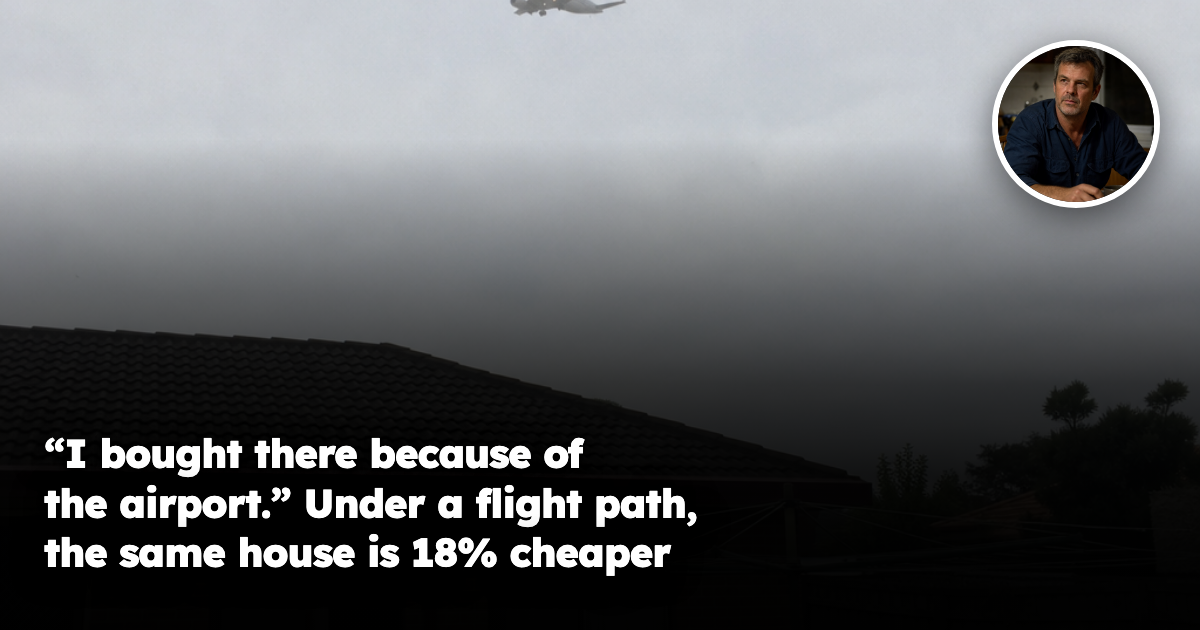
"I bought there because of the airport. Is the airport now the thing that costs me? And if it is, how would I even know by how much?"
Until recently the honest answer was a shrug and an anecdote. Not any more. Noise is now one of the most precisely measured influences on Australian property value that exists — and the measurements should change how you look at any property you own or are about to buy.
The question: does noise actually move the price, or do people just say it does?
It moves the price. And unusually, we can tell you roughly by how much.
A world-first piece of research took modelled noise levels and matched them against estimated values for 3.7 million dwellings across metropolitan and regional Victoria. Rather than working from suburb averages, the noise modelling combined terrain and building data with traffic, train and aircraft movement data to calculate noise for every facade, and every level, of every dwelling.
Read that again, because it is the whole point of this article. Not per suburb. Not per street. Per face of the building, per storey.
The results, by source of noise:
- Aircraft noise: 6–9% off the value for every 10-decibel increase. The steepest effect of any transport noise.
- Road traffic: about 6% for every 10 decibels.
- Passenger rail and trams: about 4% — and that is after allowing for the convenience and connectivity benefit of living near a line.
- Freight rail: worse than passenger rail. Higher noise, and none of the amenity upside.
Now compound the aircraft figure. A home under a flight path can sit around 20 decibels above an otherwise equivalent home outside it. At 6–9% per 10 decibels, that equivalent home is 12–18% more expensive than the one under the path. Same house, same suburb, same land size — nearly a fifth of the value, decided by something you cannot see in a photograph.
And this is not one study talking to itself. International research across many separate studies lands in the same place: prices fall by roughly 0.5–0.6% for every single decibel of aircraft noise. A separate analysis of thousands of individual Melbourne house sales found homes further from a runway — otherwise similar in standing — sold for up to 37% more than those closer in. Different evidence, different methods, same answer.
The answer: it is not the suburb, and it never was
Here is the part that matters for our investor, and probably for you.
Airports and transport corridors genuinely lift a region. Connectivity, jobs, investment — the area-wide effect is often positive, which is exactly why he bought and exactly why he was right. But that lift does not reach every house equally, and the research is blunt about who wears the cost.
The worst-affected owners are the ones far enough from the infrastructure to miss the economic uplift, but close enough to get frequent low-altitude flights over the roof. For those homes, the net effect on price is often negative — in the same suburb, sometimes on the same street, as homes that are doing beautifully out of the same project.
That is a street- and property-level distinction no suburb-level report will ever show you. A suburb median blends the winners and the losers into one number and hands it to you as though it were information. It tells you the area went up. It cannot tell you whether your facade went up.
This is what we mean by resolution. Our research works at street and property level — orientation, position on the block, aspect, what faces what, what is being built nearby and what it does to the specific dwelling rather than the postcode. It is the same lesson as what a single street tree ten metres from a house does to its value, the same reason a $210,000 renovation can add almost nothing on the wrong street, and the same mechanism behind what happens to a home when something large gets built behind the back fence.
One more twist, and it is the practical one. The discount is cyclical. Agents working near airports report that in hot markets, with urgent buyers and little stock, the gap between a busy position and a quiet one compresses — and in slow markets it widens back out. The penalty is real and persistent, but its size moves with the cycle.
What this means for you
Four things, none of which require a decibel meter.
1. Check the specific dwelling, not the suburb. Which way does it face? Which storey? Is the noisy side the bedrooms or the laundry? Two apartments in one building, one above the other, are not the same asset.
2. Ask about night, not day. Buyers pay a premium for quiet, and it is strongest where night-time noise is low. An inspection at 11am on a Saturday tells you almost nothing.
3. Find out what is planned, not just what exists. Flight paths and freight timetables are being redrawn across the country right now. This is the only value factor here that a third party can change without ever touching your land.
4. Separate the amenity from the noise. As one researcher put it, the sweet spot is near the transport but a little away from it — close enough for the benefit, far enough from the sound. Two different variables, and you can optimise them separately.
The part most people miss
It is tempting to read all this as a warning. It is the opposite.
Noise is not an unpriced risk lurking in your portfolio — it is a priced characteristic, and the market has already paid for it. That cuts three ways. Some homes are discounted for a real, permanent problem, and should be. Some quietly carry a measurable premium for being on the right side of the right street, which no suburb report will ever reveal to a competing buyer. And some sit at full price today with a flight path arriving in five years — the only genuinely dangerous group of the three.
Our investor was right about the infrastructure. He was right that the region would re-rate. What he had not done was ask the second half of the question: whether his roof, on his side of the corridor, was in the group being lifted or the group paying for the lift.
That is not a reason to avoid infrastructure suburbs. It is a reason to buy in them with better information than the person bidding against you. The discount is measurable, the premium is measurable, and both are invisible at the only level of detail most buyers ever look at.
He asked the right question. Most people never get to it.
If there's a specific street you're weighing up right now, check its Street Score first — it's free, takes ten seconds, and tells you whether that street is pulling the suburb average up or riding on it.
Market data & R-Scores for locations in this article
Drill Down Into the Markets Mentioned Above
Inspect live monthly R-Scores, median prices, rental yields, and street-by-street scores for the cities and council areas referenced in this article:
Frequently asked questions
How much can airport noise affect a home’s value in Australia?
The article says aircraft noise can reduce value by about 6–9% for every 10-decibel increase. It also notes international research that finds prices fall by roughly 0.5–0.6% for every single decibel of aircraft noise.
Why can a suburb near an airport still perform well even if some homes lose value?
Airports and transport corridors can lift a whole region through jobs, investment and better connectivity. But the article says the uplift is not shared evenly, and homes close enough to get frequent low-altitude flights can still be discounted.
What is the most important thing to check before buying near a flight path or freight corridor?
Check the specific dwelling, not just the suburb. The article says orientation, storey, and which side of the building faces the noise can materially change the impact on value.
Does the time of day matter when assessing noise risk?
Yes. The article says buyers pay a premium for quiet, especially where night-time noise is low. A daytime inspection may not reveal the noise problem that matters most.
Can the noise discount change over time?
Yes. The article says the discount is cyclical: in hot markets the gap between noisy and quiet properties can compress, while in slower markets it tends to widen again.
General information only. It does not take your objectives, financial situation or needs into account, and nothing here is legal, financial, taxation or investment advice specific to your circumstances.