News · 10 August 2026 · 8 min read
'It cost me $1,232 to mow a lawn.' An investor asked us how a $69,000 bargain got so expensive
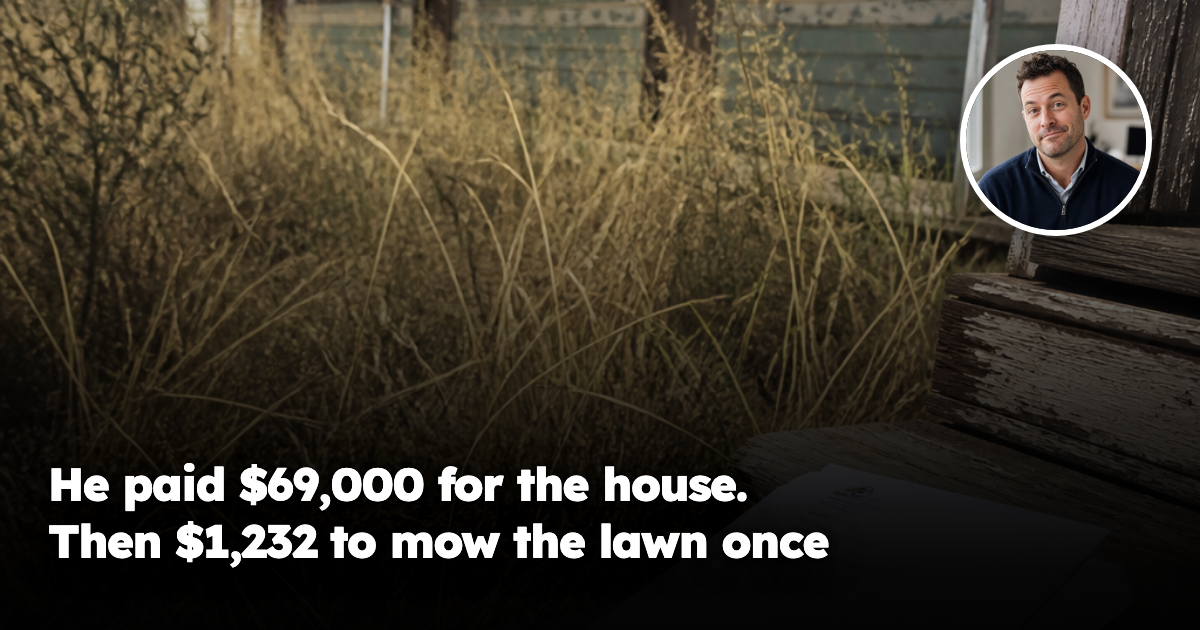
An investor bought a derelict duplex for $69,000 and was handed a $1,232 invoice to slash the grass once. The story is being shared as an absurd one-off. It isn't. It's what happens when you price the asset and forget to price the address — and the number that would have warned him is one almost nobody checks.
He had done the hard part right, which is what makes this worth writing about.
A Victorian investor, running his purchases out of an office more than three thousand kilometres away, bought a derelict duplex in the far north of regional Western Australia for $69,000. The plan was sound and genuinely creative: renovate the site, then split it into two separate titles. Two dwellings for less than the price of a new car in a capital city.
Then, while he was still waiting on council approvals — before a single trade had been booked, before the asset had earned one dollar — he opened an invoice for $1,232 including GST.
For mowing the lawn. Once.
That single slashing job came to almost 2 per cent of what he paid for the entire property.
So he asked us a fair question.
"How does a one-off mow cost two per cent of the purchase price — and how was I supposed to see that coming?"
The first half has a straightforward answer. The second half is the one worth your time, because the honest answer is: he could have seen it coming, and the number that would have told him is one that almost nobody looks at.
What actually happened
The block is 1,268sqm and it came heavily overgrown. While the approvals sat in a queue, the local shire issued a Fire Break and Fuel Hazard Reduction Notice — a routine, entirely legitimate instrument in a bushfire-prone part of the country. It required the vegetation to be cut to no more than 50mm, with a hard compliance date and fines of up to $5,000 for missing it.
The clock was four weeks, and in practice less, because the letter had to travel from Western Australia to a Geelong office before anyone read it. Inspections began the day after the deadline. The obligation didn't end there either — the property had to be kept at that standard through to the end of December.
The property was vacant, with no trades scheduled on site. There was no option to drive over on a Saturday with a trailer and a whipper snipper, because "over" was an interstate flight away. So he paid a local contractor.
For a block that size, general market rates for a maintenance visit sit around $150 to $260, and even badly overgrown or awkward sites are usually quoted $180 to $350 or more. His bill was multiples of the top of that range.
Not because anyone gouged him. Because in a remote town there is a very short list of people who own the right equipment, and a deadline-driven job commissioned by an absentee owner with no local relationships and no ability to shop around is the weakest negotiating position in property. Strong demand, thin supply, no alternatives, statutory deadline. That is the whole price explained.
The part that isn't about lawns
It is tempting to file this under "funny one-off" and move on. That would be a mistake, because the mow is a symptom of something that shows up in every line of a holding budget for that address.
Ask what else that same thinness does to the deal. Who inspects it. Who quotes the renovation. How many builders will price the subdivision, and what they charge when they know there are two of them in town. How long the approval sits in a queue at a small shire with a small planning team. What happens when something breaks on a Friday.
The $1,232 wasn't an anomaly. It was the first honest quote the deal produced — the first time the market told him what it costs to own something at that address rather than what it costs to buy it.
That is the trap in cheap property generally. A low purchase price is a single number you see once, at the start, in enormous print. Holding costs are a hundred small numbers you meet one at a time, quietly, for as long as you own the thing. Investors underwrite the first with great care and estimate the second with a shrug. It's the same failure mode as insurance renewals that triple on a property that has never made a claim — the cost was always attached to the location, it just hadn't introduced itself yet.
To his credit, the investor's own conclusion was right: vacant blocks don't stop growing while you wait for approvals, councils are entitled to expect properties to be maintained in bushfire country, and this now goes into the forecast. Most people would have simply complained.
But there's a step before the forecast.
The answer: service depth is measurable before you buy
Here is what we would have wanted on the table before that contract was signed — and none of it requires hindsight.
Every serious location assessment in this industry now scores areas on operational metrics rather than price: inventory levels, days on market, how often stock sells above asking, vacancy rates, momentum. That is the right instinct, and it's why the strongest-performing council areas in the country right now aren't the ones with the most exciting headlines — they're the ones where stock clears fast, inventory is thin and vacancy has effectively disappeared. Those are measurements of how a market behaves, not what it costs.
Our argument is that this logic has to be pushed far further down than council level, and it has to include the cost side.
Ripehouse Advisory's research engine grades locations street by street rather than suburb by suburb, because averages hide precisely the thing that decides your return. In a single suburb, the effective-yield spread between the best and worst streets routinely runs 20 to 30 per cent — measured on real outcomes, not asking rents: how long a property genuinely sits vacant between tenants, real days on market, actual achieved rents. When a suburb's median rises, it is usually a minority of its streets doing the lifting while the rest are carried along by the average and quietly credited with growth they never produced.
The same discipline answers what this investor is really asking. Depth of local trades, contractor availability, how quickly work gets quoted and completed, days on market, vacancy duration, the rate at which listings actually transact — these tell you whether an address is serviceable, and whether a renovation-and-subdivision plan runs to schedule or bleeds holding costs for eight months waiting on the one person in town who owns a skid steer.
A market where stock clears quickly and vacancy has vanished has depth: competing trades, competing agents, competing buyers, a queue of tenants. A market where you cannot obtain a second quote for mowing a lawn does not — and the same absence that produced a $1,232 invoice will produce a slow approval, a thin buyer pool at resale, and a longer vacancy when it's finally tenanted.
None of that is visible in the price. All of it is visible in the data.
What this means for you
The correction isn't "avoid cheap property" or "avoid the regions." Some of the best risk-adjusted buying in Australia right now is regional, and there are regional markets showing durable, unspectacular strength rather than boom-cycle volatility. The correction is narrower:
Underwrite the address, not just the asset. Before you buy, price the holding period the way you price the purchase — approval timeframes, trade availability and travel premiums, statutory maintenance obligations for that hazard zone, vacancy duration, and days on market at exit. If you cannot get those numbers, that is itself your answer about the depth of the market.
Treat the cheapest thing on the screen as a question, not an opportunity. Price is what the market thinks of the address, expressed once. A $69,000 house isn't automatically a bad buy — but it is always an invitation to find out why it's $69,000, and the answer is rarely "nobody noticed."
Distance multiplies every weakness. A remote holding turns small operational frictions into expensive ones, because every fix requires someone else's schedule and someone else's price. If a location is thin on services, you need a bigger margin, not more optimism. The same principle runs through the renovation that added $210,000 of work and nothing to the valuation and the dual-dwelling plans that hinge entirely on what the block and the rules actually permit.
Now the part the outrage cycle will skip.
Holding costs that were never disclosed upfront are not unique to regional land — UK buyers who paid $800,000 for a leasehold flat with ground rent doubling every ten years learned the same lesson at a very different price point.
This investor is going to be fine. He bought two potential dwellings for $69,000, he has a subdivision plan, and he has just paid roughly $1,200 for the most valuable lesson in this asset class — delivered early, in cash, before the renovation budget was committed rather than after. He has already folded it into his forecasts. That is not a cautionary tale about property investment. That is property investment working exactly as it works for people who stay in it: the market charges you for what you didn't know, you write it down, and you don't pay it twice.
The costs were never hidden. They were sitting in the operational data for that address the entire time, waiting for someone to look. Investors who buy on price alone keep meeting these numbers as surprises. Investors who buy on street-level evidence meet them as line items, budgeted, six months before settlement.
Property remains one of the most reliable wealth-building assets in this country, and it rewards precision more than courage. The right asset, on the right street, bought with a clear-eyed view of what it costs to hold — that beats a bargain price every single time.
He was never really billed $1,232 to mow a lawn. He was billed $1,232 to find out what kind of address he'd bought. The data would have told him for free.
If there's a specific street you're weighing up right now, check its Street Score first — it's free, takes ten seconds, and tells you whether that street is pulling the suburb average up or riding on it.
Market data & R-Scores for locations in this article
Drill Down Into the Markets Mentioned Above
Inspect live monthly R-Scores, median prices, rental yields, and street-by-street scores for the cities and council areas referenced in this article:
Frequently asked questions
Why did mowing a vacant duplex in regional Western Australia end up costing $1,232?
The property was overgrown, remote, and subject to a shire Fire Break and Fuel Hazard Reduction Notice in a bushfire-prone area. With a hard deadline, no local access, and no ability for the owner to do the work himself, he had to hire a contractor in a market with very limited supply.
What was the main warning sign the investor missed before buying the $69,000 property?
He focused on the purchase price but not the address’s operational cost and service depth. The article says the useful warning would have been local data such as contractor availability, approval delays, vacancy, and days on market.
What does this story show about buying cheap property in regional Australia?
A low purchase price can hide high holding costs, especially in thinly serviced or remote locations. The article’s point is that investors should underwrite the address, not just the asset, because distance and limited local supply can make routine tasks much more expensive.
What practical costs should investors factor in before buying a remote property like this one?
The article highlights approval timeframes, trade availability and travel premiums, statutory maintenance obligations, vacancy duration, and days on market at resale. These costs can turn a bargain purchase into an expensive holding if they are not budgeted upfront.
Why did the local council’s fire notice matter so much to the final cost?
The notice required vegetation to be cut to no more than 50mm and carried fines of up to $5,000 for non-compliance. Because inspections started the day after the deadline and the property had to stay at that standard, the owner had little flexibility and had to pay whatever the local market charged.
General information only. It does not take your objectives, financial situation or needs into account, and nothing here is legal, financial, taxation or investment advice specific to your circumstances.