News · 13 August 2026 · 5 min read
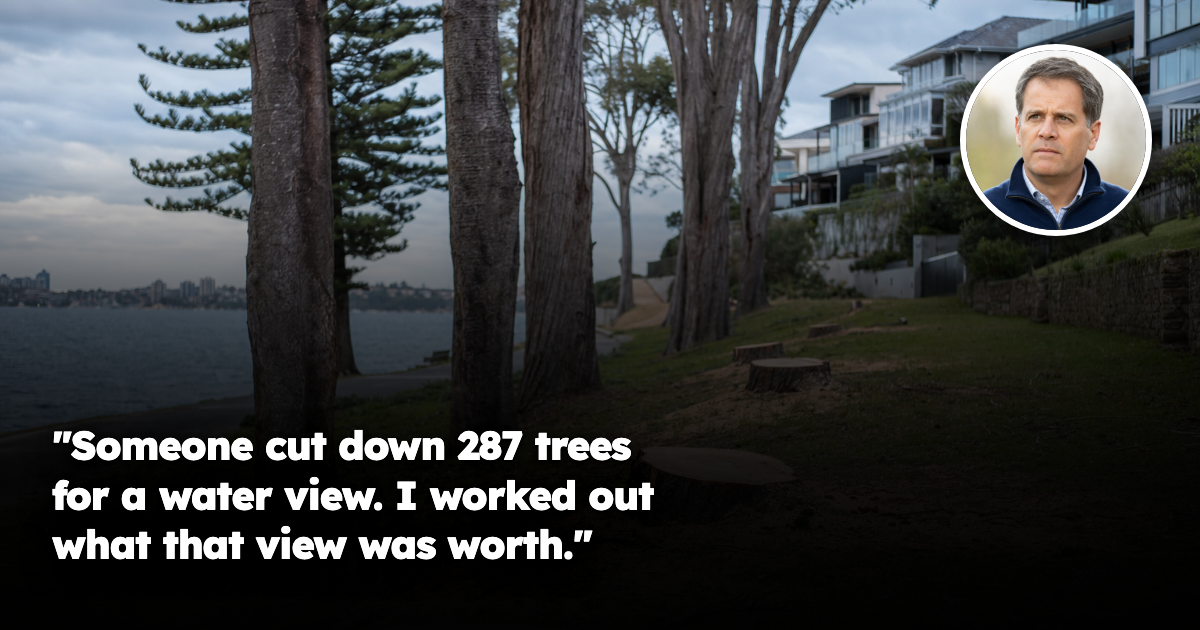
'Someone cut down 287 trees for a water view. I've just worked out what that view was worth'
Someone risked a half-million-dollar penalty to manufacture a water view. New micro-suburb data shows why: in one Sydney suburb the gap between the best and worst pocket is $11.5 million — and the suburb median is wrong about both ends of it.
A client asked us about this last week, and his question was better than the story that prompted it.
The story was one most Australians saw: a gardener fined almost $200,000 after 287 trees were cleared from a harbourside foreshore, opening up the water views above. It is not isolated. On a northern NSW headland, two mature Norfolk pines were cut and a pandanus killed by drilling, weeks apart, where the trees blocked the outlook from a walking track. Councils elsewhere have parked a shipping container on a foreshore to block a "desired" view while investigating, and installed barriers and signs specifically to obstruct newly created sightlines.
His question was not about the vandalism. It was this: what is a view actually worth, if people will risk that much to manufacture one?
The number that should stop you
In NSW, serious tree vandalism prosecuted in court can attract penalties of up to $500,000 for an individual, with a proposal to lift that cap to $1 million. For companies the range is $1.1 million to $2 million, with a proposed increase to $5 million. Courts can order remediation and replanting on top, and apply ongoing daily penalties.
Nobody risks a half-million-dollar penalty and a prosecution for a nicer outlook at breakfast. They do it because in certain positions, a sightline to water is worth several times that.
That is the uncomfortable part. The vandalism is indefensible. The economics behind it are entirely real, and almost nobody measures them properly — including the people who buy and sell these houses.
Two markets in one suburb
Here is where the property lesson lives, and it is the clearest proof point we have seen of something we argue constantly.
Analysis that breaks suburbs down into micro-pockets — small statistical areas rather than whole suburbs — shows that in Australia's most prized waterside neighbourhoods, the gap between the best and worst pocket inside a single suburb is measured in millions.
In one eastern Sydney harbourside suburb, the pocket closest to the water carries a median estimated house valuation of about $13.7 million. Another pocket in the same suburb, back near a reserve and a high school, sits around $2.2 million. That is a gap of roughly $11.5 million — the largest in the country.
Now look at what the suburb median says: about $3.7 million.
That single number is wrong about both ends of the suburb. It is nearly $10 million short of the good pocket, and it overstates the cheaper one by more than 60%. A local agent described the suburb as two property markets separated by a golf course — entry-level units around $750,000 on one side, homes near $10 million on the other. Same postcode. Same median. Same council. Two entirely different assets.
It is not a one-off. On a harbourside peninsula on the other side of the same city, view pockets sit around $11.4 million while poorer outlooks sit near $2.8 million — an $8.5 million spread, against a suburb median of $3.2 million. The explanation was simple: a house on one side of the peninsula fetches far more than a similar house on the other.
In a riverside Brisbane suburb, river-adjacent streets are valued near $4.3 million. A few streets back, toward the neighbouring suburb, the figure is about $700,000 — against a suburb median of $2 million. Every state has its version, from roughly $7.7 million in a blue-chip Melbourne suburb down to over $700,000 in Hobart's most prestigious address.
What actually drives it
The factors that separate those pockets are exactly the ones a suburb median cannot see: block size, aspect and elevation, proximity to shops and amenity, town planning rules, distance to major roads, country rail corridors and boom gates — and, above all in coastal and harbour markets, whether you can see the water. It is the same mechanism that lets a single street tree change a property's value by tens of thousands of dollars, or a school catchment boundary running between two houses create a several-hundred-thousand-dollar difference between neighbours.
This is the whole reason Ripehouse Advisory works at street and pocket level rather than suburb level. A suburb median is an average of properties that behave nothing alike: it takes the harbour-view side and the road-facing side, adds them together and divides. The number it produces describes no actual house. In ordinary suburbs, where the dollars are smaller, the same structural error is still there, still invisible, and still the difference between a good buy and a mediocre one. Our street-level work routinely finds a 20–30% spread in effective yield between the best and worst streets in one suburb, using achieved rents, real vacancy duration and real days on market rather than advertised figures.
The view case just makes it impossible to argue with, because you can stand on the footpath and see the boundary.
The trap on the other side
None of this means "buy the view at any price." Two cautions matter.
First, a premium pocket is not automatically a good buy. In tougher conditions the most expensive properties are often the hardest to sell — a small buyer pool is an asset in a rising market and a liability in a falling one. Days on market, measured at pocket level, tells you which one you are in.
Second: a compromised property in an elite suburb can easily underperform an uncompromised property in the suburb next door. When you buy in a bargain location, one day you will be selling in a bargain location. The postcode does not rescue the position.
And there is a specific risk in view stock that buyers routinely miss: a view you do not legally own can be taken away. Vegetation grows. Councils replant — often deliberately, and sometimes with barriers and signage designed to close a sightline. Neighbours build. Unless the outlook is protected by topography or by a genuine planning constraint on the land in front of you, part of what you paid for is borrowed. It belongs in the same category as the overlays and mapped constraints that reprice a block without anything physical changing. That is a checkable, street-level question, and it is one of the highest-value pieces of due diligence available in coastal and harbour markets.
The bottom line
The people cutting down trees have worked out something most buyers have not: in Australian property, position is not the suburb. It is the block, the aspect, the elevation and the sightline — and the market prices those differences in the millions while the headline number for the suburb averages them all away.
That is not a reason to be cautious about property. It is the reason property still rewards research. The same dispersion that makes a suburb median useless is what creates the opportunity — because when the market prices an entire suburb off one number, it is systematically mispricing the properties at both ends of it. You cannot exploit that with a median. You can exploit it with data at the level people actually live at.
He wanted to know what the view was worth. The real answer was that his suburb had never been one market — and neither has anybody else's.
If there's a specific street you're weighing up right now, check its Street Score first — it's free, takes ten seconds, and tells you whether that street is pulling the suburb average up or riding on it.
Market data & R-Scores for locations in this article
Drill Down Into the Markets Mentioned Above
Inspect live monthly R-Scores, median prices, rental yields, and street-by-street scores for the cities and council areas referenced in this article:
Frequently asked questions
Why would someone risk a large fine just to open up a water view in NSW?
The article says they do it because, in some waterfront and harbour locations, a water outlook can be worth several times the penalty. In serious NSW tree vandalism cases, courts can impose penalties of up to $500,000 for individuals, with further remediation and daily penalties possible.
How different can house values be inside the same Sydney suburb?
Very different. In one eastern Sydney harbourside suburb, the best pocket was valued around $13.7 million and another pocket in the same suburb was around $2.2 million, a gap of about $11.5 million.
Why is a suburb median misleading for premium waterfront areas?
A suburb median averages together homes that behave nothing alike, such as harbour-view properties and road-facing properties. The article says that can leave the median wrong about both the top end and the cheaper end of the same suburb.
What factors matter more than the suburb name when pricing a property?
The article points to block size, aspect, elevation, proximity to shops and amenity, planning rules, major roads, rail corridors, boom gates and, in coastal or harbour areas, whether the property can actually see the water. These are the factors that separate one pocket from another.
What is the main risk of paying extra for a water view?
A view you do not legally own can be lost. Vegetation can grow back, councils may replant, neighbours may build, and barriers or signs can be used to close a sightline, so buyers need to check whether the outlook is protected by topography or planning constraints.
General information only. It does not take your objectives, financial situation or needs into account, and nothing here is legal, financial, taxation or investment advice specific to your circumstances.