News · 14 August 2026 · 5 min read
'The pest report said no live termites. It said it five times' — the line she never read cost $1.1 million
Every building and pest report contains a limitations section almost nobody reads. A court decision this year put a number on what those few lines are actually worth — and it was $1.1 million.
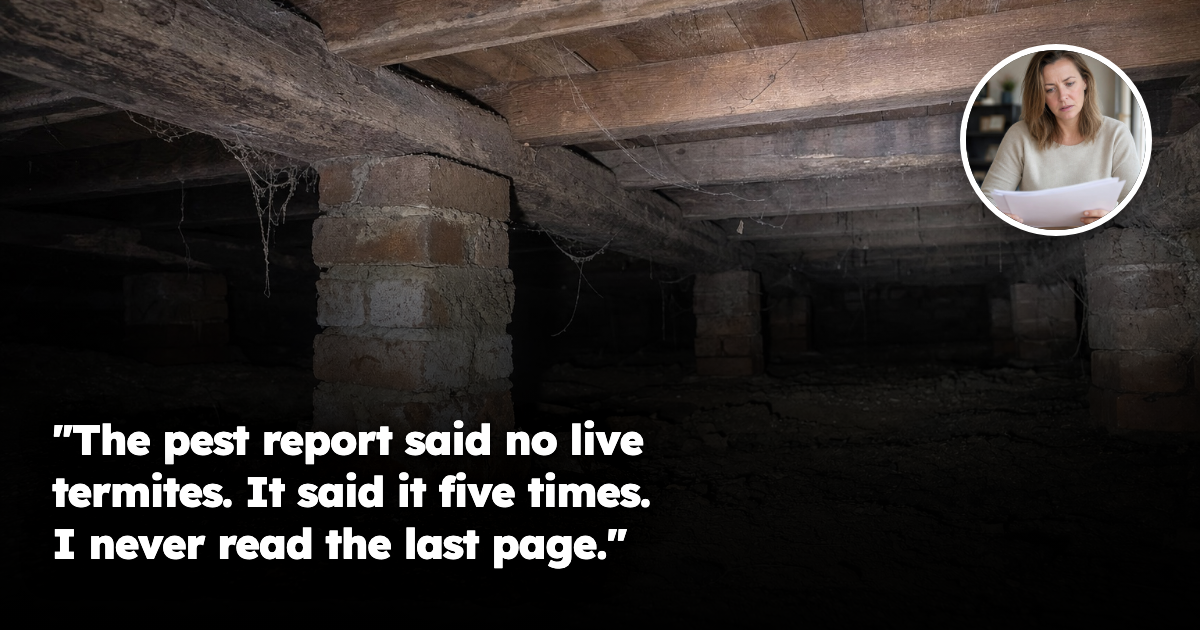
She is about to buy her second investment property, and last week she did something almost nobody does. She went back and reread the building and pest report on the first one.
"I bought that house four years ago on a report that said no live termites," she told us. "I've just read the same report properly for the first time. There's a whole page about what he couldn't get to. I don't think I read a word of it."
She is in her early forties, one property held since 2021, a tenant she likes, no problem of any kind. Nothing has gone wrong — which is what makes her question worth answering. She is not asking us to fix a disaster. She is asking whether she ever actually knew what she was buying.
She had reason to. A court decision this year put a price on those few paragraphs, and it is not small.
What the court decided
The facts are brutal in their simplicity. A pest and building inspection report was prepared for a house so it could be sold. It said there was no evidence of live termites. On evidence given in court, it said so five separate times across the document.
A buyer paid $1.8 million on the strength of it. Within twelve months they found termites — live ones in a structural wall frame, damage through structural wall timbers, infestations in the master bedroom and ensuite, tunnels running up the foundations. A later report found the house was not safe to live in. The owners moved into a rental.
The judge found the damage had reached so many parts of the house, and parts of such structural importance, that the building was structurally unsound and would have to be demolished and rebuilt.
But here is the finding that matters to every buyer in the country. The court did not simply hold that the inspector missed termites. It held that the report should have warned that termites and extensive damage could have been present in the areas he was not able to access — and that it should have recommended further investigation was required.
Those missing words were assessed at $1,113,133 in damages, plus interest.
The gap between "no termites found" and "no termites"
This is the part that should make every owner uncomfortable, and it has nothing to do with one inspector.
Every inspection has limits. A subfloor too tight to enter. A roof cavity with no hatch. A lined wall, a room full of the vendor's furniture, a deck built over the very soil an inspector would want to see. Those limits get recorded in a section most buyers skim on the way to the summary.
And termites do not travel in the open. They move through soil, foundations, subfloors, wall cavities and concealed timber — which means the areas that could not be inspected are often precisely the areas where the risk lives.
So the sentence "no live termites were detected in accessible areas" is doing something very specific. It is not a clearance. It is a statement about where somebody stood. When a report says an area was not accessed, that does not mean the area is clear. It means the risk there is unknown — and unknown is not the same as absent.
There is a timing trap folded into this. Before settlement, an unanswered question is something you can price, investigate or walk away from. After settlement, the identical question is your repair bill. Nothing about the risk changes. Only who owns it.
Why a suburb report was never going to tell her this
Here is the number from that case we keep coming back to.
A practising valuer gave evidence that the property was worth $1.8 million in 2019 if there were no active termites — and $1.3 million if there were, assessed as land only.
Same house. Same street. Same suburb, same postcode, same median, same school catchment, same census profile, same council. A $500,000 difference in value, decided entirely by something no suburb-level dataset in Australia can see.
This is the whole argument in one line item. Suburb data tells you what a category of property is doing. It cannot tell you what your asset is, because condition is not a suburb attribute. It is not even a street attribute. It belongs to one building — sometimes to one wall cavity in one building.
We measure the gap between the best and worst streets inside a single suburb at 20 to 30 per cent on effective yield, once you use achieved rents, real vacancy duration and real days on market rather than the advertised versions. Condition sits below even that. Two houses side by side, built the same year by the same builder, can differ by a third of their value on what a torch found in a crawl space — and the suburb median averages both and reports one number.
There is a detail in that case that proves the point rather than undermining it. The owners eventually sold for nearly $2.5 million as a knock-down rebuild. The land was never the problem. The land held its value the whole way through. What was destroyed was the house standing on it — and only one of those two things appears in a median.
What to actually do
We are not going to argue that inspectors are careless. One court decided one report on its facts, and the ordinary outcome is far less dramatic: the buyer simply owns the problem and pays for it quietly. That is the case to plan for.
Four things worth doing:
- Read the limitations section first, before the summary. Ask what could not be inspected, why, and whether it can be checked before settlement. Those three questions cost nothing.
- Treat "further investigation recommended", "limited access", "area not inspected", "moisture detected" and "previous termite activity" as instructions, not disclaimers.
- Commission your own report. A report the vendor paid for was written for the vendor's purpose.
- Get a termite-specific inspection where the risk warrants it. A general building and pest report is a generalist's document, and this is a specialist's problem. It is the same cheap-early, catastrophic-late shape as an easement nobody checked before the auction, or an insurance quote that reveals what a building actually is.
The point
None of this argues against buying property. It argues for knowing what you bought.
Property rewards diligence precisely because so much of the market prices assets off medians, photographs and summary pages. If everyone read the limitations section, it would already be in the price. They don't, so it isn't — and the gap between the published number and the real one is where the return lives.
She has since had a proper look under her first house. It is fine. She now knows that, which she did not before, and the second one will be bought differently.
The mistake was never trusting the report. It was reading the four words at the top and not the four hundred at the back.
If there's a specific street you're weighing up right now, check its Street Score first — it's free, takes ten seconds, and tells you whether that street is pulling the suburb average up or riding on it.
Frequently asked questions
What does a building and pest report saying ‘no live termites’ actually mean in Australia?
It only means no live termites were detected in the areas that were accessible and inspected at the time. It is not a guarantee that the whole property is termite-free, especially where parts of the building could not be reached.
Why was the court decision in this article worth more than $1.1 million?
The court found the report should have warned that termites and extensive damage could have been present in the areas the inspector could not access, and that further investigation was needed. Those missing warnings were assessed at $1,113,133 in damages, plus interest.
Why are the limitations section and access notes in a pest report so important?
Because they explain what could not be inspected, why it could not be inspected, and whether more checking is needed. In this case, the hidden risk sat in the areas the inspector could not access, not in the summary line buyers tend to read.
Can suburb data tell you whether a house has termite damage?
No. The article says suburb-level data can show trends for a category of property, but it cannot show the condition of one specific building. Termite damage can change the value of one house dramatically even if the suburb median looks unchanged.
What should a buyer do when a building and pest report mentions limited access or further investigation?
Treat those phrases as instructions, not throwaway disclaimers. The article says buyers should read the limitations section first, ask what could not be inspected, and consider their own report or a termite-specific inspection where the risk warrants it.
General information only. It does not take your objectives, financial situation or needs into account, and nothing here is legal, financial, taxation or investment advice specific to your circumstances.