News · 14 August 2026 · 6 min read
'I was about to transfer $940,000. Then I noticed my conveyancer's email had one wrong character'
She noticed at 9:40 on a Tuesday, with the transfer screen open and the amount already typed. Payment redirection is now the second-largest scam loss category in Australia at $166.8 million - and a national survey found 97% of property buyers failed to spot obvious fraud indicators in settlement emails. The uncomfortable question underneath it: how many other numbers in a property purchase arrive as a document nobody independently checks?
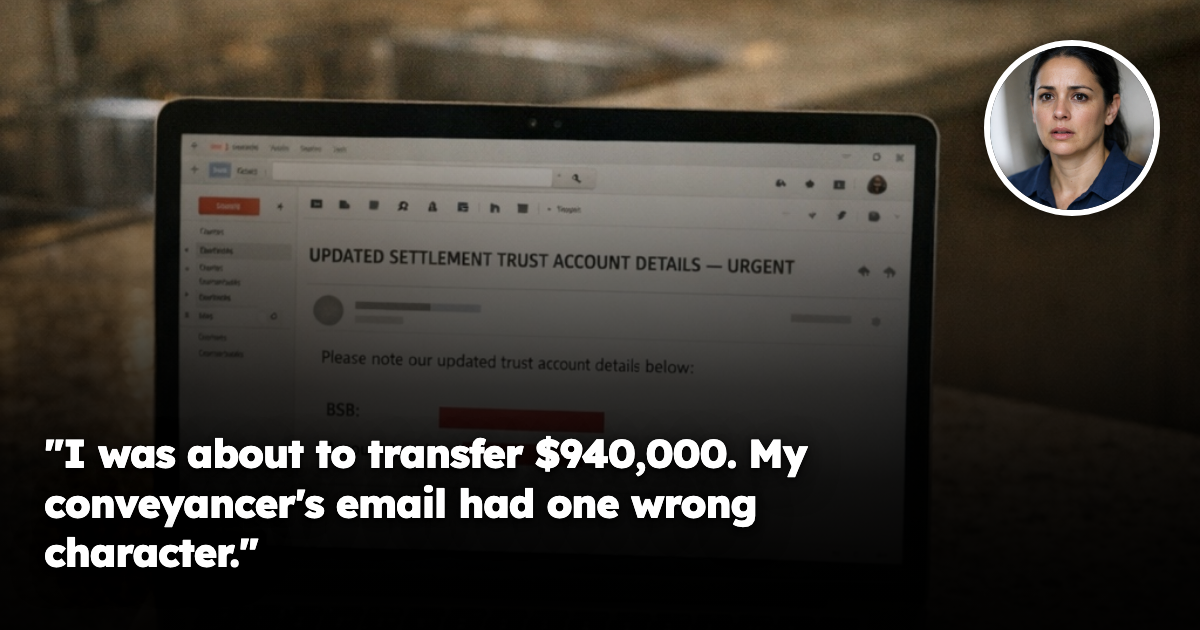
She noticed at 9:40 on a Tuesday, with the transfer screen open and the amount already typed.
The client is in her early forties, a hospital pharmacist, buying her second investment property — a three-bedroom house in Brisbane's north. Settlement was two days away. Her conveyancer had emailed the trust account details three weeks earlier. Then a follow-up arrived: the firm had changed banking providers, here are the updated details, please confirm today so settlement isn't delayed.
Everything about it was right. The signature block, the matter reference, the property address. The tone was right — mildly apologetic, faintly rushed, exactly how a busy conveyancing office writes at 4pm.
The email address was wrong by one character. A hyphen where the real domain uses a longer dash.
She caught it because she happened to have the original email open in another tab and the two addresses didn't line up. That is the entire margin. Not diligence, not training. Coincidence.
Her question to us afterwards was not "how do I avoid that". It was better: "How many other parts of this process am I trusting just because the document turned up in front of me?"
The scale of it is not what people assume
Most people file this under rare misfortune. It isn't rare, and it isn't small.
Across Australia's official scam reporting bodies, combined reported losses in 2025 came to $2.18 billion. The largest category was investment fraud at $837.7 million. The second largest was payment redirection, at $166.8 million.
The year before, payment redirection sat third, at $152.6 million. So in twelve months it rose about 9% and moved up the rankings — in a year when investment fraud fell, from $945 million. Of the five biggest loss categories in 2024, payment redirection is the only one that both grew in dollars and climbed the table.
A second number matters more. Total losses rose 7.8% while the number of reports fell 2.3% — fewer people reporting, more money gone. The individual hits are getting bigger, and property is where they get biggest. A national survey of just over a thousand Australians who had bought a property in the previous year or intended to in the next found that 97% failed to spot obvious indicators of fraud in property transaction emails — while most rated their own ability to detect a scam as high.
That gap between confidence and competence is the business model.
Why property settlement specifically
Because the conditions are perfect, and they're perfect by design rather than by accident.
A settlement combines a very large sum, a hard deadline, and routine reliance on email between parties who have often never met. The buyer is stressed and expecting to be sent bank details by someone they've never rung. Nobody has to break into a system — only into the correspondence, usually via a compromised email account in the chain, then wait for a payment instruction to fall due.
The tactics are unglamorous. A near-identical sending address. A punctuation change. Updated bank details on an urgent request. Sometimes a warning the purchase will fall over if the deadline is missed — because urgency is what stops people ringing to check.
Then the part that makes it categorically different: recovery. A disputed credit card transaction has a well-worn path back. Money sent from your own account, by you, deliberately, to an account you were told to use, does not. It is often contested, frequently unrecovered, and takes months you don't have when settlement is Thursday.
Four practical defences, in order of how much they protect you:
1. Verify every set of bank details by voice, on a number you sourced yourself — from the firm's website or your engagement letter, never from the email containing the details. Do it for the first set, not just changed ones.
2. Treat any change of account details as fraud until proven otherwise. Legitimate firms change banks rarely, and won't mind you ringing.
3. Never dismiss the name-check warning your bank now shows when the account name doesn't match what you typed. It exists for this, and is routinely clicked through.
4. Send a small test transfer first, confirm receipt by phone, then send the balance.
None of that is difficult. All of it takes about eleven minutes.
The part nobody talks about
Here is where our answer to her went somewhere she didn't expect.
She very nearly lost $940,000 because she trusted a document that arrived in front of her, from a party she had no reason to doubt, containing a number she couldn't independently check. She was rescued by an accident of tab management.
Now consider what else she had accepted the same way.
The appraisal that told her what the property was worth. The suburb median that told her the area was performing. The rental estimate that made the numbers work. Each arrived as a document, from a party with no obligation to be conservative, containing a number she had no independent way to check.
Nobody rings to verify those. We have written before about what happens when an owner spends $210,000 on a renovation the street was never going to pay back — the same failure, in slow motion.
This is the discipline gap that costs Australian investors far more, in aggregate, than settlement fraud ever will — because it doesn't announce itself. A redirected payment is brutally obvious. A property bought on an unverified number quietly underperforms for fifteen years, and the owner assumes that's what property does.
Our research is built around closing that gap at the resolution where it actually exists: not the suburb, the street. Between the best and worst streets inside a single suburb — same postcode, same median, same school catchment, same station — we routinely measure a 20–30% spread in effective yield, using achieved rents rather than advertised ones, real vacancy duration rather than a regional ratio, and actual days on market rather than a weekend clearance figure.
A suburb median cannot see that spread, because it is manufactured by averaging both sides of it. Which makes it the property equivalent of the email she nearly paid: plausible, professional, precisely formatted, and verified by nobody. The same applies to the selling-time figure most vendors never look up, and to the one opinion of your property that comes from someone with their own money at stake.
What this means for you
Verification is not a personality trait. It's a step in a process, and it belongs there twice — once on the money, once on the asset. On the money: ring the number you found yourself, before any funds move. On the asset: get the street-level evidence before you sign, from a source with no commission riding on your yes.
And to be direct — none of this is an argument against buying property. Payment redirection losses are rising because the sums moving through Australian property transactions are enormous, and they're enormous because the asset is worth owning. Criminals aren't targeting settlements because housing is fragile. They're targeting them because that's where the country's serious money is.
The failure mode was never buying the property. It was moving nearly a million dollars on a document nobody checked — then doing exactly the same thing with the research.
She rang the firm. The first email's details were the real ones. Settlement went through Thursday.
Then she asked us to check the street.
If there's a specific street you're weighing up right now, check its Street Score first — it's free, takes ten seconds, and tells you whether that street is pulling the suburb average up or riding on it.
Market data & R-Scores for locations in this article
Drill Down Into the Markets Mentioned Above
Inspect live monthly R-Scores, median prices, rental yields, and street-by-street scores for the cities and council areas referenced in this article:
Frequently asked questions
What is payment redirection in Australian property settlements, and why is it such a risk?
Payment redirection is when criminals alter or spoof settlement bank details so money is sent to the wrong account. It is a major risk in Australian property deals because settlements involve large sums, tight deadlines and routine email use, which makes urgency and trust easy to exploit.
How can I check whether a conveyancer's bank details are genuine before I transfer settlement money?
Verify the bank details by voice using a phone number you sourced yourself, such as from the firm's website or your engagement letter. Never rely on the phone number or account details in the email that asked for the transfer.
What should I do if I receive an email saying my conveyancer has changed bank accounts?
Treat any change of account details as fraud until it is proven otherwise. The article says legitimate firms change banks rarely and should not mind you ringing to confirm.
What warning signs in a settlement email should make me stop and check again?
Look closely at the sender address, because even one wrong character can matter. Also be cautious if the message is urgent, apologetic or says settlement will be delayed unless you act quickly.
Why does the article say property buyers should verify more than just bank details?
Because the same habit of trusting a document at face value can also affect the numbers used to assess a property, such as appraisals, suburb medians and rental estimates. The article argues those figures should be checked with street-level evidence, not accepted just because they look professional.
General information only. It does not take your objectives, financial situation or needs into account, and nothing here is legal, financial, taxation or investment advice specific to your circumstances.