News · 9 October 2026 · 5 min read
Her plan needed rent to rise $40 a week every year. Domain says capital city house rents just stopped at $700.
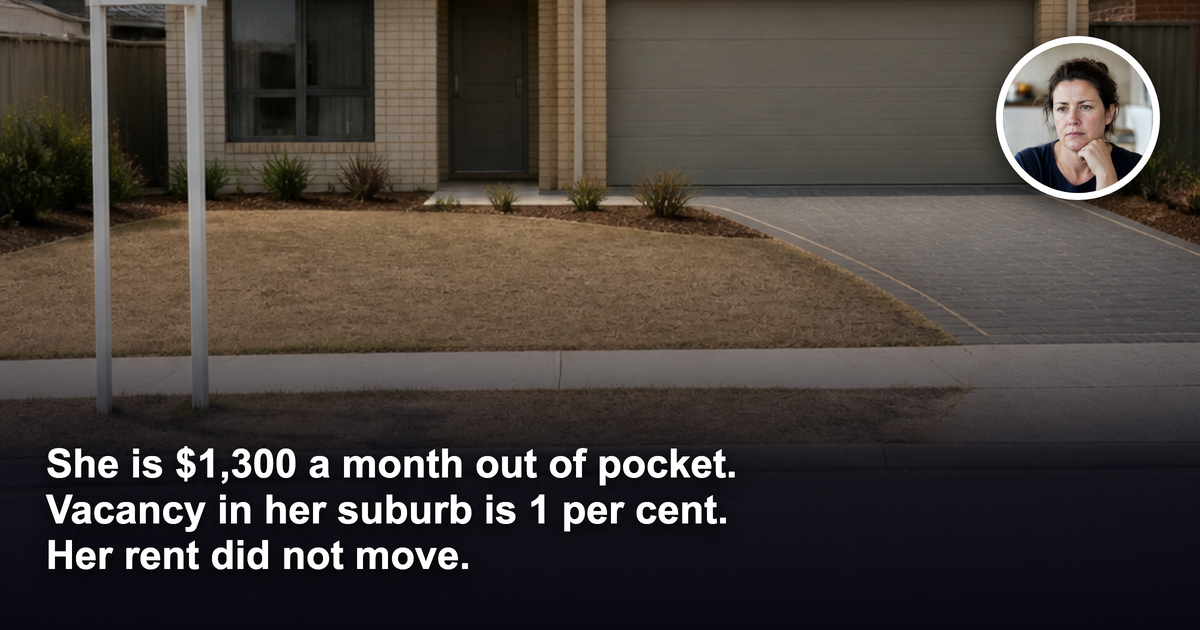
She is 38 and she is about $1,300 a month out of pocket on a three-bedroom house in Perth's south-east that she bought in 2024 against the equity in her family home.
She is 38 and she is about $1,300 a month out of pocket on a three-bedroom house in Perth's south-east that she bought in 2024 against the equity in her family home.
She is a composite illustration, not a real person. But the arithmetic she is living with is sitting in thousands of spreadsheets right now.
Her purchase was built on one idea. Perth was the tightest rental market in the country. Vacancy was close to nothing. Rent had jumped by hundreds a week in three years. So she bought a house with a shortfall, told herself it was temporary, and wrote a plan where the rent rose by about $40 a week every year until the gap closed.
That gap was meant to close by 2028.
The question
"My property manager says there are no vacancies in my suburb and twelve people came to the last inspection. So why did she tell me not to put the rent up at renewal? And if the rent does not go up, how long can I carry $1,300 a month?"
The answer: the tenants ran out of money before the market ran out of tenants
Domain's September quarter rental report, as covered by the ABC on 8 October, says capital city house rents were unchanged at $700 a week over the quarter. Unit rents rose 1.5 per cent.
The detail is worse than the headline. House rents in Melbourne, Brisbane, Perth and Adelaide flatlined over the three months. Sydney fell $5 a week. Canberra fell $10, erasing the gains from June. Only Darwin and Hobart rose, by 5.3 per cent and 1 per cent respectively.
And this happened with the national vacancy rate at 1 per cent. It crept up 0.1 of a percentage point, but it is still far tighter than a year ago. Domain's chief residential economist, Nicola Powell, still calls it a landlords' market in every capital.
So the shortage is real and the rent still stopped.
Dr Powell put it plainly to the ABC: tenants' ability to absorb further increases is the dynamic limiting rental growth. There is, in her words, almost a disconnect now between where vacancy sits and what is happening to rents.
That is the sentence our composite investor never priced in. Her plan assumed that as long as the suburb was full, the rent would climb. For three years it did. Then the people paying it hit a ceiling.
What tenants are doing instead of paying more
Independent economist Cameron Kusher told the ABC that renters are surviving by renting in less ideal locations, taking cheaper properties further from where they want to live, moving into share houses, or staying in the family home for longer.
Read that as an investor and it says something uncomfortable. Supply won't stop the next rent rise. What stops it is what the household on the other side of the lease can actually pay. A full inspection is twelve people who can afford the current rent. It says nothing about how many can afford $40 more.
What it means for you
If you own a negatively geared property, or you are about to buy one, this changes one line of your plan and that line matters more than any other.
Most holding-cost plans take rent growth for granted. Three, four, five per cent a year, written in because that is what happened from 2021 to 2025. At $1,300 a month out of pocket, a rise of $40 a week closes about $170 of the gap. If the rise does not come, the gap does not close. Over three years that is roughly $46,000 of cash with no change in the position.
That is the expensive mistake. Not buying in a tight market. Buying with a plan that only works if the tightness keeps converting into rent, and then finding out the conversion has stopped.
The pressure runs both ways. Mr Kusher also said the budget changes that made investment less attractive are still flowing through the system, and so far they have not produced the big rent rises some feared. If you were counting on an investor exodus to push your rent up, that is not showing up in the data either.
Test your plan with flat rent for three years. If it still stands, you own an asset. If it only stands with rent growth, you own a bet on tenants' wages.
The Ripehouse reframe
The averages in this report are capital-city medians. They hide the spread, and the spread is where the money is.
In the same Perth suburb, one street can be full of households already stretched to the limit on rent, and another can be full of households with room to move. Two houses, same postcode, completely different ability to carry a rent review. The citywide flatline tells you nothing about which one you own.
That is why we do not underwrite a purchase on vacancy and yield. Those are research inputs. They are the reasons a spruiker gives you to buy. We look at outcomes: what has the full distribution of results on that street been, what can the local tenant base actually pay, and does the structure of the purchase survive if the rent does nothing for three years.
Our clients' portfolios have grown at a median of +19.0 per cent a year on a 5-year rolling basis, against roughly 4.3 per cent nationally (benchmark: CoreLogic/Cotality). Past performance is not a guarantee of future results. We publish the full spread, including the portfolios that underperformed, because an investor who only sees the highlight reel is the one who ends up with a $40-a-week plan that does not arrive.
The rent did not stop because the market broke. It stopped because the plan was never built on the right numbers. The right asset, the right street and the data beat the headline every time. Structure, not timing.
Want to see how we stress-test a purchase against flat rent, street by street? Join Jacob's free live webinar.
General information only. It does not take your objectives, financial situation or needs into account, and nothing here is legal, financial, taxation or investment advice specific to your circumstances.