News · 9 October 2026 · 5 min read
He earns $111,000, can borrow $600,000 and the average Perth home is $1 million. Who is this market for?
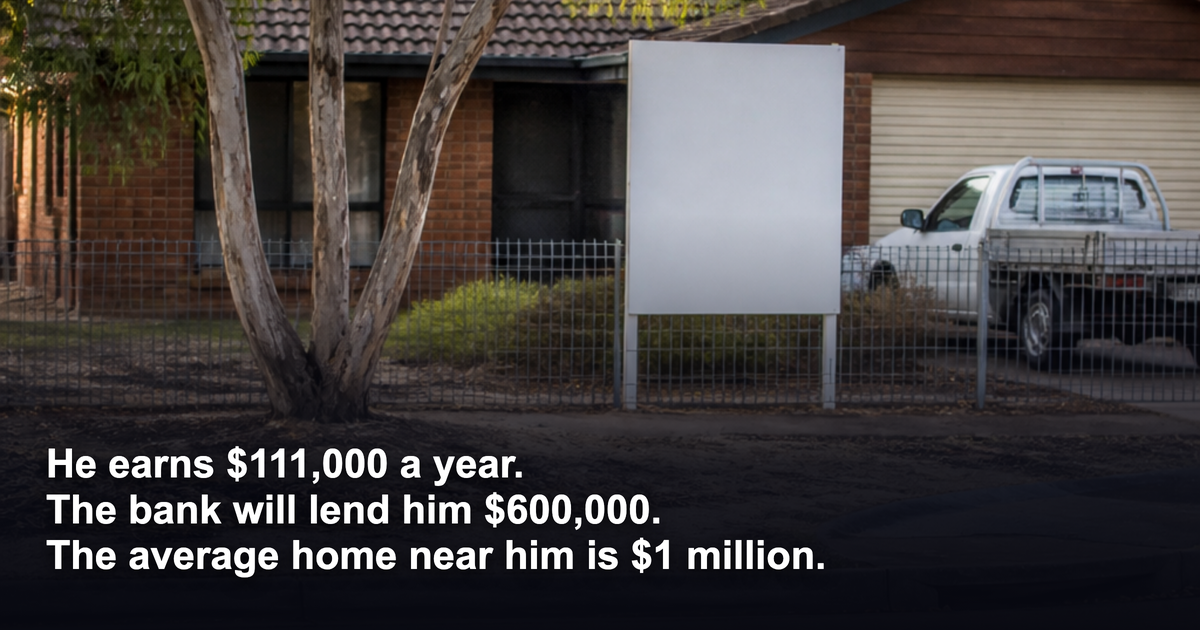
He has been a police officer in Western Australia for nine years. His base salary is $111,000. The most a bank will lend him is $650,000, and realistically closer to $600,000.
He has been a police officer in Western Australia for nine years. His base salary is $111,000. The most a bank will lend him is $650,000, and realistically closer to $600,000.
The average home in Perth is now around $1 million.
That is the whole story, reported this morning by the Sydney Morning Herald, and it deserves a minute before anyone reaches for a solution.
The man in the story
Sam Collins came back to Perth after a stint in Broome, where he had lived in government-assisted housing through his work. He rented in a few places and started looking. What he could afford on his own, he told the Herald, would have been "probably a shoebox in a non-desirable area", nowhere near his kids' school and without room for them when he has them.
He has never copped a big rent hike. He has a stable job, with overtime, shift penalties and allowances on top of base pay. By any measure you would use at a dinner party, he has done everything right.
He still could not buy in the city he polices.
The question
He put it better than any analyst: "It's an issue when essential workers are locked out of large sections of the housing market. I don't know the answer really, the market has stabilised a little bit now, but it's just gone to a level where it is unachievable."
The question underneath that quote is the one that matters for anyone reading this with a mortgage and some equity. If a nine-year police officer on $111,000 cannot close the gap by earning and saving, what makes you think you can?
The answer: the gap is structural, and it is growing
Here are the numbers from the story.
- Perth house prices rose about 25 per cent in the last year, according to HOPE Housing chief executive Phil White.
- A single-income household on $125,000 can borrow, on average, $428,800 on a 30-year loan at 6.26 per cent, according to Canstar.
- More than 60 per cent of renting essential workers are in housing stress, and three-quarters of long-serving renters fear they may never own, according to a HOPE Housing survey.
- In 1999, a registered nurse needed about five times their annual wage to buy a median house in Sydney. It is now 18 times. Perth is 12 times, Brisbane 14, and Darwin, the cheapest capital, is eight.
Read those together and the shape is obvious. Wages move in single digits. Borrowing capacity moves with interest rates. Prices in a city like Perth just moved 25 per cent in twelve months.
Saving harder does not close a gap that widens faster than you can save. That applies to a police officer renting in Perth, and it applies to a homeowner on $250,000 who keeps saying they will buy an investment property "once things settle".
The part nobody puts in the headline
The solution Sam found is a not-for-profit, HOPE Housing, which co-invests up to half the purchase price so he can buy, live in the home and buy out the share over time. It works. It also has more than 2,200 people on its waiting list, and its funding comes from wholesale investors only. In Mr White's words, "it's not available for mum-and-dad investors, but there's plenty of people that have made good money in Perth."
So the mechanism that gets an essential worker into a home is capital from people who already own assets. The people with equity are the ones providing the equity.
That is the uncomfortable truth in this story. The market has sorted people into two groups: those who hold appreciating assets and those who rent from them. Income alone no longer moves you between the groups. Perth just proved it with a 25 per cent year.
What it means for you
If you own your home and have equity, you are in the first group, whether or not you feel like it. Most of our readers do not feel like it. Household income is strong, the mortgage is manageable, and net worth still lags what the income should have built by now. That is a structure problem, and it is fixable.
The expensive mistake is treating the next purchase as a savings problem. Waiting to save a larger deposit, waiting for prices to settle, waiting for a better rate. Every one of those waits is a bet that the gap will close on its own. Perth's last twelve months is what that bet looks like when it loses.
The second expensive mistake is buying the wrong thing in a hurry because the first mistake finally became obvious. A 25 per cent city average hides a wide spread. Two streets in the same suburb can be having completely different outcomes: one with tightening vacancy and short days on market, the other with a run of new listings and buyers walking away. A headline number tells you nothing about which one you are standing on.
The Ripehouse reframe
Sam's story will be used by other people this week to sell urgency. We think it says something more specific.
Access to the market now runs through assets, and the equity in your home is the asset. Structure is what turns that equity into a second property that holds its own, on the right street, in the right market, bought on data rather than on a feeling about where the cycle is. Timing is the part nobody controls. Structure is the part you can.
We publish our clients' results across the whole cohort, including the portfolios that underperformed, because a full distribution is the only honest way to show whether a method works. Across 997 client portfolios since 2021, median portfolio growth has been 19.0 per cent a year on a five-year rolling basis, against about 4.3 per cent nationally. Benchmark source: CoreLogic/Cotality. Past performance is not a guarantee of future results.
If a nine-year police officer cannot earn his way across the gap, nobody is going to save their way across it either. The people who close it are the ones who use what they already hold, carefully, and let the data choose the street.
Want to see how we test a decision like this street by street? Join Jacob's free live webinar, "If I Were Buying an Investment Property in Australia Today".
General information only. It does not take your objectives, financial situation or needs into account, and nothing here is legal, financial, taxation or investment advice specific to your circumstances.