News · 8 October 2026 · 5 min read
45 per cent clearance rate: what a quiet spring auction market means if you have equity to deploy
45 per cent.
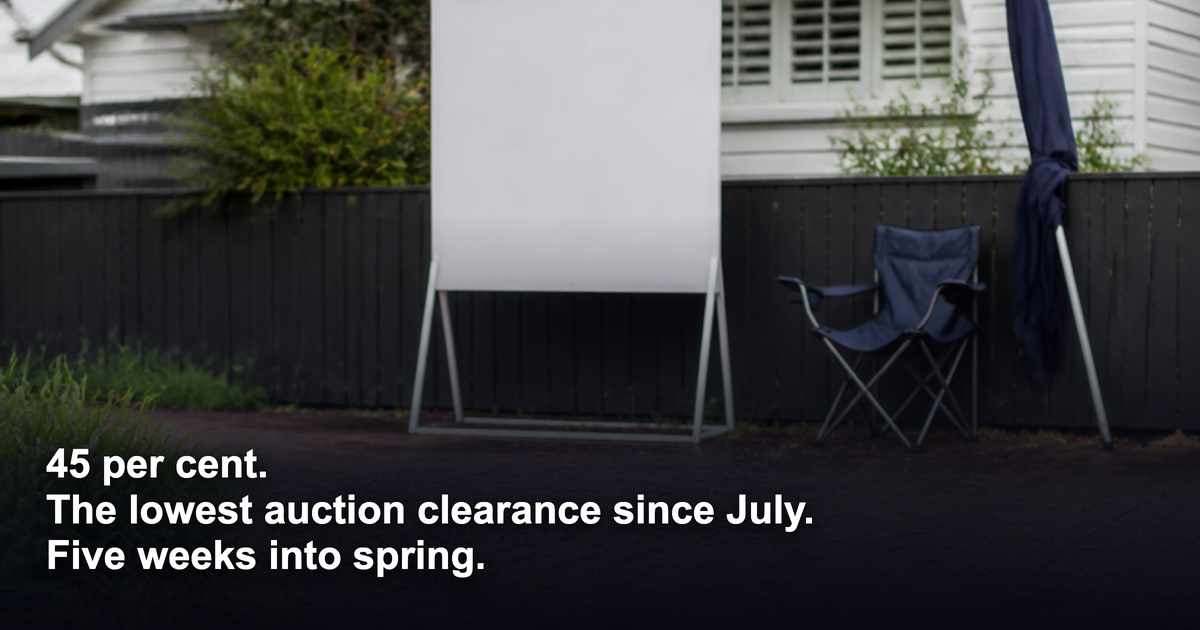
45 per cent.
That is the combined-capital auction clearance rate for this week, according to Cotality, reported on 8 October. It is the lowest reading since July, and it has arrived five weeks into the spring selling season, the period when agents and vendors usually expect the market to find its feet.
Put plainly: more than half of the homes taken to auction across the major capitals did not clear.
What changed
Spring is when listings build. Vendors who sat out winter come to market, and the auction calendar fills. In a strong year, buyers absorb that stock and clearance rates hold up.
This year the stock arrived and the buyers were more careful. A 45 per cent clearance rate means that on auction day, the reserve and the bidding did not meet for most properties. Some of those homes will sell in the days after, usually at a price closer to what the buyers were offering than what the vendor hoped. Some will be withdrawn. Some will sit.
We are not going to tell you why it happened, because the source does not, and the honest answer is that a clearance rate is a symptom. It tells you how confident buyers and vendors are relative to each other on one weekend. It does not tell you where prices go next, and anyone who says it does is guessing.
What it means if you have equity
If you own your home and have usable equity, or cash, or a pre-approval, the number changes one thing: the negotiation.
When clearance rates were high, you turned up to an auction with four other bidders, one of whom had a parent in the crowd. You paid what the room decided. Due diligence was a luxury, and conditions on a contract were a way to lose.
At 45 per cent, the room is thinner. A property that passes in on a Saturday is a property where the vendor has had a public, documented reminder that the market did not agree with their reserve. The buyer who makes a sensible offer on Monday, with finance in order and a building inspection already done, is dealing with a different vendor than the one who walked out at 11am.
That is the opportunity. It is a procedural one. You get time, you get conditions, and you get a vendor who has been told the truth by the market rather than by their agent.
The decision and the trade-offs
The decision a reader with equity now faces moves from "should I wait for the market to cool" to "what do I actually want to buy, and can I act when I see it".
That sounds obvious. It is rarely done.
Most buyers in a soft market do one of two things. The first group reads 45 per cent as a signal that prices will fall further, so they wait. The problem with waiting for a reading is that readings move. A clearance rate that is the lowest since July can be followed by one that is higher, and the buyer who was waiting for confirmation has no criteria for when to stop waiting. They are reacting to a weekly number with a decision that will run for fifteen years.
The second group reads 45 per cent as a sale. They go out and buy whatever passes in, on the logic that a passed-in property is a discounted property. Some are. Many passed in because buyers who did their homework worked out what was wrong with them: a street of investor stock with high vacancy, a flood overlay, a flat rental history, a suburb where the supply pipeline is about to double.
A quiet auction market lowers the price of mistakes. It does not remove them. The mistake is cheaper, and it is still a mistake.
The trade-off, honestly stated, is this. Act now with criteria and you may pay slightly more than the eventual low, if there is one, in exchange for choice, negotiating leverage and time to check the asset. Wait, and you may pay slightly less, in exchange for competing with every other buyer who was also waiting, on the weekend the number turns.
We know which trade we would take, and we have published the reason.
The street decides, the headline does not
A combined-capital clearance rate is a blended figure across five cities and thousands of suburbs. Inside it, two streets in the same suburb can be having completely different outcomes. One has tightly held family housing, low vacancy, owner-occupiers who are not selling at any price. The other has a run of investor apartments where every third owner is trying to exit at once. Both sit under the same 45 per cent.
The buyer who wins in this market is the one who already knows which street they want before the auction is advertised, and why. Days on market, vacancy, the mix of owners to renters, what is being approved two blocks away. Those are the inputs. The clearance rate is weather.
This is the way we run client portfolios. Across 997 client portfolios since 2021, the median has grown at +19.0 per cent per year on a 5-year rolling basis, against about 4.3 per cent nationally (CoreLogic/Cotality benchmark). We publish the full distribution, including the portfolios that underperformed, because a number you cannot audit is a marketing claim. Past performance is not a guarantee of future results.
The point of publishing it is this: that result was built in strong markets and soft ones, by choosing assets and streets on data rather than on how a weekend felt. Structure beat timing every time we have measured it.
What to do with this week's number
Treat 45 per cent as an input. Set your criteria, get your finance ready, and know your street before the board goes up. The negotiation is better than it was in July. The fundamentals of a good asset have not moved at all.
If you want to see how we test a purchase like this street by street before a soft market decides it for you, join Jacob's free live webinar.
General information only. It does not take your objectives, financial situation or needs into account, and nothing here is legal, financial, taxation or investment advice specific to your circumstances.