News · 17 October 2026 · 4 min read
$150,000 under reserve and $200,000 over, on the same Sydney Saturday: what the gap means for your equity
On Saturday in Croydon Park, a two-bedroom semi sold at auction for $1.3 million. The reserve was $1.45 million. One person registered. She offered $1.25 million before the auction opened, the agent talked her up to $1.3 million, and the vendor took it, according to the Sydney...
$150,000 under reserve, with one bid
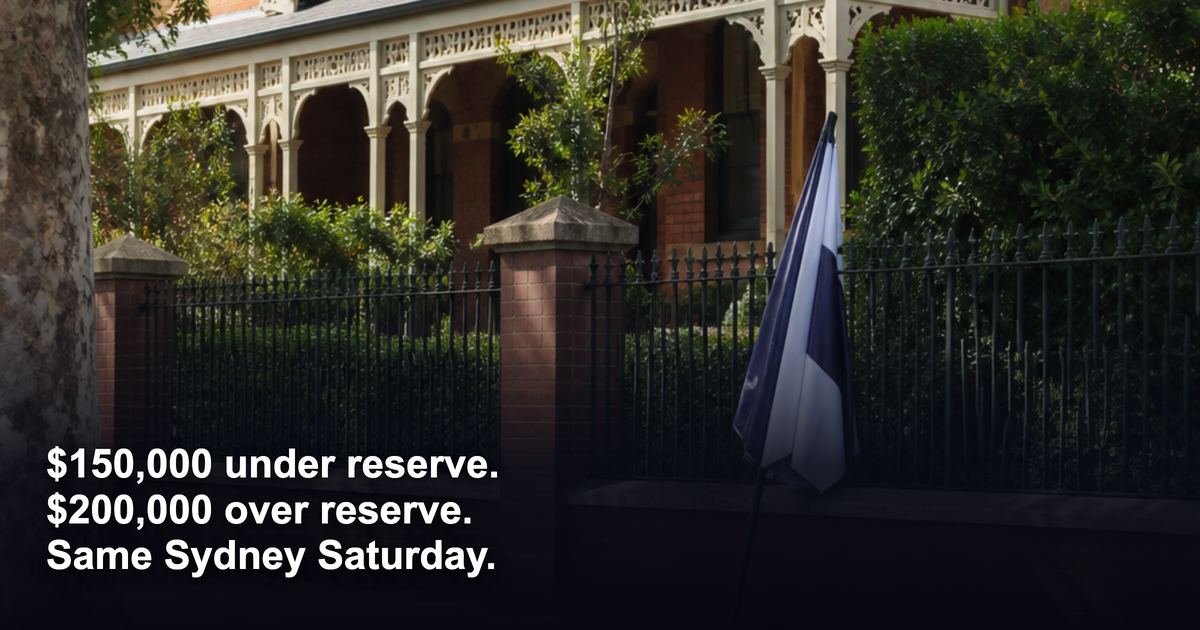
On Saturday in Croydon Park, a two-bedroom semi sold at auction for $1.3 million. The reserve was $1.45 million. One person registered. She offered $1.25 million before the auction opened, the agent talked her up to $1.3 million, and the vendor took it, according to the Sydney Morning Herald's auction report.
The vendor had held it as an investment since 2009, when it sold for $520,000.
The same morning, about ten minutes' drive away in Haberfield, a four-bedroom Federation home on a 563 square-metre block sold for $3.1 million. The reserve was $2.9 million. Four parties registered, three bid, and more than 30 people stood on the street to watch.
Two inner west auctions. One finished $150,000 short. One finished $200,000 clear. Same Saturday, same lending conditions, same newspaper.
What changed
The number of buyers per property.
Sydney had 845 auctions scheduled this week. By Saturday evening Domain had a preliminary clearance rate of 52 per cent from 501 reported results, with 154 withdrawn. Withdrawn auctions count as unsold.
A Woolooware agent put it plainly after selling a townhouse to a single registered bidder for $1.43 million against a $1.52 million reserve: "This time last year, we would have had five or six buyers, but today there was only one."
That is the whole story in one sentence. Where a property attracts one bidder, the reserve stops mattering and the buyer's maximum becomes the price. Where it still attracts three, the result looks like it did in a strong year.
The Haberfield buyers said it themselves: "The market has changed a bit, and it has opened up some areas." They had been looking for "quite a while". Softer conditions got them a contract. They still paid $200,000 over reserve to get it.
What it means if you have equity
If you own a home with usable equity, or have cash and borrowing capacity, Saturday answered a question a lot of people have been sitting on.
Streets that were closed to you two years ago are opening. The Croydon Park semi sold $50,000 under its own guide and $150,000 under reserve because nobody else turned up. The vendor still left with roughly two and a half times the 2009 purchase price. The agent's own words: "If we had guided it a bit lower, we would have had more people."
So the opportunity is real. It is also uneven, and the unevenness is the whole point.
The person waiting for "the bottom" is waiting for a Sydney-wide signal. Saturday showed there is no Sydney-wide signal. There is a 52 per cent clearance rate, which averages a Haberfield crowd and an empty Croydon Park footpath into one figure that describes neither street.
The decision, and what each option costs
Keep waiting. The cost is that the signal you are waiting for is an average. By the time the headline clearance rate turns, the properties that still pull three bidders in a 52 per cent week will have already moved. You will be bidding against the Leichhardt and Annandale families who were underbidders on Saturday, plus everyone who read the same headline you did.
Buy the discount. The Croydon Park buyer paid $150,000 under reserve because she was the only registered bidder, and she bid the most she could afford. That is a genuine win on the day. The trade-off is that a thin buyer pool cuts both ways. If one bidder sets the price when you buy, one bidder may set the price when you sell. You own that risk for as long as you own the asset.
Buy the depth. The Haberfield buyers paid $3.1 million, $200,000 over reserve, in a week when 154 Sydney auctions were withdrawn. What they bought, along with four bedrooms and four fireplaces, was evidence. Three families competed for that house in a soft market. That is the single most useful piece of information a buyer can have about an asset.
The expensive mistake is confusing those last two. A thin buyer pool and a cheap asset look identical on auction day. They behave very differently over ten years.
Two streets, one suburb, two outcomes
This is what we see in portfolio data every month, and Saturday simply put it in a newspaper. Two streets in the same suburb can be having completely different outcomes at the same time. Days on market, vacancy, the number of registered bidders, the depth of the buyer pool: these are street-level facts, and they are the facts that decide whether a purchase compounds or stalls.
A timing plan asks, "Is this the bottom?" Nobody can answer that, and Saturday's results show why the question is badly posed.
A structure plan asks, "Which asset, on which street, keeps attracting buyers when the headline number is 52 per cent?" That question has an answer, and it can be checked before you bid.
Across 997 client portfolios since 2021, the median Ripehouse portfolio has grown 19.0 per cent per year on a 5-year rolling basis, against roughly 6.3 per cent for the combined capitals (Cotality, formerly CoreLogic). Past performance is not a guarantee of future results. We publish the full spread, including the portfolios that underperformed, because an average hides exactly what Saturday's clearance rate hides.
Prices softening is a reason to look. It is a reason to buy only if the street holds up under the same scrutiny Haberfield passed on Saturday.
Want to see how we test a decision like this street by street before the paddle goes up? Join Jacob's free live webinar.
If there's a specific street you're weighing up right now, check its Street Score first — it's free, takes ten seconds, and tells you whether that street is pulling the suburb average up or riding on it.
General information only. It does not take your objectives, financial situation or needs into account, and nothing here is legal, financial, taxation or investment advice specific to your circumstances.