Market Intel · 30 September 2026 · 4 min read
Brisbane Clearance Rate Falls to 33% After 4.6% Rate Rise
Brisbane’s clearance rate fell to 33% before the cash rate reached 4.6%. Here’s what auction data, vacancy and contrasting Victorian suburb signals reveal for buyers and investors.
▶ Watch the full video on YouTube: 33% Brisbane Clearance: What the 4.6% Hike Means
The Brisbane clearance rate fell to 33% before the Reserve Bank lifted the cash rate to 4.6%, highlighting how quickly buyers can thin out when debt becomes more expensive. But a weak auction result is not a verdict on every property — it is a signal to examine pricing, negotiation conditions, vacancy and underlying demand more carefully.
Brisbane clearance rate falls as buyers become more selective
The Reserve Bank lifted the cash rate to 4.6%, a 15-year high and, according to ABC, its fourth rate hike. The bank’s published cash rate table had not yet caught up: its last filled row, dated the 29th of September, still showed 4.35%, while the 30th was blank.
That means the latest clearance figures show the market before the hike. Across the five capitals, 603 properties sold from 1,268 reported results, producing a preliminary clearance rate of 47.6% in Ripehouse Advisory’s aggregation.
Every capital cleared below its result from a year earlier:
- Sydney: 50%, down from 70%
- Melbourne: 49%, down from 71%
- Canberra: 47%, down from 62%
- Adelaide: 39%, down from 48%
- Brisbane: 33%, down from 64%
Brisbane recorded the steepest decline, falling 31 percentage points. Of its 116 reported results, 38 sold and 68 passed in.
That is evidence of a pricing gap, not a blanket verdict on Brisbane homes. When borrowing costs rise, bidders often retreat before sellers adjust their expectations.
The Brisbane clearance rate needs context beyond the headline
A clearance rate alone does not explain what happened at auction. Withdrawals and passed-in properties tell a different story about seller behaviour and buyer depth.
Sydney withdrew 219 properties, or about 29% of reported results, and passed in 163, roughly one in five. Many Sydney sellers stepped back before auction day.
Brisbane withdrew just 10 properties, yet 59% of its reported results passed in. Adelaide passed in 51%, Melbourne 38% and Canberra 34%.
The distinction matters. In Sydney, a large number of properties did not reach the auction floor. In Brisbane and Adelaide, more sellers turned up and encountered a thin room of buyers. That can create negotiation opportunities, particularly where a vendor’s reserve is disconnected from recent evidence.
A property passed in last week may still be worth buying. The question is whether the price, rent, vacancy and long-term demand justify proceeding.
Two high-ranked Victorian suburbs show opposite signals
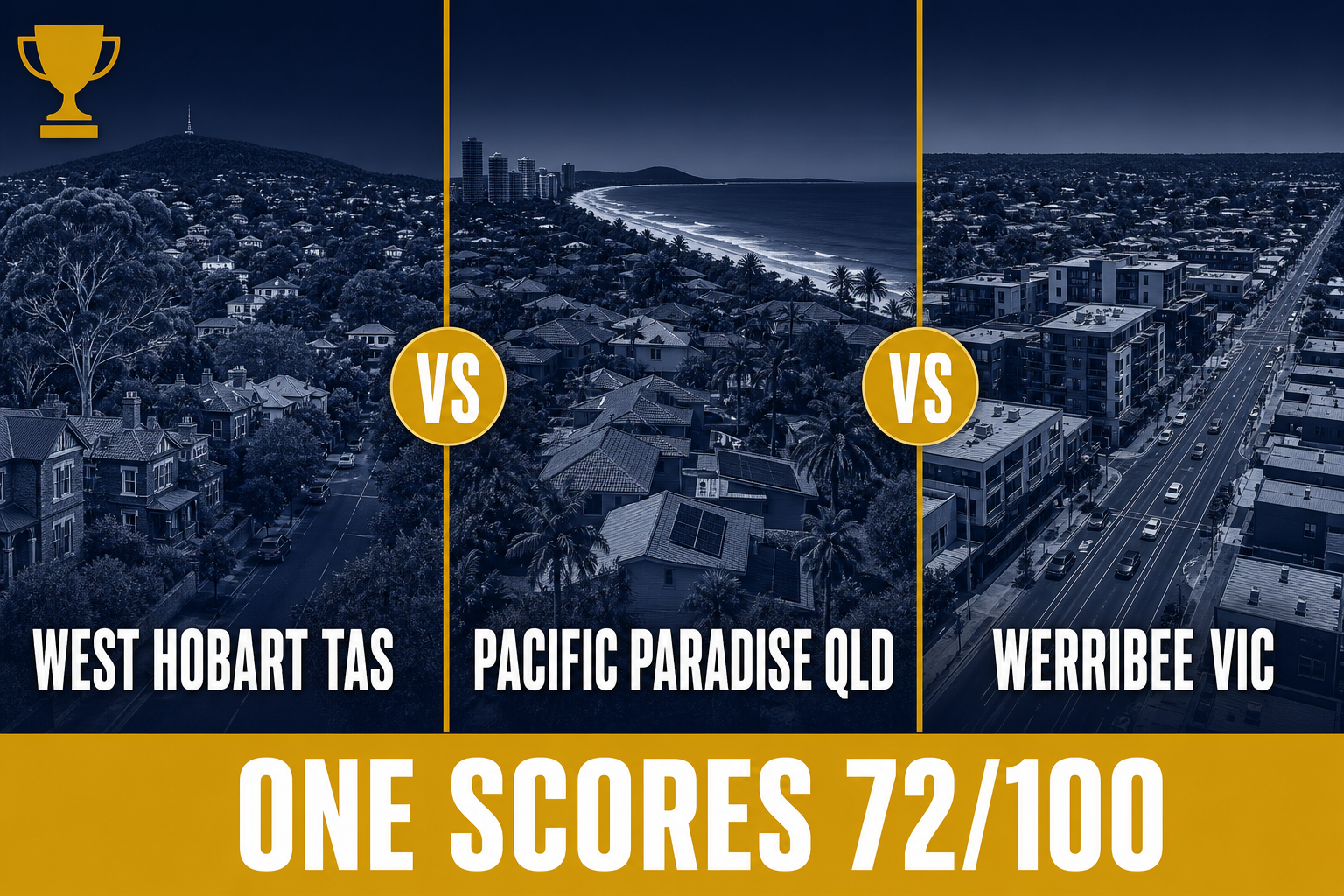
Ripehouse Advisory’s August snapshot identified two new regional Victorian suburbs at the 99th percentile nationally. Both appear attractive on selected measures, but their underlying signals are not identical.
The suburb in the city of Wodonga recorded a rolling yield of 4.51%, with 83.9% of homes owner occupied. It had 38 sales in 12 months, ranging from $615,000 to $1.25 million.
However, its vacancy rate was 14.5% — the figure to investigate first. The suburb has 1,287 addresses across 103 streets, a 90-day rolling sold price of $749,000 and no public housing recorded in the profile.
Seymour, in Mitchell Shire, recorded a yield of 4.67%, vacancy of just 1.8% and an owner-occupied share of 63.9%. Its rolling sold price was $518,000, with public housing at about 6.7% in the profile.
There was one important data limitation: the sales table found no matching Seymour sales in 12 months, so its market depth remains unverified.
Why vacancy can outweigh a headline yield
The contrast between these suburbs is the point. They sit in the same state and at the same national percentile, but Ripehouse Advisory’s engine showed the sold-price signal moving down for the Wodonga suburb and up for Seymour.
The rental picture also splits sharply. Vacancy in the Wodonga suburb is about eight times Seymour’s. For a buyer carrying more expensive debt, the rent needs to arrive consistently. A headline yield may look appealing, but a high vacancy rate can put pressure on cash flow and undermine the reliability of that income.
Four map layers help examine the street-level picture:
- Sold price
- Rental yield
- Owner-occupied depth
- Social housing
These layers are prompts for further research, not automatic verdicts. The exact street, property condition, competing stock and local rental demand still need to be checked.
What lower November rate-rise odds mean for property
ABC reported that the Reserve Bank was unlikely to lift again in November after lower-than-expected inflation figures, while traders cut their bets on another rise as the major banks passed on Tuesday’s decision. Realestate.com.au presented the counterview: stubborn inflation could keep a November hike in focus.
That uncertainty reinforces the need to test an investment across more than one interest-rate scenario. It is also relevant that home approvals fell, with an apartment decline threatening the Albanese target. Fewer new homes can mean tighter supply, which may support well-chosen assets through the rate cycle.
The right response is not to make a decision from one inflation print or one auction result. It is to test the evidence beneath the headline.
The Ripehouse Advisory take
The Brisbane clearance rate of 33% shows that buyers were already becoming more selective before the cash rate reached 4.6%. That may create negotiation leverage, but it does not mean every passed-in property is good value — or that every suburb with a high ranking is low risk.
For investors and homebuyers, the practical process is straightforward:
- Stress-test the buffer at 4.6%.
- Check the property’s yield and vacancy together.
- Examine owner-occupier depth and local sales evidence.
- Treat small or incomplete samples cautiously.
- Use street-level data before committing to a suburb-level thesis.
Professional research and a buyers agency can help separate a genuine opportunity from a property that only looks attractive in a headline table.
Download our no-cost Top Five Markets Report 2026 → https://ripe.house/brief-inflation
General information only. It does not take your objectives, financial situation or needs into account, and nothing here is legal, financial, taxation or investment advice specific to your circumstances.