
News · 8 September 2026 · 4 min read
$34 billion vanished from the property market. Why is her street still out of reach?
National dwelling values posted their first fall since 2022, yet the streets buyers actually want did not move. Street-level data explains which streets carry a downturn and which are immune to it.
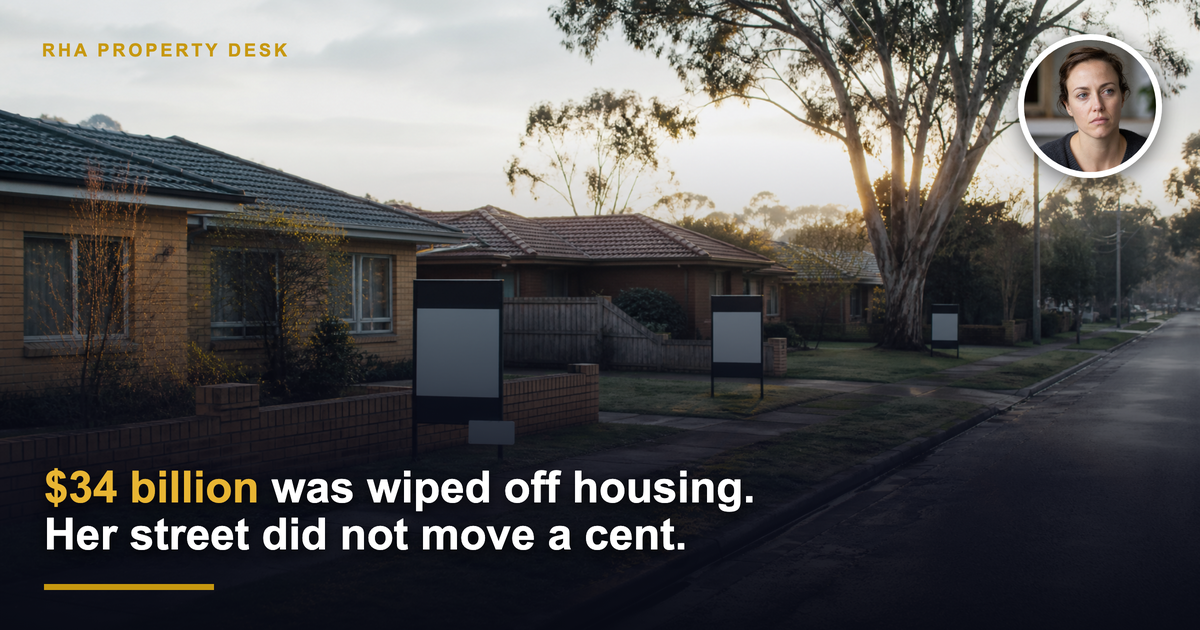
She is 31, a single mother of two, and she has been saving for six years.
When the headlines announced that tens of billions of dollars had been wiped off the value of Australian housing — the first national fall in dwelling values since 2022 — she did what any reasonable person would do. She opened the listings for the two suburbs she had been watching since her eldest started school, and she waited for the discount to arrive.
It did not arrive. The house she had been tracking on the street she actually wanted came back to market eleven weeks later at the same asking price. Two streets over, in the same postcode, a comparable home had dropped $48,000. Her street had not moved at all.
Her question, which we get asked in some form almost every week, was blunt: if the market has fallen this far, why has nothing fallen where I want to live?
The number is real. The experience of it is not evenly shared.
A national figure is an average of averages. It is the sum of every capital city, every regional market, every apartment and every house, compressed into one sentence that fits in a news headline. It is genuinely useful for economists and almost useless for a buyer choosing between two houses 400 metres apart.
Here is what a national decline actually looks like on the ground. Some streets carry the entire fall. Others do not participate in it at all. A handful quietly rise straight through a downturn because the thing that drives their value — a school intake boundary, a walkable strip, a protected leafy verge, an absence of competing development sites — does not care what the national index did last quarter.
That is the part the headline cannot tell her. And it is the part that decides whether she has just been priced out or handed an opportunity.
What the street-level data shows
When we run a comparison like hers through our research engine, we are not asking "did the suburb fall?" We are asking six narrower questions about the exact street:
- Achieved rent, not advertised rent. What tenants actually signed for in the last six months on that street — which is regularly $30 to $70 a week below the asking rents she was reading.
- Vacancy at street level. A suburb sitting at 1.1 per cent can contain a pocket at 3.4 per cent, because one apartment completion dumped forty near-identical dwellings into a two-block radius.
- Days on market. The single most honest signal of buyer depth. A street where stock clears in 24 days and a street where it sits for 78 days are not the same asset class, whatever the suburb median says.
- Competing supply. How many approved-but-unbuilt dwellings sit within walking distance, waiting to compete with her resale in five years.
- Tenant demand. Enquiry volume per listing on that street, which is what actually protects her from a rent void if her circumstances change.
- Buyer depth on exit. How many qualified buyers historically compete for that exact stock type at that exact price point.
In her case the answer was uncomfortable and useful in equal measure. The street she wanted had not fallen because it barely ever falls — days on market of 26, vacancy under one per cent, almost no competing supply, and consistent owner-occupier demand. It is expensive because it is genuinely scarce. The street two over had dropped $48,000 because it had 61 days on market, a run of near-identical stock, and a development approval at the end of the road.
The cheaper house was not a bargain. It was correctly priced for a weaker asset. This is the same pattern we found when we looked at why a cheaper house can still be the harder buy and at what a single school-zone line did to two otherwise identical homes.
So who pays for the gap?
This is where the frustration is legitimate. A buyer in her position absorbs the downside of a national market — tighter lending, weaker confidence, sellers withdrawing stock — without receiving the upside the headline promised her. She is asked to be patient during a correction that is, on her street, not happening.
She has also been told for two years that supply is coming. The streets she can afford are the ones where supply genuinely is coming, and that competing supply is precisely what will cap her growth and her rent. The streets where nothing new can be built are the ones she cannot reach. The policy conversation and the street-level reality are pointing in opposite directions, and nobody sends a buyer that memo.
What she did instead
She stopped waiting for a national number to rescue her and started buying on evidence.
Her deposit did not stretch to the street she wanted. It did stretch, comfortably, to a third street she had never looked at — nine minutes further out, no competing development approvals, 29 days on market, vacancy at 0.8 per cent, and achieved rents that had risen every one of the last four half-years. Not glamorous. Structurally sound.
That is the honest lesson of a falling market. Broad declines do not make property a worse investment; they make undifferentiated property a worse investment. When the tide goes out, the difference between a scarce street and an abundant one stops being cosmetic and starts being the whole return.
The headline number will keep moving. The physical and legal characteristics of an exact address will not. Buyers who understand which streets carry a downturn and which streets are immune to it are not competing with the market — they are competing with people who only read the average. In a market where $34 billion of value can move without touching a single house on one street, that gap in information is the most valuable thing an investor can own.
For buyers who can’t tell whether a postcode-wide fall reaches the street they want, the Ripehouse Advisory webinar offers a practical way to test vacancy, days on market and competing supply before assuming the headline tells the whole story.
Frequently asked questions
Why did Australian property values fall nationally, but the street I want still didn’t get cheaper?
The article says national dwelling values are only an average, so the decline is not shared evenly across every street. Some streets carry the fall, while others barely move or even keep rising because of local scarcity, school zones, walkability, and limited competing supply.
What does street-level property data look at that suburb medians miss?
It looks at achieved rent, street-level vacancy, days on market, competing supply, tenant demand, and buyer depth for that exact stock type. These factors can show whether a specific street is under pressure or still tightly held, even if the suburb average looks weaker.
How can two streets in the same postcode have very different prices?
The article shows that one street can have low vacancy, short days on market, and strong owner-occupier demand, while another nearby street has slower sales and more competing stock. Those local conditions can make one street hold value while another drops significantly.
Does a falling national market mean a better buying opportunity for first-home buyers or investors in Australia?
Not necessarily. The article says broad declines can make undifferentiated property a worse investment, while scarce streets may stay expensive because their underlying demand and supply balance does not change much.
What is the main risk of waiting for a national property downturn to create affordability on a specific street?
The risk is that the downturn may not reach the street you actually want, so you lose time without getting a better price. The article shows that some buyers absorb the weaker national market without seeing any discount in the exact location they are targeting.
General information only. It does not take your objectives, financial situation or needs into account, and nothing here is legal, financial, taxation or investment advice specific to your circumstances.